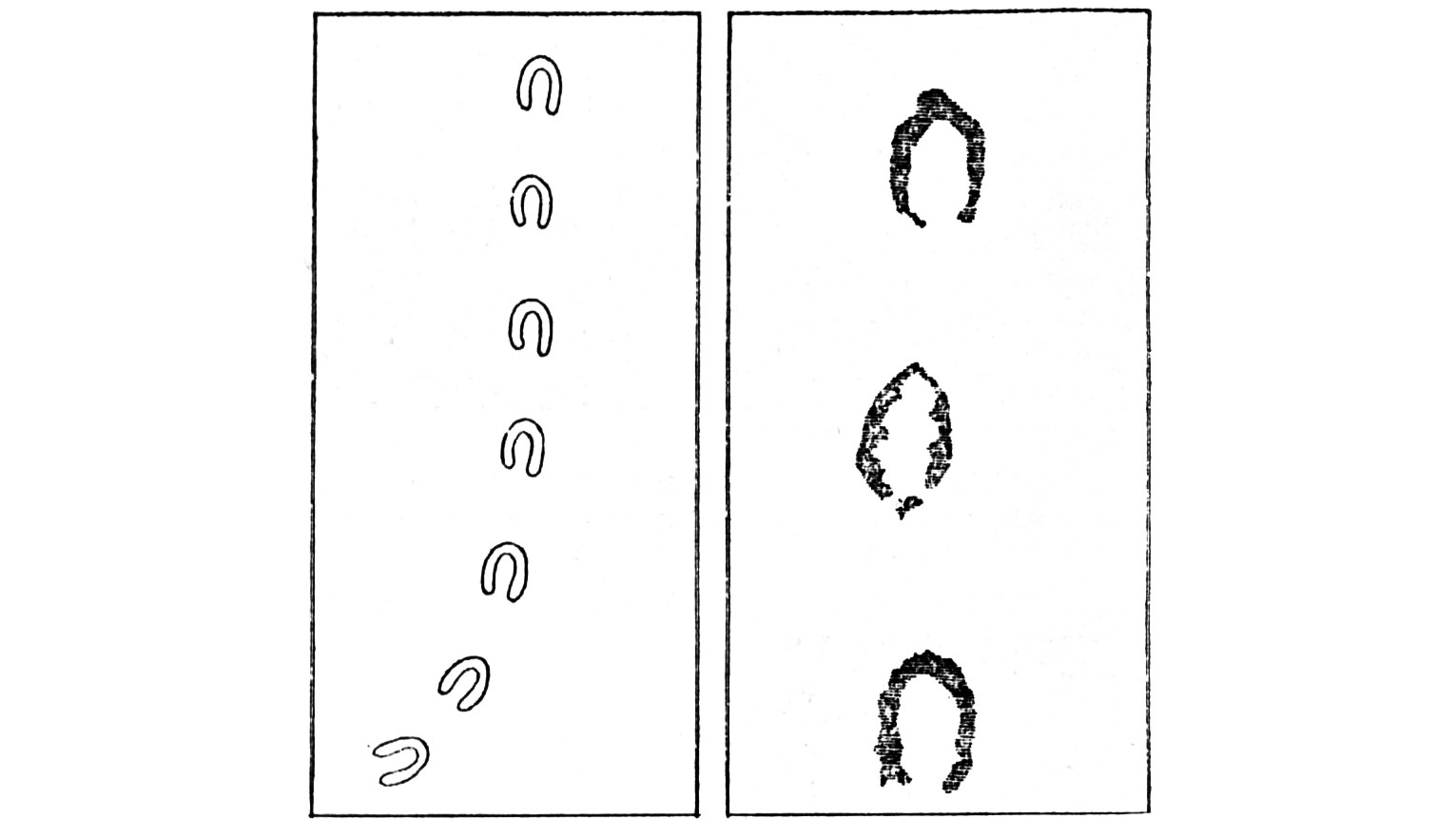

On the morning of February 9, 1855, people in towns and villages on both sides of the Exe estuary in south Devon woke to find lines of small, hoof-shaped prints pressed into fresh snow. The marks wandered through gardens, across fields and along the tops of walls. Within a week a London newspaper was reporting that frightened residents believed the marks had been left by the Devil, and the story of a single creature walking more than 100 miles in one night was soon in print. So what really made the tracks, and how much of the famous legend was added after the snow had melted?
According to The Times of February 16, 1855, the discovery caused “Considerable sensation” in Topsham, Lympstone, Exmouth, Teignmouth and Dawlish. “The superstitious go so far as to believe that they are the marks of Satan himself,” the paper reported, adding that the subject had even been discussed from the pulpit. Its verdict was brief, and it read “At present it remains a mystery.”
The case matters because it shows how a scattered set of local sightings hardened into one of the best known puzzles in English folklore. The caveat is that the firsthand record is thin. Mike Dash, a contributing editor to Fortean Times who gathered the surviving source material for Fortean Studies in 1994, concluded that the direct evidence comes from “two clergymen, a doctor and a young gentleman,” supported by newspaper reports and recollections written down years later.
What Did Devon Residents Find on February 9, 1855?
The winter of 1854 to 1855 was a hard one in Devon, and Dash notes that both the Exe and the Teign froze. As reported by a correspondent to the Exeter and Plymouth Gazette, the night of Thursday, February 8 brought a heavy fall of snow, followed by rain, an easterly wind and then frost before dawn. That sequence of snow, thaw and refreezing would become central to every later attempt at an explanation.
The earliest known report appeared in the Western Luminary on February 13, 1855, and described marks at Dawlish “exactly, in shape, like a donkey’s hoof” with a stride of about a foot. “Many parties have traced the prints for miles, but as yet, without any solution to the mystery,” the paper noted, before recording that some residents suspected an escaped monkey from a traveling menagerie. In Dawlish itself, Dash records, an armed group of local tradesmen followed one set of tracks for around five miles without finding anything.
The Times described prints that measured from an inch and a half to two and a half inches across, usually about eight inches apart. “The impression of the foot closely resembled that of a donkey’s shoe,” the paper stated, although it added that a few prints looked cloven. Dash eventually counted more than 30 places where marks were reported, almost all of them in south Devon, with one or two possible sightings over the border in Dorset.
Where Did the Story of a 100-Mile Trail Come From?
Most of the dramatic details trace back to a single letter printed in the Illustrated London News on February 24, 1855, signed only “South Devon.” The writer described himself as a man who “has had much experience in tracking wild animals and birds” and insisted the foot marks were the same size in every parish. He reported prints on rooftops and beyond a wall said to be 14 feet high, and he calculated that “the actual progress must have exceeded a hundred miles.” He then concluded “No known animal could have traversed this extent of country in one night,” while noting that other prints in the snow, including “the fresh marks of cats, dogs, rabbits, birds, and men clearly defined,” were easy to identify.
That letter has shaped almost every retelling since, yet its author was far younger than readers assumed. Dash explains that papers kept by the Reverend H. T. Ellacombe, vicar of Clyst St George, reached the folklorist Theo Brown in 1952. They identified “South Devon” as young D’Urban, then 19, who later became the first curator of the Royal Albert Memorial Museum in Exeter. Dash saw no reason to doubt his skill with animal tracks. “It is, nevertheless, reasonable to wonder how far youthful enthusiasm may have coloured his telling of events,” he wrote.
The surviving evidence also weakens the image of a single unbroken line. Dash found that the greatest distance any party can be shown to have followed one trail was about five miles, and he noted that contemporaries described “meandering lines of prints crisscrossing gardens and churchyards” rather than a straight path. On the famous claim that the creature crossed the 2-mile-wide estuary, he was blunt. “All we can say with certainty is that hoofmarks were found on both sides of the Exe estuary,” he wrote. The measurements he compiled also varied, with prints from about 3.5 to 4 inches long and strides from 8 to 16 inches.
Which Animals Did Naturalists Blame for the Tracks?
The Illustrated London News of March 3, 1855 printed a letter from the naturalist Richard Owen, who argued that the prints came from a badger, since “This is almost the only plantigrade quadruped we have in this island.” Owen dismissed the idea of a single walker, writing “The onus of the proof that one creature made them in one night rests with the assertor.” Rupert Gould, a former naval officer with a keen interest in puzzles of the sea, later objected that a badger leaves a staggered double line of prints and could hardly have walked across roofs, as Dash summarizes.
The same issue carried a letter from the Reverend G. M. Musgrave of Withecombe, who had earlier suggested in a sermon that a pair of escaped kangaroos might be responsible. His letter explained that he welcomed the kangaroo idea because it helped push aside the fears of parishioners who were “dreading to stir out after sunset” and were “under the conviction that this was the Devil’s walk.” A doctor in Topsham proposed an otter instead, although he admitted “I am not acquainted with the otter myself.” Another correspondent favored the great bustard, a large bird.
Later investigators offered quieter suspects than kangaroos and otters. Dash records that the tenant of Aller Farm in Dawlish, the only person definitely known to have been out that night, watched the thaw and frost turn his cat’s tracks into the shape of a small hoof. The zoologist Alfred Leutscher later found similar hopping trails in Epping Forest, lectured on them to the Zoological Society and argued that wood mice were small enough to leave the 8-inch strides seen in Devon. Dash judged that “Only one other animal has been definitely shown to leave prints closely resembling the Devil’s Hoofmarks in the snow, and that is the woodmouse.”
Brian Dunning, host of the Skeptoid podcast, also favored a mouse in a 2007 episode, describing the reports of impossible feats as “purely anecdotal, unsubstantiated, uncorroborated verbal reports during a media circus.” The investigator Joe Nickell, writing in Skeptical Inquirer in 1996, agreed that a variety of common animals made the prints. He argued that the general clamor conditioned witnesses to see hoofmarks, a process he called contagion, as summarized in the afterword Dash added to his study that year. None of these suggestions accounts for every reported print, which leaves the animal explanations indicative rather than conclusive.
Could Pranksters Have Laid Some of the Prints?
Theo Brown suspected that some marks were made by people, and Dash agreed that a few may have been. He noted that the Western Times referred to fresh tracks appearing in Topsham on February 13, days after the first sightings, crossing the churchyard to the vestibule door. Brown thought locals at odds with their vicar could have laid that trail, and Dash judged those prints particularly likely to be a prank. Yet he doubted that pranksters could have produced all the marks found on February 9, since that would have required a conspiracy of dozens working through a freezing night.
Other theories arrived much later, long after the snow had gone. A suggestion that a drifting balloon trailed a weighted rope across the county was never proposed in 1855, and Dash called it a hypothesis “that could only be advanced by someone largely ignorant of the complexity of the case.” His own conclusion was that “the cause of the prints was almost certainly multiple,” and his survey closes with the words “The mystery remains.”
Read next: The Jersey Devil
More than 170 years on, the strongest evidence points to many ordinary sets of tracks, distorted by a night of snow and thaw and then gathered into one alarming tale by letter writers and newspapers. The Devil’s Footprints remain less a record of one impossible night walker than a study in how a frightened winter turned scattered marks into a single legend.
Established: Hoof-shaped prints were found in snow at many places on both sides of the Exe estuary in south Devon around February 8 and 9, 1855, and newspapers reported that some residents feared the Devil had made them.
Disputed: Most of the prints were left by ordinary animals such as wood mice, cats or badgers, with thaw and frost distorting their shape. Richard Owen, Alfred Leutscher and Mike Dash argued for animal causes, while Rupert Gould and the letter writer “South Devon” argued that no known animal fits all the reports.
Unverified: The tracks formed one continuous trail of 100 miles or more that ran in a straight line, crossed the Exe estuary, vaulted a 14-foot wall and passed over rooftops. Some prints were laid by pranksters, and others by escaped kangaroos, otters, a great bustard or a balloon trailing a rope.
Fringe: The prints were left by the Devil or another supernatural creature.
By Historic Mystery
Sources
- Mike Dash, The Devil’s Hoofmarks: Source Material on the Great Devon Mystery of 1855, Fortean Studies 1 (1994), 71 to 150, with a 1996 afterword. Includes transcriptions of the Western Luminary (February 13, 1855), The Times (February 16, 1855) and the Exeter and Plymouth Gazette (February 17, 1855). mikedash.com
- “South Devon,” Foot-Marks on the Snow, in Devon, Illustrated London News, February 24, 1855 (scan via Internet Archive). archive.org
- Richard Owen, G. M. Musgrave and other correspondents, letters on the foot marks in the snow in Devon, Illustrated London News, March 3, 1855 (scan via Internet Archive). archive.org
- Brian Dunning, The Devil Walked in Devon, Skeptoid podcast episode 31, March 7, 2007. skeptoid.com
