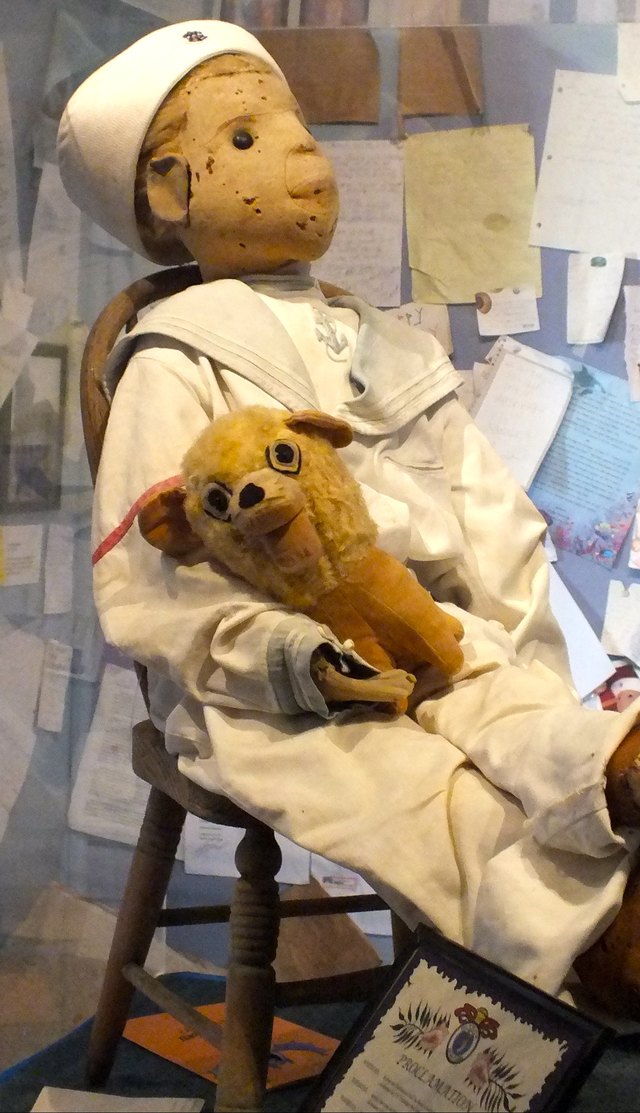
Robert the Doll is one of the most famous so-called haunted objects in the world, a felt figure in a sailor suit who sits behind glass at the Fort East Martello Museum in Key West, Florida. Visitors are told to ask his permission before they take a photograph, and letters still arrive at the museum from people who are convinced he has turned their luck.
Over the years Robert has been blamed for “car accidents, broken bones, job loss, divorce and a cornucopia of other misfortunes,” as Atlas Obscura put it. The legend says he moved around the house where he lived, giggled in empty rooms and pulled faces when anyone insulted his owner. But did a child’s toy truly carry a curse, or did a century of storytelling turn a peculiar old doll into Key West’s most feared resident?
A Doll Named Robert
According to the Key West Art and Historical Society, which owns him today, Robert is a one-of-a-kind handmade doll created around the turn of the 20th century. He stands about 40 inches (about 1 meter) tall, is stuffed with the wood wool known as excelsior and once bore painted features rather like those of a jester. Writing for Skeptical Inquirer in 2025, the researcher Autumn Sword added that his hair is believed to be mohair that has darkened with age and that his black eyes are shoe buttons, wooden buttons painted black.
The doll belonged to Robert Eugene Otto, a boy from a prominent Key West family who went by Gene. The society notes that the doll took the name Robert, while the boy kept the name Gene, and that the doll’s unusual size suggests it may have been made in the boy’s image. Gene grew up at 534 Eaton Street, and Robert would stay in that house until 1980.
Where Did Robert Come From?
The story of how the doll arrived is where the legend begins to split apart. The Artist House, the Eaton Street home that is now a guesthouse, says that in 1904, when Gene was four, a young girl believed to be of Bahamian descent gave him the doll. It adds that the doll was given “as a gift, or maybe as retaliation for a wrongdoing as some locals believe.”
Sword traced how this version changed in print over time. One of the earliest references she found, in the Fort Lauderdale News of August 4, 1985, said the doll had been given to Gene “by a black girl his parents had helped raise.” In 1996, The Miami Herald claimed it was “created in 1909” and given by “a Haitian or Bahamian girl who lived with his family.” Gene’s Find a Grave page credits instead “his Jamaican nurse.”
However, Atlas Obscura tells a very different story, in which the doll was a birthday present from Gene’s grandfather, who bought it on a trip to Germany. A Steiff historian told the museum that Robert was probably made for a shop window display of clowns or jesters, and the sailor suit was probably an outfit Gene himself wore as a child. The ghost tour operator and author David L. Sloan consulted Steiff’s archivist, who thought Robert was probably an authentic Steiff doll made before 1912. Sloan conceded, though, that “100% certainty for identification of such a rare doll is difficult to achieve with photos alone.”
The archivist also noted that the doll would have been “a very expensive item at the time.” For Sword, that price tag makes it unlikely that a family of servants from the Bahamas could have bought it, and she found no evidence they ever traveled to Germany.
A Boy and His Doll
Whatever its origin, the doll became Gene’s constant companion. The historical society says that young Gene would shift the blame when he misbehaved, pointing at the doll and saying, “I didn’t do it. Robert did it”. The Artist House goes further, claiming that the doll eventually took the blame for everything that went wrong in his life.
Cori Convertito, the society’s curator, told Atlas Obscura that the bond lasted well past childhood. In her words:
“What people really remember is what they would probably term as an unhealthy relationship with the doll,” she said. “He brought it everywhere, he talked about it in the first person as if he weren’t a doll, he was Robert.”
As an adult, Gene became a successful artist. According to Sloan, writing in Keys Weekly, he moved to Paris to study the Old Masters and there met Anne Parker, a concert pianist born in Cincinnati in 1902. The couple married, spent time in New York and returned to Key West in 1945 when Gene’s mother fell ill, settling into his childhood home. Gene also designed the gallery at Fort East Martello, the same museum where Robert now sits.
Back on Eaton Street, the doll was given its own place in the house. The Artist House says Robert spent his days propped against the southwest window of the turret, where Gene painted, and that schoolchildren walking past reported seeing him move from one side of the window to the other. The same account claims that Anne loathed the doll and, after her husband’s death, insisted it stay in a cedar chest in the attic, a detail that sits awkwardly with other versions in which the doll remained in plain view.
A Legend Grows After Gene Otto’s Death
Gene Otto died in 1974, and it was only after that, the historical society says, that stories of the doll’s strange behavior became commonplace. Tenants heard footsteps in the attic room above them, and a plumber reportedly heard giggling and turned to find the doll had moved across the room. A reporter for the local paper Solares Hill who visited Robert described the moment he walked in: “It was like a metal bar running down my back.”
Myrtle Reuter bought the house in 1974 and became Robert’s new caretaker. Six years later she moved to Von Phister Street and took the doll with her. In 1994 she donated him to the Fort East Martello Museum, saying he moved around her house on his own and was haunted. However, almost every eerie report about Robert comes from the years after Gene’s death, and one of the earliest print references Sword found appeared in 1985, more than a decade after he died and some 80 years after the doll is said to have arrived.
Letters of Apology
At the museum, Robert’s fame grew quickly with the public, and the society says that once he was put on show, cameras and electronic devices malfunctioned in his presence, and letters began arriving that apologized for disrespectful behavior or asked forgiveness. “He gets probably one to three letters every day,” Convertito told Atlas Obscura, adding that the museum had received more than a thousand, which staff keep and catalog.
Many of those writers link a run of bad luck after their visit to having failed to respect Robert. Others ask him for advice or for a hex on someone who wronged them, and some send candy because, at some point, it became known that Robert had a sweet tooth. Once a year Convertito takes him out of his case and weighs him to check whether the humid Florida climate has harmed his excelsior-stuffed body.
Robert has been on television, had his aura photographed, inspired a horror movie and become a stop on a ghost tour. Sword writes that “The two most infamous haunted dolls are arguably Robert the Doll and Annabelle,” and notes that cursed or haunted objects in general attract a lot of attention. He has plenty of company among the artifacts said to carry a curse.
A Curse With No Evidence
Much of the darker lore comes from Sloan, whom Sword describes as Robert’s unofficial biographer. In a 2014 book he blamed the doll for “accidents, mishaps, bad luck, misfortune, physical injury, and even deaths.” He also proposed that a Bahamian-born servant of the Otto family, Emeline Abbott, had placed a voodoo curse on the doll after losing a child, and later said that a psychic medium told him the curse had opened “a portal inside the doll.”
Sword went back to the surviving records to test the theory. However, the census entries she found tell a quieter story, showing that Emeline and her husband William arrived in Key West from the Bahamas in 1880, that William worked for the Otto family for decades and that the couple were later buried in the Otto family plot. The 1910 census does show that Emeline had a child who had died, but nothing records that child’s identity, fate or sex. Sword calls the voodoo story “pure fabrication” and writes that “there is no historical, verifiable evidence that supports such a conclusion.” She adds that she is “deeply uncomfortable with the allegations against Emeline Abbott,” and calls such stories a case of “slandering someone’s reputation for the sake of telling a good story.”
The other claims fare little better under scrutiny. For dying cameras and phones, Sword points out that “There are plenty of prosaic reasons batteries die,” such as old, faulty or cheap batteries. As for the letters, she writes that if Robert can be blamed for everything “from car accidents to burning dinner, there’s really nothing that can’t be attributed to his influence.”
So Is Robert Haunted?
Even the woman who knows Robert best will not commit either way. Asked whether the doll is haunted, Convertito told Atlas Obscura, “I don’t know. I really don’t,” adding, “I’ve never had a bad experience with him.”
What can be said with confidence is remarkable enough, since a real, finely made doll, quite possibly German, belonged to a Key West artist who treated it as a living friend for most of his life. After his death, tenants, owners, reporters, tour guides and television crews added layer after layer of story, until the doll became a legend with more than a thousand letters in its files. Whether anything more than that sits behind the glass at Fort East Martello remains a mystery.
Read next: Mystery of the Burke and Hare Murder Dolls
Established: Robert is a handmade doll about 40 inches tall, stuffed with excelsior, that belonged to the Key West artist Gene Otto, who died in 1974. Myrtle Reuter donated it to the Fort East Martello Museum in 1994, where letters to the doll still arrive.
Unverified: Robert was made by the German toy company Steiff before 1912, possibly for a shop window display, as a Steiff historian and archivist suggested from photographs.
Unverified: Robert was given to Gene Otto in about 1904, either by his grandfather after a trip to Germany or by a girl of Caribbean descent.
Unverified: As a boy, Gene Otto blamed his own misdeeds on the doll, and later witnesses saw it move, giggle or change expression.
Fringe: Robert the Doll is haunted or cursed and brings misfortune to people who disrespect him.
Fringe: A voodoo curse placed by a servant of the Otto family, or a portal full of spirits, lies inside the doll. No record supports the allegation against Emeline Abbott.
By Historic Mystery
Sources
- Key West Art and Historical Society, Robert the Doll (exhibition page). https://www.kwahs.org/exhibit/robert-the-doll/
- Key West Art and Historical Society, Haunted History: Robert the Doll Returns to the Florida Keys History and Discovery Center (press release, 2017). https://www.kwahs.org/8579-2/
- The Artist House Key West, Robert the Doll. https://www.artisthousekeywest.com/robert-the-doll
- Atlas Obscura, The Story Behind the World’s Most Terrifying Haunted Doll (2016, updated October 2021). https://www.atlasobscura.com/articles/story-behind-robert-the-doll
- Autumn Sword, Are Haunted Dolls Mere Child’s Play? Part One, Skeptical Inquirer (August 28, 2025). https://skepticalinquirer.org/exclusive/are-haunted-dolls-mere-childs-play-part-one/
- David L. Sloan, Robert the Doll’s Killer Key Lime Pie, Keys Weekly. https://keysweekly.com/42/robert-the-dolls-killer-key-lime-pie/
