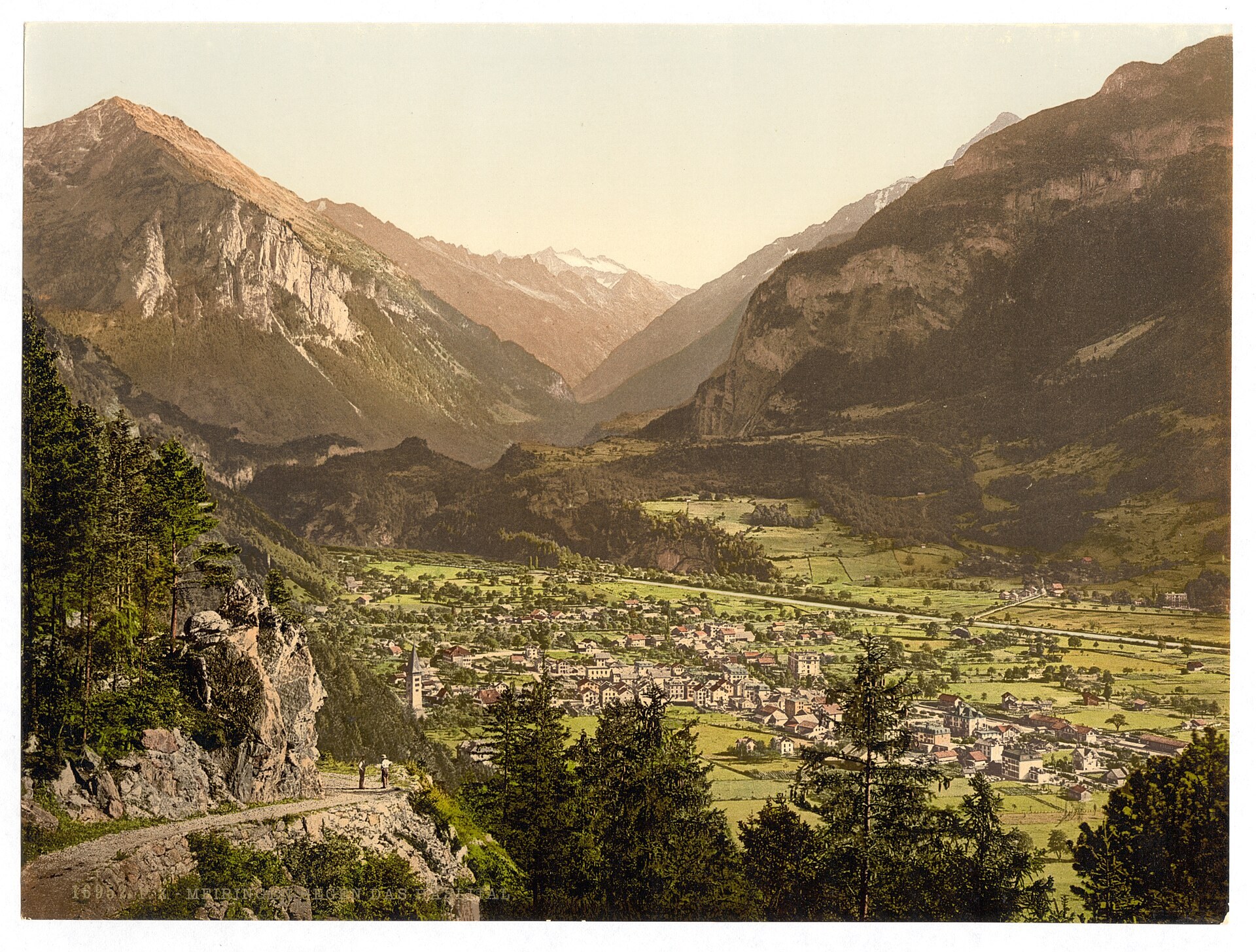

In April 1935 a Berlin magazine with a print run of more than a million copies printed a photograph that seemed to show a creature from Alpine folklore lying in the grass near Meiringen in Switzerland. The Berliner Illustrirte Zeitung credited the picture to a photographer called Balkin and asked its readers whether the Tatzelwurm, the stubby, cat headed lizard of many mountain tales, had at last been caught on film. The magazine sent staff to the valley, offered a reward of 1,000 Reichsmarks and drew mocking coverage from Swiss newspapers, some of which suspected a stunt to bring in tourists.
More than ninety years later the photograph still hangs over the Aare Gorge, where the company that runs the gorge reproduces it on its website. The original reports survive too. The Swiss newspaper Der Oberhasler summarized the Berlin story on April 18, 1935, and a photograph of that page was later reproduced by the regional paper Plattform J. Both are in German, as are several of the accounts below, and the summaries given here are translations. Read side by side, these sources show how quickly a single blurry image became a sensation, and how quickly Swiss journalists began to ask who stood to profit from it.
What Is the Tatzelwurm?
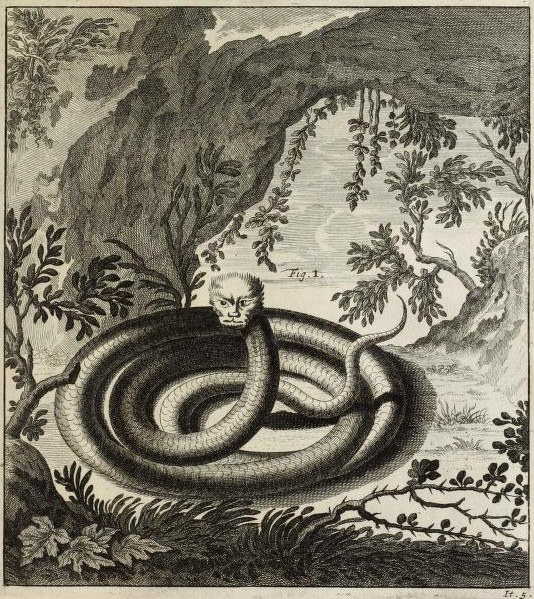
The creature had been part of Alpine storytelling for centuries before anyone pointed a camera at it. According to Plattform J, the name joins the German words Tatze, meaning paw or claw, and Wurm, so the Tatzelwurm is essentially a worm with legs. In different parts of the mountains it goes by names such as Springwurm, Stollenwurm, Dazzelwurm, Praatzelwurm and Bergstutzen. The legends describe it as a small relative of the dragons, between 80 and 150 centimeters long, living in caves, passages and tunnels that it sometimes digs into the rock itself.
In the Bernese Oberland, where Meiringen lies, the usual local name was Stollenwurm. The writer Johann Rudolf Wyss described it in his 1817 account of a journey through the region, as quoted by the Swiss book blog Bergliteratur. He recorded that country people reported the snake with very short feet almost every year, that it usually had a round head like a cat, and that witnesses gave it two, four or even more legs. Wyss added that some people described it as hairy. He also made it clear that he would not accept the creature as proven on the strength of such reports.

What Did Balkin Say He Saw in 1935?
Der Oberhasler gave the fullest early version of the photographer’s own story, drawn from the report he wrote for the Berlin magazine. He was looking for a subject for his camera off the road between Meiringen and Innertkirchen, roughly halfway along, when he noticed a strange shape lying in a small hollow in the ground. At first he took it for an oddly formed tree trunk. As he came closer he was no longer sure whether it was a piece of wood or an animal, so he aimed his camera and pressed the shutter.
The click, he said, made the supposed tree trunk move. According to the Oberhasler summary, it fixed him with piercing bright eyes, made as if to attack and hissed like a snake, and the sight was so frightening that he ran away. He described the animal as about 80 centimeters long and about 25 centimeters thick, brown with light spots, with front legs. The paper added that the visible front half of the creature was hard to compare with any known animal, with a mouth like a shark full of pointed teeth and a nose rather like a monkey’s.
The Aare Gorge company tells a slightly different version today. Its website says the photographer recovered over a schnapps and told his story in the restaurant of the Hotel Baer in Meiringen, describing a creature “shaped like a very big snake, but with forelegs.” In that telling, the innkeeper suggested that the stranger had met the animal locals called the Stollenwurm. Der Oberhasler also reported that residents of Meiringen had told the photographer that the fabled Tatzelwurm still lived on in local belief and had once been seen in the area.
How Did the Berlin Magazine Present the Picture?
The Oberhasler article explained why the story mattered so much in Germany. The Berliner Illustrirte Zeitung, which it said printed more than a million copies, ran the encounter under the heading “Rätselhafte Begegnung im Schweizer Hochgebirge,” which translates as a puzzling encounter in the Swiss high mountains, with a photograph filling almost a whole page. Bergliteratur dates the issue to April 17, 1935, and gives a headline that asked whether the secretive fabled animal of the Alps had been photographed for the first time. Jungfrau Region Tourism identifies the picture as appearing in issue number 17 of that month.
The magazine did more than print a picture. According to Der Oberhasler, it organized a small expedition to the spot, led by a zoologist who did not believe in the creature. Jungfrau Region Tourism says the editors sent staff to the Haslital twice. Nothing was found, and the Oberhasler drily observed that the magazine now offered a reward to anyone who could deliver the Tatzelwurm, dead or alive, to a zoological garden in Switzerland or Germany. Bergliteratur adds that too much snow lay at the reported site for any trace to be found.
However, the reward itself became part of the legend. Jungfrau Region Tourism puts the sum at 1,000 Reichsmarks and states plainly that “The prize money was never awarded.” No animal, carcass or skeleton was ever delivered to any zoo, and the magazine’s teams left the valley with nothing more than the original photograph.
What Did the Swiss Newspapers Make of It?
The Swiss press reacted with a mixture of amusement and suspicion. The Oberhasler headline itself asked whether the wonder of Loch Ness had come to Meiringen, a pointed reference to the Scottish monster that had become world famous only two years earlier. Swissinfo notes that Nessie “only became famous in 1933, when two separate sightings were claimed.” The writer of the Oberhasler piece, who signed with the initials H. B., ended by hoping that the new wonder might bring the Haslital even a fraction of the publicity that Loch Ness had enjoyed.
The Neue Zürcher Zeitung was cooler. As quoted by Plattform J, its April 23, 1935 report said that nobody gave the rumors any credence and that people suspected the cleverness of a skilled tourism promoter, encouraged by the example of Loch Ness. The paper conceded that the Bernese Oberland was welcome to its new attraction, while pointing out that the Aare Gorge was well worth seeing without a Tatzelwurm. Jungfrau Region Tourism adds that the NZZ found it odd that a monster should appear beside an already popular sight, a year after another monster had performed the same service for tourists at the Grimsel.
Der Bund remarked on the huge publicity effect the story was having on the Bernese Oberland. The satirical weekly Nebelspalter joined in as well. Its 1935 volume, indexed by the Swiss journal archive e-periodica, lists cartoons and articles with titles such as “Der Tatzelwurm von Meiringen,” “Meiringen erwartet den Tatzelwurm,” “Wo ist der Tatzelwurm?” and “Interview mit dem Tatzeli-Wurm.” According to Jungfrau Region Tourism, the Aare Gorge and the Meiringen tourist office distanced themselves from all the reports of a Tatzelwurm sighting.
Was the Balkin Photograph a Hoax?
The picture reproduced by Aareschlucht AG shows a pale, blotchy head with two dark nostrils and a row of pointed teeth, resting in rough grass, with no clear sign of a body, legs or tail. Bergliteratur’s reviewer was blunt about it, writing that the animal looks about as alive as a log lying on the ground with two eyes and a broad set of teeth painted on. Jungfrau Region Tourism quotes a man it names as S.J. Blaupot ten Cates, who believed the image was a newspaper hoax that could easily have been modeled on old Tatzelwurm drawings.
The basic facts about the photographer are also unsettled. Aareschlucht AG calls him “a Berlin-born photographer called Balkin,” while Jungfrau Region Tourism prefers “a Russian photographer called Balkin” in its version. However, Plattform J calls him a German photographer and places the walk in 1934, and Swissinfo says that “A Swiss photographer photographed an alleged tatzelwurm in 1934.” The sources disagree on where the film was processed too. Aareschlucht AG says it was developed in Bern, but Jungfrau Region Tourism states that “it was done at an official office in Berlin” instead.
However, none of these sources offers documentary proof of a deliberate fake. No confession has surfaced, no model has been found, and the only first person account is the one Balkin gave the magazine that paid for his picture. The strongest case against the photograph is circumstantial: the creature was never seen again, the searches found nothing, and the people with the most to gain from the publicity were never far from the story.
What Could People Have Mistaken for a Tatzelwurm?
The author Ulrich Magin collected more than 430 eyewitness accounts for his 2020 book on the creature, according to Bergliteratur’s review. The book’s final chapter concludes that the Tatzelwurm is a collective term, a name that has been given to many different animals. The review names the Gila monster and a stump tailed lizard as reptiles that look the part, though neither lives in the Alps. Otters, martens, marmots and adders all do, and all of them have been mistaken for the fabled animal. Because people already know what a Tatzelwurm should look like, he argues, almost anything glimpsed among the rocks can become one.
Der Oberhasler printed some local memories of its own beside the Balkin report. Hunters from Meiringen said that a similar animal had been killed on the Brünigsberg about twenty years before, and other residents recalled walkers stoning to death a strange creature they found sunning itself on a rock in a pond near Unterbalmiweg. Neither story came with a body or a specimen, and as Bergliteratur’s reviewer notes, that was always the way with the Tatzelwurm. As soon as anyone looked into a report, the creature vanished.
Read next: Gef, the Talking Mongoose | The Awful: Vermont Monster That Inspired Lovecraft | Dobhar-chú: The Otter King of Irish Folklore
The Tatzelwurm never turned up for its reward, and in Meiringen it has settled into a gentler role. A green wooden Tatzelwurm greets visitors at the entrance to the gorge, and chocolate versions with marzipan tongues sit in the shop windows of the town. Aareschlucht AG says that “The Tatzelwurm is now considered the local animal of the Aare Gorge.” What Balkin actually photographed in the grass that spring has never been established.
Established: In April 1935 the Berliner Illustrirte Zeitung published a photograph credited to a photographer named Balkin, said to show a Tatzelwurm near Meiringen. The magazine sent staff to search the area and offered a reward of 1,000 Reichsmarks, which was never paid. Swiss papers, including Der Oberhasler and the Neue Zürcher Zeitung, reported the story at the time, and the NZZ suspected a tourism stunt.
Unverified: What the photograph actually shows, whether it was staged, and who Balkin was. Sources give him different nationalities, date the picture to 1934 or 1935, and disagree on where the film was developed.
Fringe: An unknown reptile matching the Tatzelwurm legend lives in the Aare Gorge or elsewhere in the Alps.
By Historic Mystery
Sources
- H. B., Das Wunder von Loch Neß in Meiringen?, Der Oberhasler, April 18, 1935 (in German). Read from the page photograph reproduced in Plattform J (below). plattformj.ch
- Berliner Illustrirte Zeitung, No. 17, April 1935 (issue number per Jungfrau Region Tourism, issue not seen). Balkin photograph as reproduced by Aareschlucht AG. Headline cited through Der Oberhasler and Bergliteratur. aareschlucht.ch
- Nora Devenish, Sagenumwobene Felsklüfte, Plattform J, July 16, 2014. plattformj.ch
- Aareschlucht AG, The Tatzelwurm. aareschlucht.ch
- André Wellig, The Loch Ness Wonder in Haslital, Jungfrau Region Tourism, 2017. jungfrauregion.swiss
- Anker, Der Tatzelwurm (review of Ulrich Magin, Der Tatzelwurm: Porträt eines Alpenphantoms, Edition Raetia, 2020), Bergliteratur, June 25, 2021. bergliteratur.ch
- Julia Slater, How a Monster Builds Bridges, swissinfo, July 14, 2008. swissinfo.ch
- Nebelspalter, vol. 61 (1935), contents, e-periodica. e-periodica.ch
