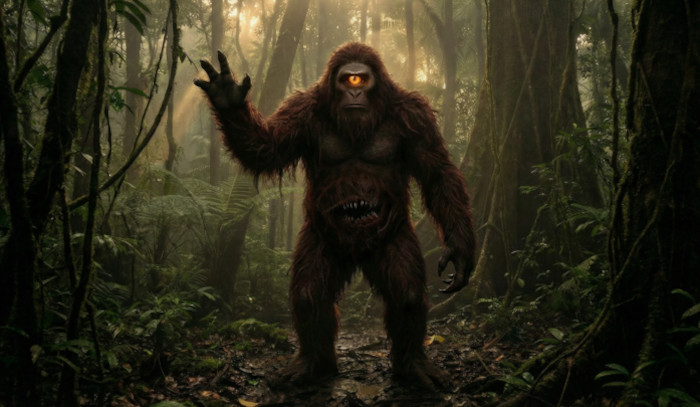
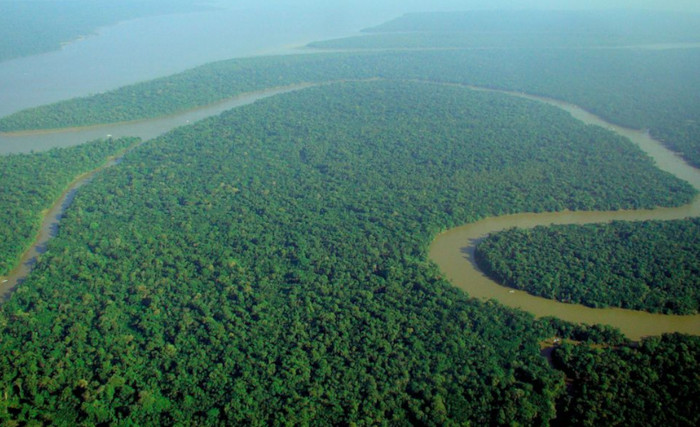
Deep within the almost impenetrable emerald expanse of the Amazon rainforest, indigenous tribes and rubber tappers have long whispered of a creature that defies natural classification. Known as the Mapinguari (sometimes spelled Mapinguary) this beast is one of the most enduring and terrifying figures in Brazilian and South American folklore. Unlike the elusive and shy Bigfoot of North America, the Mapinguari is said to be an aggressive, stench-ridden monstrosity: a hulking giant with a single eye, backward-facing feet, and a gaping second mouth on its belly. For generations, this legend has served as both a cautionary tale to protect the jungle and a genuine source of terror for those who venture too far into the uncharted depths of the Amazon. But could there be a kernel of scientific truth behind this mythical Amazonian cyclops?
A Monstrous Appearance
The physical description of the Mapinguari is the stuff of nightmares, blending humanoid characteristics with grotesque, supernatural anomalies. The creature is universally described as massive, standing anywhere from seven to over nine feet tall when rearing up on its hind legs, and covered in thick, matted, reddish-brown fur so dense it is said to repel arrows and bullets. According to widespread Brazilian folklore, the Mapinguari possesses only one eye in the center of its head, much like the cyclopes of Greek mythology. Even more disturbing is the claim that it has a second, massive mouth located on its abdomen – a cavernous maw lined with razor-sharp teeth, said to be used to consume humans and animals whole.
Adding to its bizarre anatomy, the Mapinguari is often described as having backward-facing feet, a trait common in various South American myths such as the Curupira. This detail serves a practical folklore purpose: it confuses trackers, making it impossible to determine which direction the beast is traveling. Beyond its terrifying appearance, the creature announces its presence through an overwhelming, putrid stench, described as a sickening mixture of rotting meat and feces, so potent it can disorient or knock a grown man unconscious. Its vocalizations are equally chilling, often compared to the deafening roar of a predator mixed with the agonizing scream of a human being.
- The Yowie: More Than Just Australia’s Bigfoot?
- The Yeti: A Never-Ending Search for the Abominable Snowman

Protector of the Forest or Man-Eating Beast?
In the folklore of the Amazonian indigenous peoples, the Mapinguari occupies a complex dual role. According to legend, the creature was once an indigenous shaman who discovered the secret to immortality, but the price for this eternal life was a horrific transformation into a wandering, monstrous beast. As a protector of the jungle, the Mapinguari is said to target those who disrespect nature – hunters who kill more animals than they need, or those who needlessly destroy the forest. In this context, the legend serves a vital ecological function, enforcing sustainable hunting practices and respect for the delicate balance of the Amazonian ecosystem.
However, to the rubber tappers (seringueiros) and gold miners who pushed deep into the Amazon during the 19th and 20th centuries, the Mapinguari was simply a monster to be feared. Numerous accounts from the mid-20th century detail terrified workers abandoning their camps after hearing the creature’s blood-curdling screams or catching a whiff of its nauseating scent. According to a 2007 investigation by The New York Times, dozens of indigenous witnesses across Brazil and Bolivia described consistent encounters with a large, hairy, foul-smelling beast that walked upright and was virtually impossible to kill.
- Orang Pendek: Is There An Unknown Great Ape In Remotest Sumatra?
- Mokele-Mbembe: A Dinosaur Hidden in the Jungles of Africa?
The Giant Ground Sloth Connection
While folklorists view the Mapinguari as a fascinating cultural myth, cryptozoologists and some scientists have proposed a tantalizing alternative: what if the legend is rooted in a real animal? The most prominent scientific theory suggests that the Mapinguari is a cultural memory of the Megatherium, a genus of giant ground sloths that inhabited South America during the Pleistocene epoch. These massive creatures could grow up to 20 feet long and weigh several tons. They were covered in thick reddish hair, had large claws that caused them to walk on the sides of their feet, which could be misinterpreted as backward-facing footprints, and were capable of rearing up on their hind legs to reach vegetation.
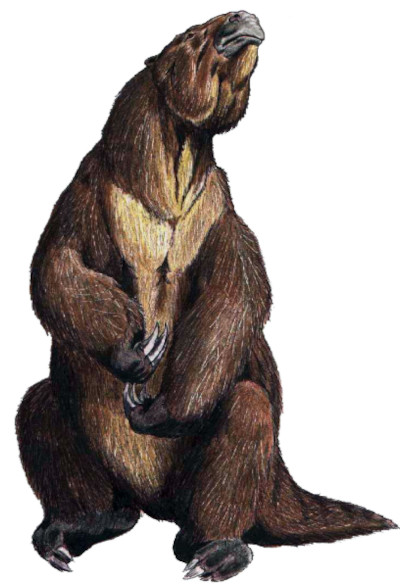
Giant ground sloths went extinct approximately 10,000 years ago, coinciding with the arrival of early humans in the Americas. It is highly probable that early indigenous populations interacted with, hunted, and feared these massive beasts, and the cultural memory of those encounters could have been passed down through generations of oral tradition, gradually morphing into the monstrous Mapinguari. The “mouth on the belly” might be a distorted description of a specialized scent gland on the stomach of some sloth species, or a misinterpretation of the animal’s lighter-colored underbelly fur.
The late ornithologist Dr. David Oren of Brazil’s Goeldi Museum took the theory a step further, conducting numerous expeditions into the Amazon in the 1990s and early 2000s to gather physical evidence. Oren collected witness testimonies, hair samples, and footprint casts, becoming convinced that the locals were describing a real, biological entity. While the physical evidence ultimately proved inconclusive — hair samples turned out to belong to giant anteaters or modern sloths — the sheer volume and consistency of the eyewitness accounts was remarkable. [1] Dr. Oren passed away in 2023, leaving behind a legacy of serious scientific inquiry into one of the Amazon’s most enduring mysteries.
Whether the Mapinguari is a purely mythological construct designed to protect the rainforest, the exaggerated cultural memory of an extinct Ice Age megafauna, or a flesh-and-blood creature still hiding in the dense jungle canopy, the legend endures. The Amazon rainforest covers over 2.1 million square miles, much of it still completely untouched by modern civilization. Until every corner of the great jungle is explored, the Mapinguari will continue to roam the shadows of the human imagination — a terrifying reminder of the wild, untamed power of nature.
Top image: An AI interpretation of how the Mapinguari might have appeared, according to descriptions. Source: AI generated
By Gary Manners
References