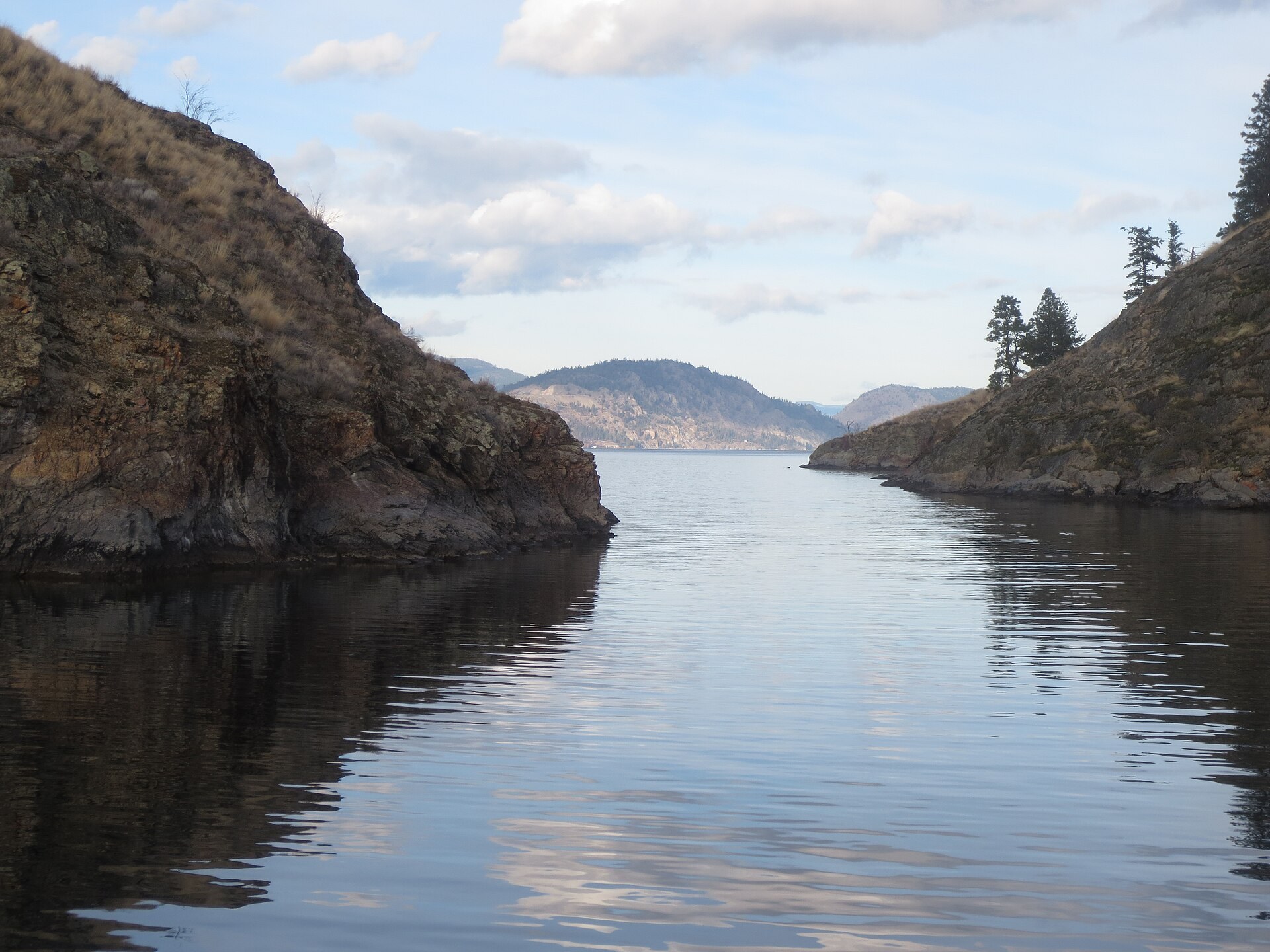

Okanagan Lake runs for about 84 miles through the hills of southern British Columbia, and for more than a century people have reported seeing something long, dark and humped moving across its surface. Settlers called it Ogopogo, and the name became a mascot, a statue and a tourism symbol for the city of Kelowna. The syilx people, who have lived beside the lake for thousands of years, call the being in the water by another name and tell a very different story about it.
The answer to what is in the lake depends on whether you ask a cryptozoologist, a skeptic, an earth scientist or a syilx knowledge keeper, and the sources do not agree on much beyond the basic geography.
Who first told stories about the lake?
The syilx (Okanagan) people knew the lake long before European fur traders arrived in 1809. A 2020 BBC report by the travel writer Lisa Kadane says they had lived in the area for at least 12,000 years. In their language, nsyilxcən, the being in the lake is called nx̌ax̌aitkʷ, a name spelled in slightly different ways by different writers.
Xwayluxalqs, known in English as Tricia Manuel, leads a ceremony to feed nx̌ax̌aitkʷ on Okanagan Lake every spring and fall. She told the Indigenous news outlet IndigiNews that the name breaks down to mean “There is a sacred being in the water,” and that this “sacred being takes care of the water.” In her account, young men offer a deer to the water while women stand on the shore and sing, praying that nobody drowns and that the water stays clean.
Coralee Miller, then assistant manager of the Sncəwips Heritage Museum in West Kelowna, gave the BBC a description of how the being appears in syilx stories. “In our stories, [n ̓x̌ax̌aitkʷ is] actually very dark in colour and it’s got the head of a horse and the antlers of a deer,” she said. She added that “Missionaries saw our water spirit and the habit was to demonise our spiritual beliefs.”
Tourism Kelowna, in an article by Justin DeMerchant of its visitor team, says the syilx made offerings when they crossed the lake near Rattlesnake Island, where the being was said to live in a cave at Squally Point. That small island appears on the left of the photo above.
Were the offerings live sacrifices?
This is the first point where the sources clash. Many popular books on lake monsters describe a creature called Naitaka or N’ha-a-itk that demanded a toll in blood. Benjamin Radford, a researcher with the Committee for Skeptical Inquiry, summarized those books in a long article for Skeptical Inquirer. He wrote that the toll was “a live sacrifice,” and that travelers dropped chickens or other small animals into the water near Rattlesnake Island.
Radford also retold a story from the local historian Frank Buckland about Timbasket, a visiting chief who mocked the lake spirit and was drowned with his family near Squally Point. In that version the creature lashed the lake into a storm with its tail.
Syilx sources describe the offerings in gentler terms. Miller told the BBC that the syilx fed the spirit symbolically, with tobacco and sage and sometimes kokanee salmon, as thanks for food and water. “That’s where I think that misunderstanding came from,” she said, explaining that settlers saw people throw a little meat into the water. The BBC report adds that pioneers then spread stories of a serpent that needed live animal sacrifices, and that some settlers began patrolling the lake with guns.
Radford, from a skeptic’s side, reaches a related conclusion by another route. He argues that the old stories describe “a legendary disincarnate force of nature, not a corporeal creature,” and he quotes Celeste Ganassin, then curator of education at the Kelowna Museum, who warned that “People pick and choose parts of the First Nations myths to fit their needs.” Radford notes that it is almost always white writers, and not native people, who treat N’ha-a-itk and Ogopogo as the same being.
The late Elder Joey Pierre made the same point more directly, according to Xwayluxalqs. “You don’t call him Ogopogo, you call him by his name, nx̌ax̌aitkʷ.”
What did the settlers report?
The written settler record of strange events on the lake begins in the 1850s. Tourism Kelowna says the first reported encounter came in 1855, when John McDougall, a Métis settler, was crossing the lake with his horses tied behind his canoe. The horses were dragged under, and he cut the ropes to keep the canoe from sinking. Radford gives the date as 1854 or 1855 and spells the name MacDougall, and he treats the tale as part of the legend rather than as a documented event.
According to Tourism Kelowna, the first reported sighting by a European settler came in 1872, when Susan Allison was certain she had seen a dinosaur in the lake. Neither source quotes Allison’s own words, so the details of what she saw are not recorded in the material used here.
Where did the name Ogopogo come from?
The name Ogopogo came from outside the valley entirely. Radford, citing the zoologist Karl Shuker, says the songwriter Cumberland Clark wrote a music hall song in 1924 called “The Ogopogo: The Funny Fox-Trot.” The BBC quotes lines from the song, including a line about a mother who “was an earwig,” and says tourism officials took up the name in the 1920s.
Radford reports that sightings rose sharply soon after the song spread. In a note to his article he argues that the rise “was strongly linked to publicity and not other sightings,” and that people who expected to see the creature began to read ordinary lake events as Ogopogo. Linda Digby, executive director of Kelowna Museums, put it more simply to the BBC. “You live here long enough everyone’s going to see something.”
The creature went on to become a civic symbol. Radford notes that Kelowna adopted a coat of arms in 1955 with a seahorse that a city brochure called “the closest approximation of our Ogopogo.” In the 1980s the regional tourism association offered a $1 million reward for proof that it existed, the BBC reports, and the same article says 16 percent of British Columbians believe in the creature.
What is the best evidence for an animal?
Supporters of a living animal point to films, sonar readings and repeated eyewitness reports. John Kirk of the British Columbia Scientific Cryptozoology Club told Radford that the films and videos of Ogopogo are “more numerous and of better quality than anything I have personally seen at Loch Ness.” Readers who know the Scottish case can compare it with the story of the Loch Ness Monster.
The film most often cited was shot in 1968 by Arthur Folden, who noticed “something large and lifelike” on calm water and filmed about a minute of footage. Tourism Kelowna says scientific analysis confirmed that a real object surfaced but did not determine its size. Radford, writing for Live Science, says he and Kirk designed a test for the National Geographic Channel show “Is It Real?” in 2005. They concluded that Folden filmed a real animal whose size had been greatly overestimated, “probably a waterfowl or beaver too far away to be identified.”
Tourism Kelowna also mentions a sonar image of a 12 meter object recorded during a Japanese expedition in 2000. On the other side, Radford reports that a 1991 search with a remotely operated vehicle and a small submarine reached about 840 feet at the deepest part of the lake and found neither animals nor bones.
What could people be seeing?
The most common ideas fall into three groups. The first is a known fish. Tourism Kelowna notes that white sturgeon live elsewhere in the Columbia system and can grow to about 6 meters, but it adds that dams built by the 1920s cut the lake off from the rivers and that no sturgeon has ever been officially reported there.
The second group of explanations looks at the water itself rather than at animals. Robert Young, an earth sciences professor at the University of British Columbia Okanagan, told the BBC that thermal stratification can make a wave appear from nowhere when a denser layer of water slides under a lighter one, often in spring or fall. He calls it an “Ogopogo wave.” Radford adds that the lake’s geology produces long waves that can mimic a row of humps.
The third is floating debris and small animals. Radford found that many reports describe a featureless “log” that seemed alive, and he points out that the lake holds tens of thousands of timber logs floating just below the surface. A 2011 video by a visitor named Richard Huls, in his reading, shows two straight dark shapes that look like logs. Tourism Kelowna lists river otters, beavers, schools of fish and hoaxes among other causes.
None of this covers every report, and Tourism Kelowna says some sightings involve large groups who claimed to see the same thing. Yet no body, bone or clear close photograph has been produced in more than a century of searching.
Why does the question still matter?
For many people in Kelowna, Ogopogo is a cheerful local character. For syilx people, the question is about respect. Xwayluxalqs told IndigiNews that settler folklore paints the being as a lake demon or a friendly serpent, and that this is harmful. She said that plush toys and divers hunting for a sighting amount to “minimizing and tokenizing something that’s sacred to the original peoples of this land.”
Tourism Kelowna notes that in 1989 the creature was listed under the BC Wildlife Act, which made it illegal to hunt or disturb it. Young, the earth scientist, told the BBC that he sees no need to disprove Ogopogo at all, because it is a Canadian cultural icon and nx̌ax̌aitkʷ is an important part of syilx belief.
That leaves two questions that are easy to blur. One is whether an unknown animal lives in Okanagan Lake, and the evidence so far points toward waves, logs and misjudged wildlife. The other is what the being in the water means to the people who first named it, and that question belongs to the syilx, not to monster hunters.
Established: Sightings of something in Okanagan Lake have been reported since the 1800s, the name Ogopogo spread after a 1924 song, and Arthur Folden filmed an object on the lake in 1968, according to Tourism Kelowna, Skeptical Inquirer, Live Science and the BBC.
Disputed: Whether syilx offerings to nx̌ax̌aitkʷ were live sacrifices. Popular lake monster books summarized by Benjamin Radford say they were, while syilx sources quoted by the BBC and IndigiNews describe symbolic offerings that settlers misunderstood.
Unverified: That an unknown large animal lives in the lake. Supporters cite films and a 2000 sonar contact, but a 1991 submarine search found nothing, and a 2005 test of the Folden film pointed to a small animal.
Fringe: That Ogopogo is a surviving plesiosaur or prehistoric whale. Tourism Kelowna mentions the idea, and no fossil or physical evidence from the lake supports it.
Sources
- Justin DeMerchant, The Legend, The Spirit, The Creature: The History of Ogopogo, Tourism Kelowna, February 28, 2020. tourismkelowna.com
- IndigiNews, Don’t call him Ogopogo, call him by his name, Nx̌ax̌aitkʷ, says Syilx Elder, April 21, 2021. indiginews.com
- Benjamin Radford, Ogopogo the Chameleon, Skeptical Inquirer 30.1, January/February 2006. skepticalinquirer.org
- Lisa Kadane, article on Ogopogo and nx̌ax̌aitkʷ, BBC Travel, March 10, 2020. bbc.com
- Benjamin Radford, Ogopogo: Canada’s Loch Ness Monster, Live Science, January 8, 2014. livescience.com
