
On the night of October 4, 1967, a teenager named Laurie Wickens was driving friends home from a dance along Highway 3 in southwestern Nova Scotia when he saw lights in the sky over the fishing village of Shag Harbour. Within an hour police officers, fishermen and a Coast Guard boat were out on the water looking for a downed aircraft that no one ever found.
The Shag Harbour incident is unusual among UFO cases because the Canadian government took it seriously and left a paper trail. Police reports, military messages and a United States Air Force study all describe the same basic events. However, they leave open the central question of what the witnesses saw descend toward the sea that night.
What did Laurie Wickens see on October 4, 1967?
According to a 2026 CBC News profile written after Wickens died at 76, the 17-year-old saw “four lights in the sky that flashed in sequence, then all together at the same time.” Then, in the CBC’s words, “the object crashed into the waters off the fishing village of Shag Harbour.”
Wickens drove to a phone booth and called the Royal Canadian Mounted Police, the RCMP, where he “was initially met with skepticism and was asked if he’d been drinking.” His daughter, Stephanie Wickens, told the CBC that the payphone rang soon after he hung up. It was the RCMP calling back to tell him officers were coming, because by then they had received more calls.
A report sent from the Rescue Coordination Centre in Halifax the next day, now held in a National Research Council of Canada file, recorded the sighting as reported by an RCMP corporal from Barrington Passage and six other witnesses. It described a dark object more than 60 feet long carrying four white lights, which descended rapidly to the water with a high whistling sound and a bright flash, after which a single light floated on the surface for a long time.
What did the police and the Coast Guard find?
The Condon Committee, the University of Colorado study of UFOs funded by the U.S. Air Force, interviewed officials by telephone and filed the case as Case 34. Its summary says the RCMP officers “had arrived about 15 min. later, in time to see the light on the water,” and that the light “persisted about five minutes longer.”
Ten minutes after the light went out, two officers were at the site in a rowboat, along with a Coast Guard boat and six fishing boats. According to the Condon account, they found “only patches of foam 30-40 yd. wide that the fishermen thought was not normal tide foam.” The same report notes that “the tide was ebbing, and the white light had appeared to drift with it.”
The UFO researcher Chris Styles, who has written books on the case, told the CBC that the searchers found “a trail of odd yellow foam that’s bubbling to the surface,” and added that “some say it smelled of sulphur.” Styles also told the CBC that, depending on who you ask, the object “either disappeared or submerged.” One RCMP officer, Constable Ron O’Brien, was quoted by The Canadian Press as saying the light “was being carried out to sea by the tide and disappeared before we could get a boat to it.”
One detail in the Condon report matters a great deal. It states that “Apparently no one actually saw anything enter the water.” The young witnesses could not see the object for about ten seconds while passing a small hill, and when they could see again there was “a single white light on the water about where they estimated the object should have gone in.”
Why did the navy send divers?
The authorities looked first for an ordinary cause. The Condon report says Air Search and Rescue had no report of missing aircraft, and that “an RCAF radar station nearby reported no Canadian or U.S. air operations in the area at the time, nor any unusual radar object.” The RCMP corporal also said the light on the water was not on any boat.
On October 6, 1967, Colonel W. W. Turner, the director of operations at Canadian Forces Headquarters in Ottawa, wrote a memo that the CBC quotes. “The Rescue Co-ordination Centre conducted [a] preliminary investigation and discounted the possibilities that the sighting was produced by an aircraft, flares, floats, or any other known objects.” The CBC adds that another Turner memo later used the term unidentified flying object, “but that does not mean its origins were extraterrestrial.”
Military messages in the National Research Council file show that Maritime Command sent a diving officer and three men to the area, approved hiring a local boat, and arranged a helicopter to fly divers and equipment from Shearwater. A situation report on October 8 said two days of underwater searching in good conditions had produced nothing, and a later message that day recorded the search as terminated.
The Canadian Press reported that the water searched was nine to 20 meters deep and that “visibility was good over a flat sand sea bottom,” according to the CBC. Styles told the CBC that the divers “claimed to find nothing, although some local residents claimed,” as recorded in the weekly papers, “that some debris was brought up.” No such debris is described in the official messages saved for this article.
Was Shag Harbour part of a larger night of sightings?
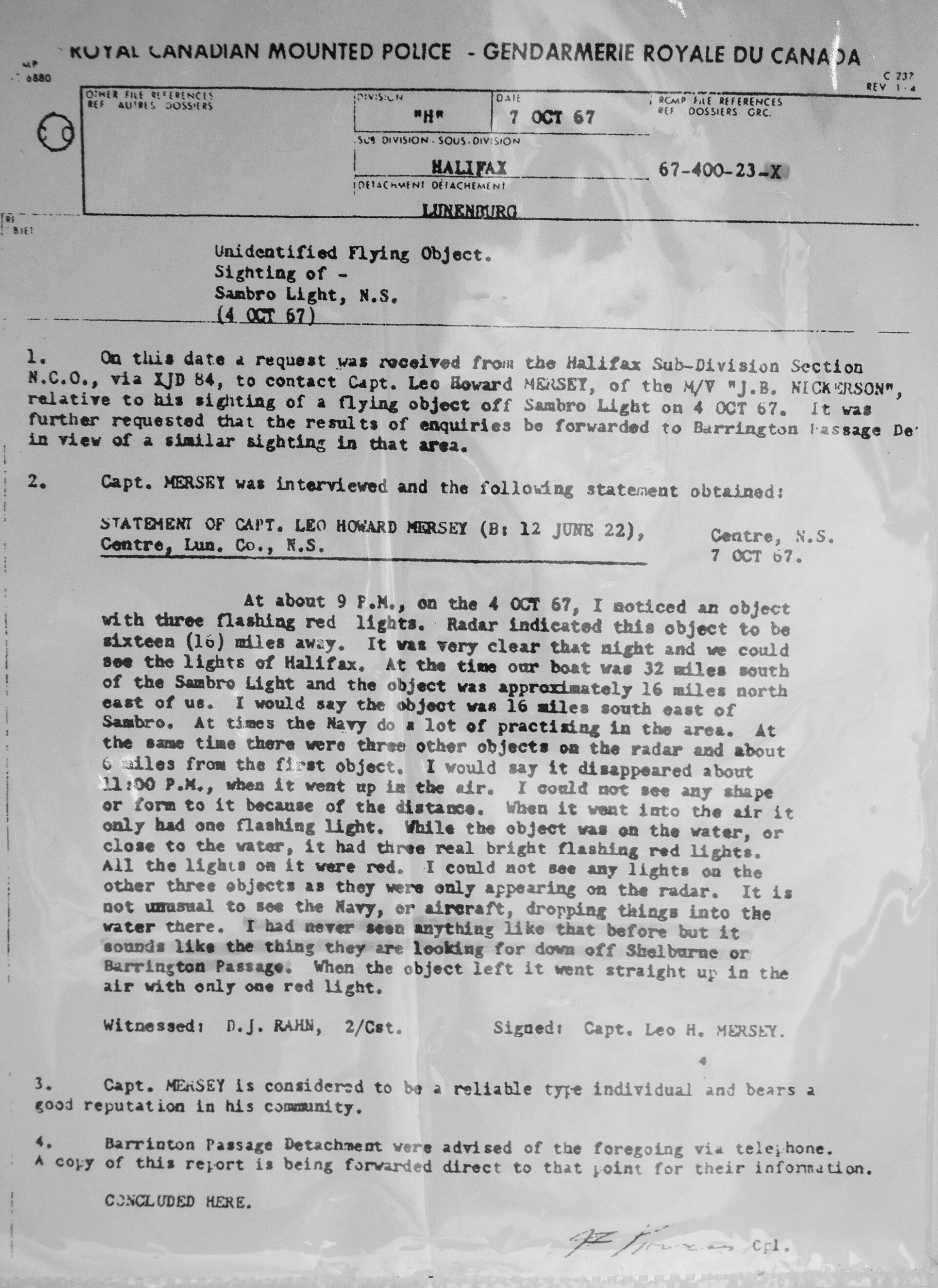
Styles told the CBC that researchers often call October 4, 1967, “The Night of the UFOs,” because there were sightings elsewhere in Nova Scotia, including Wedgeport, Sambro and Halifax. Styles said he himself saw an orange orb over Halifax harbor that night. The RCMP file shown above concerns one of those other reports, from near Sambro Light.
The Condon investigators also heard from the captain of a fishing boat who reported three bright red lights on the water and radar returns that he took for naval vessels, with one light going straight up. Because the position he gave was about 175 nautical miles from Shag Harbour, the report concluded that “the two situations do not appear to be related.”
However, the Condon project closed its file with a short judgment. “No further investigation by the project was considered justifiable, particularly in view of the immediate and thorough search that had been carried out by the RCMP and the Maritime Command.”
What about the stories of an underwater chase?
The case gained a second life decades later. A page on the website of the Municipality of the District of Barrington, written by B. J. Booth, says that Styles and fellow investigator Don Ledger found witnesses who described what happened after the divers left.
According to that account, the object traveled underwater “for about 25 miles to a place called Government Point, which was near a submarine detection base,” where naval vessels were positioned over it until “a second UFO joined the first.” The same page says the two craft later reached the Gulf of Maine and “shot away into the skies.” It also admits a weakness in this version, noting that the witnesses spoke off the record.
However, the official records cited here do not mention a sonar contact, a second object or a chase. They describe a short search near the shore that ended on October 8. The off-the-record story may come from real witnesses, but it rests on testimony no document in these sources confirms.
Why does Shag Harbour still matter?
Styles told the CBC that the case is considered Canada’s most famous UFO incident partly because of “the large witness pool, what authorities said at the time, and the subsequent paper trail left behind.” The village now has the Shag Harbour UFO Incident Society, which runs a museum and an annual conference, and Wickens worked with it in his later years.
In 2018 the Royal Canadian Mint began a coin series called Canada’s Unexplained Phenomena, and the CBC reports that the first coin was for the Falcon Lake incident in Manitoba. Styles said Wickens urged the mint to make one for Shag Harbour, which was released in 2019.
Wickens himself never settled the matter. His daughter recalled that he first called it a plane crash, and that as she grew older he told her, “I don’t know what it was.” That uncertainty, shared by the officials who searched the water in 1967, is where the record still stands.
Established: Witnesses including an RCMP corporal reported lights descending toward the water off Shag Harbour on October 4, 1967, a light was seen floating offshore, boats found foam, navy divers searched until October 8 and found nothing, and officials ruled out aircraft, flares and other known objects at the time.
Disputed: Whether anything entered the water and whether debris was recovered. The Condon report says no one actually saw anything enter the water, and residents’ claims of debris are not supported by the official messages.
Unverified: That the object traveled underwater to Government Point, was watched by naval vessels and was joined by a second craft. This rests on off-the-record testimony gathered decades later.
Fringe: That the object was an extraterrestrial spacecraft. No record cited here supports it, and the CBC notes that the official use of the term UFO does not imply it.
Sources
- Richard Woodbury, profile of Laurie Wickens and the Shag Harbour incident, CBC News, August 2, 2026. cbc.ca
- Condon Committee, Scientific Study of Unidentified Flying Objects (1968), Case 34, North Atlantic, Fall 1967. ncas.org
- National Research Council of Canada, file UAR/N/116-125 (1967), Library and Archives Canada, RG77. realufo.org (scan)
- B. J. Booth, Shag Harbour UFO Incident, Municipality of the District of Barrington. barringtonmunicipality.com
