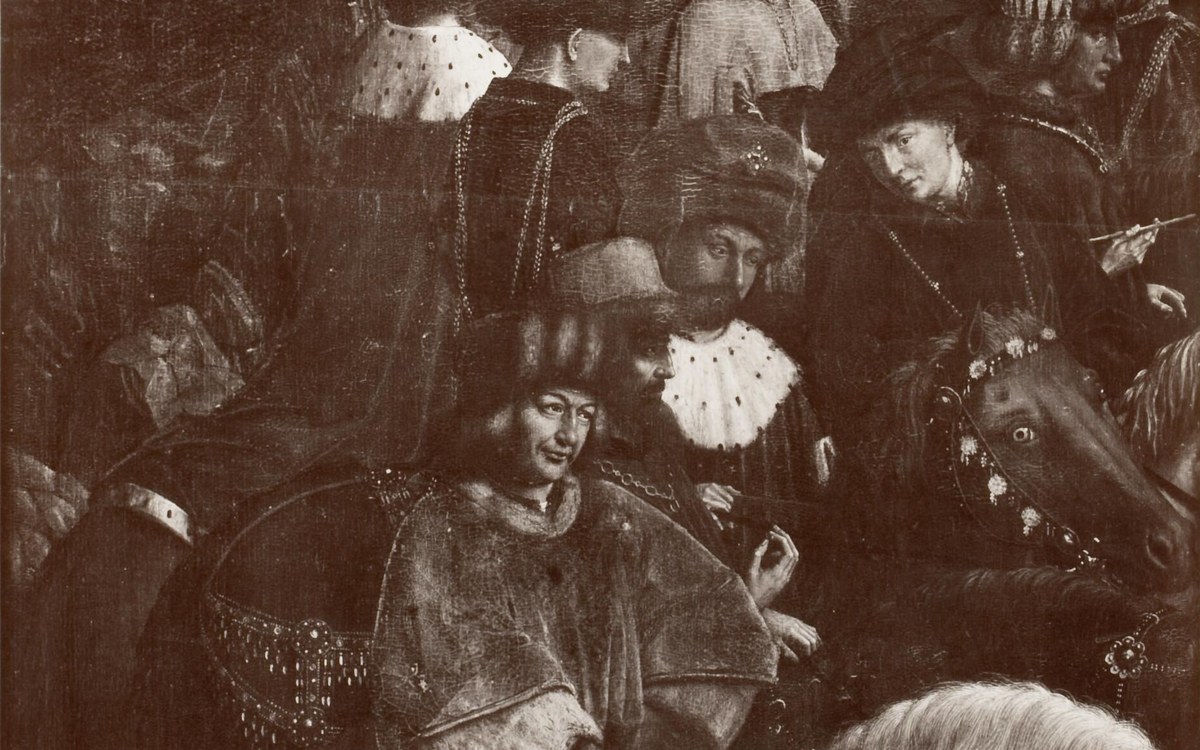

The Adoration of the Mystic Lamb, better known as the Ghent Altarpiece, has survived fire, war, looting and dismemberment over almost six centuries. Its most stubborn mystery dates from a single spring night in 1934, when thieves removed two painted panels from its frame in St. Bavo’s Cathedral. One of them, a group of mounted figures known as the Just Judges, has been missing ever since, and the case remains open.
According to the cathedral’s own guide to the panels, the altarpiece was painted by the Van Eyck brothers, inaugurated in 1432 and made up of twenty panels, with wings painted on both sides. It was commissioned by Joos Vyd and his wife for their chapel in the cathedral. The Just Judges panel sat at the lower left of the opened altarpiece, and the guide describes its riders as representatives of worldly power who “exercise the Christian virtue of justice.”
A Forced Lock and a Note in French
The City of Ghent’s tourism office gives a detailed account of the discovery. On April 11, 1934, the sexton, Van Volsem, noticed during his morning round that the lock on the door to the Vyd chapel had been forced. Inside, he found that the Just Judges and John the Baptist panels were gone. On the frame of the altarpiece there was a note, written in French, with the text “Taken from Germany by the Treaty of Versailles.”
The two paintings were in fact the front and back of a single panel. The city’s account explains that forty years earlier they had been in the Kaiser Friedrich Museum in Berlin, where in 1894 the panel was sawn in half lengthwise so that both sides could be shown at once, an intervention that made the theft easier. The police found no fingerprints or traces of the thieves, and the note pointing to German revenge, the city’s account adds, turned out to be a diversion.
The early investigation does not come out well in later accounts. Writing in The Guardian in 2013, Noah Charney, author of a book on the altarpiece’s history, describes the Ghent police commissioner, Antoine Luysterborghs, taking a quick look at the empty frame and leaving to deal with another theft from the same night, at a cheese shop across the street.
The Letters Signed D.U.A.
The silence ended on April 30, 1934, when the bishop of Ghent, Coppieters, received a demand for one million Belgian francs, signed with the initials D.U.A. If the money was not paid, the letter said, the panels would be destroyed. The city’s account records that the bishop was willing to pay, but the public prosecutor and the Minister of Justice refused permission, so he kept up the negotiations for appearance’s sake.
As a sign of good faith, the extortionist sent a receipt for the left luggage office at Brussels North station with his third letter. In exchange for the receipt, the clerk handed over a large package containing the John the Baptist panel. The clerk recalled that the man who had left the package at the station was about fifty years old, with a pointed beard.
The authorities then tried a different tactic. A later letter named an intermediary, Father Henri Meulepas of St. Laurentius parish in Antwerp, to hand over the money. The police gave the priest a parcel containing only 25,000 francs instead of the million demanded. On June 14, 1934, a taxi driver arrived at the rectory with half of a torn newspaper page that matched a half sent earlier by the extortionist, and drove away with the parcel. A series of angry letters followed over the summer, and the last of them arrived on October 1.
A Deathbed Claim
After about six weeks of silence, by the city’s count, Arsène Goedertier, a 57-year-old banker from Wetteren and a former sexton with good connections to the diocese, collapsed after speaking at a political meeting in Dendermonde, according to the city’s account. He died shortly afterward at the home of his brother-in-law, and the Dutch-language history site Historiek gives the date of his death as November 25, 1934.
Before he died, Goedertier spoke to his lawyer, Georges de Vos. In the version reported by Charney, De Vos claimed that Goedertier whispered: “I alone know where the Mystic Lamb is. The information is in the drawer on the right of my writing table, in an envelope marked ‘mutualité.'” The city’s account renders his final words as “desk, key, closet, health service folder.”
The folder held copies of the thirteen ransom letters to Bishop Coppieters, but no sign of the panel. Charney adds that it also contained a final, unsent letter, which said the panel “rests in a place where neither I, nor anybody else, can take it away without arousing the attention of the public.” He writes that De Vos waited a month before telling the police about the confession, and that an officer later began using Goedertier’s typewriter, on which the ransom notes had been written, before it was fingerprinted.
Was Goedertier Working Alone?
The police eventually concluded that Goedertier had been the thief, and the case went cold, although later investigators have questioned that picture. Charney reports that Karel Mortier, chief of the Ghent police from 1974 to 1991, found that Goedertier had an eye problem that left him barely able to see in the dark, and that he already had more than the ransom sum in his bank account. Mortier also argued that removing the panel from its high framework would have needed a ladder and at least two people.
Goedertier’s own remarks, as Charney recounts them, point in no clear direction. He reportedly told his wife “What is misplaced is not stolen,” and when she suspected the Germans, he replied: “I wouldn’t look so far. If they’d let me search for it, I’d stay in the vicinity of the cathedral.” In a 2025 review of a book by Kurt Impens, Historiek reports that the author regards Goedertier as a minor figure who wrote the ransom letters on behalf of others. That remains one author’s interpretation, and no court has tested it.
The Search During the War
The panel’s fame drew the attention of Nazi Germany during the occupation of Belgium. Charney writes that during the Second World War, Joseph Goebbels sent an art detective, Heinrich Köhn, to Ghent to find the Just Judges as a gift for Hitler. Köhn’s 176-page file, which Mortier later copied from his widow, showed that he believed the panel was still somewhere inside the cathedral. VRT, the Flemish public broadcaster, notes that German troops searched for it during the occupation, as far as anyone knows without result.
Charney also reports a claim, made later by a Belgian collaborator who worked with Köhn, that the cathedral’s canon, Gabriel van den Gheyn, had found the panel during the war, and he points out that this would not explain why the canon never returned it once the war was over.
A Copy in the Frame
Visitors to the cathedral today see a substitute in the frame, and the cathedral’s guide is direct about it: “The original panel was stolen in 1934. Jef Van der Veken painted this copy in 1939.” Historiek notes that the copy is the panel now on view in the cathedral.
Theories and Tips
VRT, marking the 90th anniversary in 2024, lists the main theories. One holds that the panel is still in or near the cathedral, and a dig on the Kalandeberg square nearby in 2019 found only an old iron ladder. Another places it in the royal crypt of King Albert I, who died in 1934. The journalist Rudy Pieters has argued that it was destroyed in 1971, though, as VRT notes, he wrote that “So far, no one has claimed to have witnessed that destruction, so perhaps there is still hope.” The historian Paul De Ridder has argued since 2014 that the panel is held by a prominent Ghent family afraid of scandal, a claim others dispute and that has never been confirmed. Charney also describes a theory that a failed investment scheme lay behind the theft, while noting that Goedertier was wealthy and devout.
None of these ideas has yet produced the painting itself, and Charney reports that Saint Bavo had been searched six times since the Second World War, and that the attorney general’s office keeps a 2,000-page file on the case. Historiek reports that the Ghent prosecutor’s office carried out further searches at Oosterzele late in 2024 after Impens’s book appeared, again without result. VRT adds that the investigation is still ongoing.
Other famous art thefts have ended in different ways. The theft of the Mona Lisa from the Louvre in 1911, as this site’s account describes, ended more than two years later when the painting was found with the thief. The 1990 Gardner Museum heist in Boston, by contrast, has never led to a single arrest, and the Nazi looting that seized the Amber Room in 1941 left another treasure whose fate remains unknown.
As Charney put it, “There are gaps in every theory.” Ninety years after a sexton found an empty frame, the Just Judges remain the one part of the Ghent Altarpiece that nobody can account for.
Get the Historic Mysteries newsletter, free
Unsolved cases, strange sightings and hidden history, straight to your inbox.
Sources
- The disappearance of the Just Judges panel. Visit Gent, City of Ghent.
- The Lamb of God, panel guide. Saint Bavo’s Cathedral, Ghent (PDF).
- Charney, Noah. The Ghent Altarpiece: the truth about the most stolen artwork of all time. The Guardian, December 20, 2013.
- Clapson, Colin. The mystery of the disappearance of the Just Judges 90 years on. VRT NWS, April 13, 2024.
- Van Clemen, Sam. Diefstal van De Rechtvaardige Rechters blijft mysterie. Historiek, September 15, 2025.
