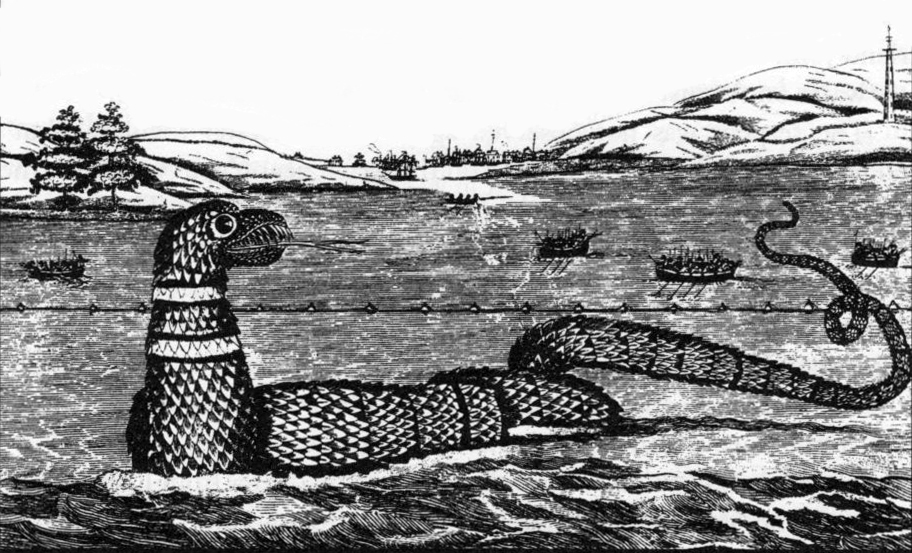

In the second week of August 1817, the people of Gloucester, Massachusetts, began crowding the shores of their harbor to watch an animal that nobody could name. Mariners, ship masters and a carpenter with a gun described something long, dark and fast near Ten Pound Island. Within days, a learned society in Boston had decided to treat the reports as evidence, and its inquiry left behind an unusually detailed record of a sea serpent sighting.
According to an article published by the Cape Ann Museum for the 200th anniversary in 2017, the first sightings on August 6 were generally discounted, but by August 14 spectators were lining the shores in the hope of seeing the creature. The Massachusetts Historical Society notes that the Boston Daily Advertiser reported on August 18 that “hundreds of people” had seen a “prodigious snake” in the harbor over several days.
A Committee Takes Evidence
The Linnaean Society of New England had been founded in 1814 to promote the study of natural history, and its president was John Davis, a federal judge. On August 18 the society appointed Davis, the physician Jacob Bigelow and Francis C. Gray as a committee to collect evidence about the animal, according to the committee’s own report, which was published in Boston later that year.
The committee took unusual care over its method from the start. It asked Lonson Nash, a justice of the peace in Gloucester, to examine witnesses under oath, and it sent him a list of 25 questions, from the animal’s color and length to whether it had a mane or made any sound. Only people who said they had actually seen the animal were to be examined. The examinations were to be separate, and the committee’s rules stated that “the matter testified by any witness not to be communicated until the whole evidence be taken.”
Nash sent back eight sworn depositions on August 28, and three more were taken in Boston. In his covering letter he reported that the witnesses “differ in some few particulars, still, for the most part, they agree.” Privately, Davis was less certain. In a letter to his son-in-law now held by the Massachusetts Historical Society, he warned that “as the animal was seen so imperfectly and in swift motion, great allowance must be made.”
What the Witnesses Agreed On
Read together, the depositions describe a long, dark brown animal, about as thick as a barrel or a man’s body, that moved very fast, turned sharply and seemed to some to be jointed like a line of kegs.
Amos Story, a mariner, watched the animal on August 10 for an hour and a half from the shore. “His head appeared shaped much like the head of the sea turtle,” he testified, and he judged that it moved a mile in two or three minutes. Matthew Gaffney, a ship carpenter, got closer than anyone. He was in a boat within thirty feet of the animal on August 14 and fired at its head. “I had a good gun, and took good aim,” he said, and he thought he must have hit it, but the animal sank under the boat and surfaced about a hundred yards away.
Sewell Toppan, master of the schooner Laura, saw it pass his vessel off Cape Ann on August 28. He had seen whales very often, he said, and this moved much faster. “I have been to sea many years, and never saw any fish that had the least resemblance to this animal.”
Where They Differed
The disagreements between the witnesses were just as revealing. Solomon Allen, a ship master who watched the animal on three days, estimated its length at “between eighty and ninety feet,” while Story said he saw only ten or twelve feet of it on his first day and at least fifty feet on the second. Asked how many distinct parts of the body were out of the water at once, Allen answered, “I should say fifty distinct portions.” Story saw no bunches at all.
The witnesses also disagreed about how it moved. Allen said, “He moved to the right and left,” like a land snake. Gaffney described the opposite. “His motion was vertical, like the caterpillar,” he said. Nash, who had watched the animal himself for nearly half an hour, sided with Gaffney. He told the committee that Allen was mistaken and that he had never seen more than eight portions at once. “I believe the animal to be straight, and that the apparent bunches were caused by his vertical motion,” he wrote.
The Baby Serpent
Then came the discovery that would define the case. The Massachusetts Historical Society records that on September 27, 1817, a Gloucester resident named Gorham Norwood killed an unfamiliar snake about three feet long with a strangely undulating spine, and the Cape Ann Museum places the find near Loblolly Cove, more than four miles from the harbor. In the committee’s words, the snake was brought to Boston and “exhibited as the progeny of the great serpent.”
The committee examined it through an opening cut in its side and found a row of forty humps along its back, apparently formed by undulations of the spine. It named the animal Scoliophis atlanticus. A footnote in the report explains that the name drew on a term used by the Greek physician Hippocrates for a distortion of the spine, which in hindsight was the right diagnosis.
The committee then set out the case that the snake was the young of the harbor serpent. It argued that the humps, the brown color and the pale underside matched the depositions, and that “These coincidences cannot be the effect of design,” because all the Gloucester statements had been taken before the snake was found. Where the witnesses had offered guesses that did not fit, such as a completely white belly, the committee reasoned that this was “what might naturally be expected from honest men testifying in regard to an object, with which they were but partially acquainted.”
The Snake Mistake
The new genus did not survive for long once other naturalists saw the specimen. Grace Costantino of the Biodiversity Heritage Library writes that the naturalist Alexandre Lesueur examined the specimen shortly afterward and reported that it was a deformed common blacksnake. The Massachusetts Historical Society notes that the Boston Society of Natural History reexamined the preserved snake and confirmed in its Proceedings of 1863 and 1868 that it was a common black snake with a deformed spine. The Cape Ann Museum attributes the bunches on its back to tumors under the skin.
The error is easy to see in hindsight. The committee had linked two animals found in different places and of vastly different sizes because they shared a hump-backed outline, and the outline in the harbor animal had been disputed by the witnesses themselves. Contemporary records can expose the same kind of disagreement among eyewitnesses in other famous puzzles, as this site’s account of the Devil’s footprints in Devon shows, where the sketches and letters of 1855 reveal that the prints were never all alike.
What Did Gloucester See?
Nobody has proved what was in the harbor, and the candidates proposed over two centuries all have weaknesses. Costantino notes that suggestions have included a row of leaping porpoises, giant eels, sea snakes, whales, seals and the oarfish, the longest bony fish alive, which has a red crest and a dorsal fin running the length of its body. The Boston Society of Natural History, according to the Massachusetts Historical Society, favored a “humpbacked whale scooping fish.”
One explanation comes from a hunt for the animal itself. The Cape Ann Museum relates that in 1818 the experienced whaler Captain Richard Rich set out to harpoon the serpent with a crew of fishermen who believed they had seen it. When he first sighted his quarry, he was convinced it was at least 100 feet long. After repeated attempts he harpooned it on September 6, and it proved to be a large “horse mackerel,” which today would be called an Atlantic bluefin tuna. Rich explained that the fast fish had left a series of ripples on the calm surface that looked like the bunches earlier witnesses had described.
That answer does not account for every deposition, and it came a year after the first sightings. Still, it fits Davis’s warning about an animal seen imperfectly and in swift motion, and the gulf between Allen’s eighty or ninety feet and Story’s ten or twelve shows how hard it was to judge size on open water.
Similar reports have followed the same pattern elsewhere. Researchers who studied the Cadborosaurus of British Columbia, as this site’s account describes, compiled hundreds of reports and in the 1990s named it as a new species, much as the Linnaean committee did. And the “long, dark and humped” shape that people have reported on Okanagan Lake for more than a century, according to this site’s account of Ogopogo, has also been blamed on known fish and on unusual waves.
Costantino writes that sightings of the Gloucester serpent continued through the 19th and 20th centuries, the last documented one in 1962. The Linnaean Society itself disbanded in 1822, according to the Cape Ann Museum. What it left behind is a set of sworn statements that still show, more clearly than most sea serpent stories, how honest witnesses can agree on an animal and still disagree about almost everything that would identify it.
Get the Historic Mysteries newsletter, free
Unsolved cases, strange sightings and hidden history, straight to your inbox.
Sources
- Linnaean Society of New England. Report of a Committee of the Linnaean Society of New England, Relative to a Large Marine Animal, Supposed to Be a Serpent, Seen Near Cape Ann, Massachusetts, in August 1817. Boston: Cummings and Hilliard, 1817. Internet Archive.
- Halsted, Tom. Mysteries of the Deep. Perspectives, Summer 2017. Cape Ann Museum (PDF).
- Martin, Susan. It appeared so strange and wonderful. Massachusetts Historical Society, The Beehive, October 29, 2019.
- Costantino, Grace. The Quest for the Sea Serpent: An Oarfish or Something More? Biodiversity Heritage Library blog, October 29, 2014. Republished in Smithsonian Magazine.
