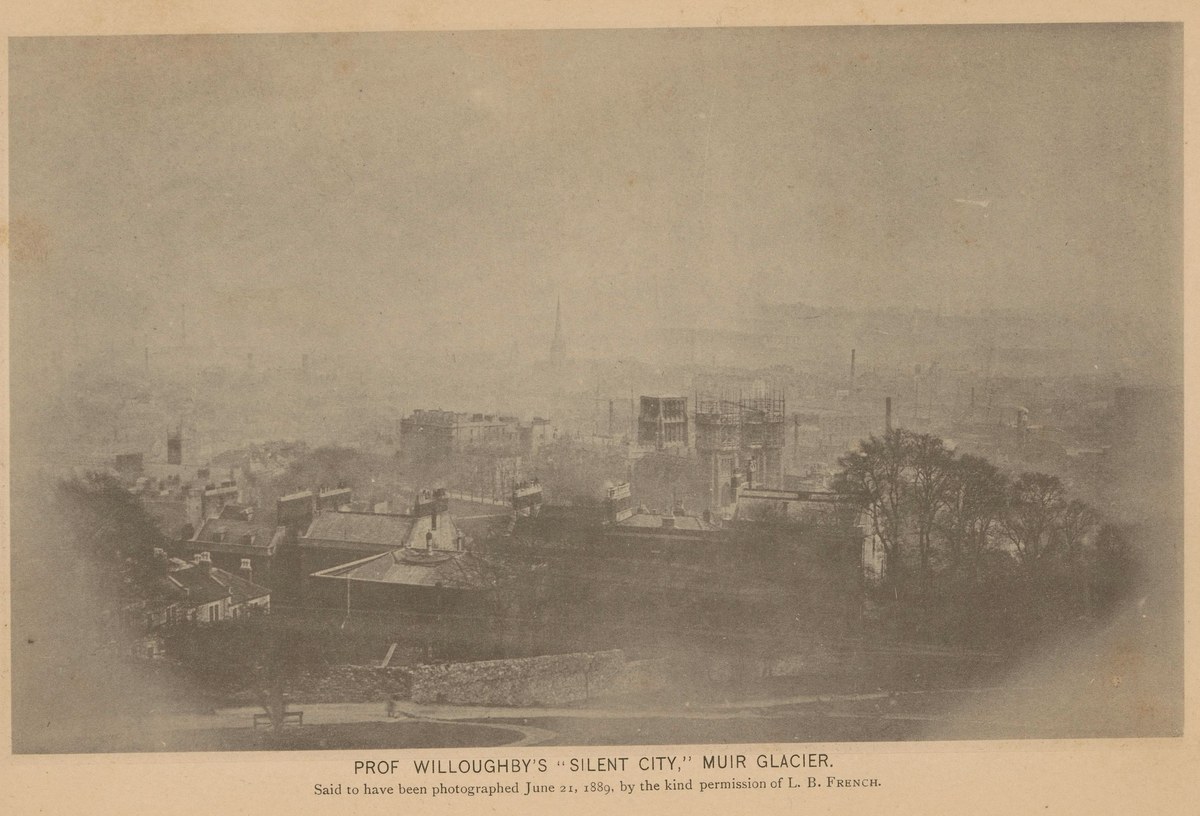

In 1896 the naturalist David Starr Jordan, president of Stanford University, paid seventy-five cents in Sitka, Alaska, for a souvenir photograph. It showed a city of tall houses, chimneys and church towers, faint and gray, as if seen through mist. According to the card, the city had appeared as a mirage in the air above the Muir Glacier, and a local prospector had managed to capture it on a glass plate. A year later Jordan explained in Popular Science Monthly exactly where the city really was.
The man behind the picture was Richard Willoughby, known around Juneau as Uncle Dick or the Professor. In a 2026 article for the Anchorage Daily News, the historian David Reamer describes him as the town’s leading character, a prospector with a long white beard and a booming voice who liked to tease tourists. Reamer recounts that when visitors complained about the rain, Willoughby would stare at the sky in mock astonishment and exclaim, “Why, Juneau is the driest place on Earth.” His name survives on Willoughby Avenue in Juneau and on Willoughby Island in Glacier Bay National Park.
A City in the Sky
Willoughby’s story of the city changed a good deal in the telling over the years. Reamer writes that after a visit to Glacier Bay in 1885 Willoughby returned to Juneau claiming to have seen a city of churches, castles and streets above the Muir Glacier, and that his neighbors mostly laughed it off as another tall tale. Jordan, relying on Willoughby’s own statement, dates the first sighting to June 1888 and says Willoughby saw the city several times from year to year.
The vision he described was remarkably detailed for something seen in the sky. Jordan records that Willoughby described a great city of brick and stone houses, a river with ships behind it and leafless elm trees in the foreground. In the center stood a large building with several towers, some wrapped in scaffolding, and Willoughby claimed he could follow the progress of the work from one season to the next.
The photograph followed, although its origins are just as tangled as the sighting. Reamer writes that around 1887, in Victoria, Willoughby bought a camera that came with a set of glass negatives already developed, and that in the summer of 1888 he returned from Glacier Bay with a picture of the mirage taken by a “secret process” he would not discuss. The Museum of Hoaxes gives a different version, in which he bought the equipment for $10 from a stranded English photographer. Jordan, by contrast, says Willoughby sent to San Francisco for a camera and plates.
Selling the Silent City
The prints sold well, and Willoughby did not work alone in marketing them. Reamer quotes the mining engineer Thomas Arthur Rickard, who wrote in 1909 that “An association of local men was formed at Juneau for the purpose of exploiting the discovery and of selling the prints struck off Willoughby’s wonderful negative.” The back of the card praised Willoughby as “the first American who discovered gold within Alaska’s icy-bound peaks,” a claim Reamer calls false. Rickard’s own explanation of the scheme was scathing. “His imaginative mind came to the aid of his loose morality, and from the union of the two arose the idea of a photograph of the Silent City vibrating in the tenuous air of Glacier Bay,” he wrote.
Reamer also points out what the name meant to buyers. In the 19th century a silent city usually meant a cemetery, or sometimes an abandoned city such as Pompeii, so customers were left to imagine for themselves where this ghostly place had come from.
The theories that appeared in the newspapers grew steadily wilder as the picture circulated. Jordan writes that some readers debated whether a distant city such as Montreal could have been brought into view by the Alaskan air, while others believed there must be an undiscovered settlement somewhere in Alaska or British Columbia. According to the Museum of Hoaxes, Willoughby himself suggested the city was the reflection of a real city thousands of miles away in Russia. Otto J. Klots, the chief astronomer of Canada’s Department of the Interior, replied that “such a thing as the reflections of a city thousands of miles away would be an utter impossibility.” When the San Francisco Examiner sent a correspondent to find the mirage for himself, the Museum of Hoaxes adds, he could not find anything.
The Science of Mirages
Part of what made the story believable is that mirages over ice are real. The World Meteorological Organization’s International Cloud Atlas explains that a superior mirage occurs over a surface much colder than the air above it, such as a snow field or a cold sea, and makes distant objects appear higher than they really are. It describes the Fata Morgana as “a very complex superior mirage, usually seen in polar regions,” in which objects are stretched, inverted and raised in changing patterns.
Australia’s Bureau of Meteorology notes that the Fata Morgana takes its name from Morgan le Fay, the sorceress of Arthurian legend, and that it can make ships beyond the horizon appear to sail in the sky. That effect is the usual explanation for the Flying Dutchman, as this site’s account of the phantom ship describes.
However, a real mirage could never have produced Willoughby’s picture. Reamer writes that mirages on glaciers are rare and appear mainly in winter temperature inversions, and that even complex ones show only limited features, nothing like the identifiable streets and buildings in the print. The card sold with the picture, meanwhile, claimed it was taken on the longest day of June 1888.
Unmasking Bristol
The first clue appeared in print in 1889. Reamer notes that when the San Francisco Chronicle reviewed the photograph that July, its reporter observed that “The style of architecture is decidedly modern, the roofs are like those of England.” The Museum of Hoaxes says the Chronicle later solved the puzzle when an employee of Wells Fargo wrote in to say he recognized the scene as Bristol, England, seen from a public park on Brandon Hill.
Jordan gathered further evidence of his own before he published in 1897. Charles H. Gilbert, the naturalist on the research ship Albatross, had questioned Willoughby about his methods. Willoughby told him the exposed plates had to soak for three months in a secret compound, in open daylight, and he seemed unaware of what a darkroom was for. Gilbert found the original negative to be “a very old, stained, and faded plate, apparently a negative which had been discarded because underexposed.”
The identification Jordan relied on came from his own university. William H. Hudson, a professor who had lived in Bristol, recognized the view as the city seen from Brandon Hill. He remembered the scaffolding around the towers of Bristol Cathedral during repairs some twenty years earlier, which explained the unfinished towers in the picture, and he also recognized the hotel and the church beside the cathedral. Jordan’s verdict was blunt. “A more transparent fraud could hardly be devised,” he wrote.
Why It Spread Anyway
However, exposure did little to stop the trade. Jordan observed that “The skeptical bought it as an original document in the natural history of mendacity,” while the credulous saw it as a wonder to rival the glacier itself. He also heard that in 1896 a group of people had camped on the glacier hoping to see the city, and he noted that they did not see it.
Some people even claimed to have seen the city with their own eyes. Reamer cites an 1889 statement to the Los Angeles Times by Robert Christie and George Patterson, who said they saw a city rise from the sea near Glacier Bay on July 2 of that year. “We are satisfied it was a mirage,” they said. Reamer notes that reports of the city continued as late as 1928, decades after the hoax was revealed. He compares the pattern to the flood of UFO reports that followed the first newspaper stories in 1947.
A public appetite for wonders that brushed doubt aside was familiar long before the Alaska boom. In 1835, as this site’s account of the Great Moon Hoax relates, other New York newspapers rushed to reprint the Sun’s invented reports of life on the moon because readers were so eager for them. And as this site’s account of the Cottingley Fairies shows, a set of faked photographs could win the endorsement of no less a figure than Sir Arthur Conan Doyle.
Willoughby did well from his invention. According to the Museum of Hoaxes, he sold the negative to a San Francisco photographer for $500 in 1890. Reamer gives Willoughby’s dates as 1832 to 1902 and says he died in Seattle, still playing tricks on strangers to the end, although the Museum of Hoaxes says he died two years after the sale.
The Silent City was a real place all along. It simply stood on the other side of the Atlantic, and the scaffolding that Willoughby presented as building work in a phantom metropolis had been put up to repair an English cathedral.
Get the Historic Mysteries newsletter, free
Unsolved cases, strange sightings and hidden history, straight to your inbox.
Sources
- Jordan, David Starr. The Silent City of the Muir Glacier. Popular Science Monthly, vol. 51, June 1897, via Wikisource.
- Reamer, David. The 19th-century Silent City hoax and the con-artist namesake of a Juneau street. Anchorage Daily News, October 4, 2026.
- Boese, Alex. The Silent City. Museum of Hoaxes.
- Mirage. International Cloud Atlas, World Meteorological Organization.
- Mirrors in the sky: Demystifying the legend of the Flying Dutchman. Bureau of Meteorology.
