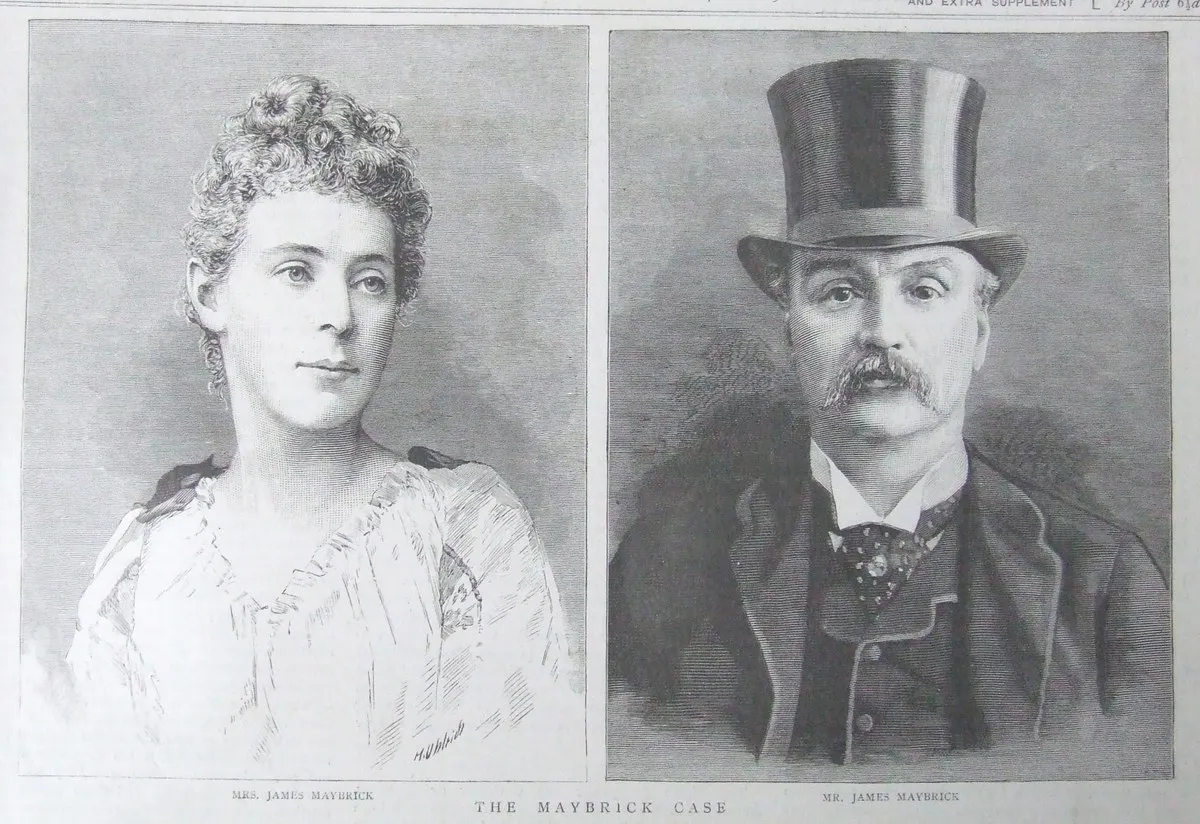

James Maybrick, a Liverpool cotton merchant, died at his home, Battlecrease House in Aigburth, on May 11, 1889, after a short illness that his doctors had treated as an upset stomach. Within days his American wife, Florence, was under arrest. By August she had been tried, convicted and sentenced to hang for murdering him with arsenic. The case has been argued over ever since, and the trial record shows why.
According to Dinah Birch’s 2014 review in The Guardian of Kate Colquhoun’s book on the case, Florence Chandler was a 17-year-old from Alabama when she met James Maybrick on an Atlantic steamer in 1880, and he was 23 years older than she was. They married in July 1881, his brother Michael told the court, and had two children. By 1889 the marriage was failing on both sides. Birch writes that James kept a long-term mistress in London. Florence had run up debts and begun an affair with a family friend named Alfred Brierley.
The Prosecution’s Flypapers
The trial opened in Liverpool on July 31, 1889, before Mr. Justice James Fitzjames Stephen, with John Addison leading for the Crown and Sir Charles Russell for the defense. In his opening speech, Addison built much of his case around flypapers, which at the time were sheets of paper treated with arsenic and soaked in water to poison flies.
Addison told the jury that around April 20 Florence bought a dozen flypapers from a local chemist, saying that “the flies had begun to be troublesome in the kitchen.” He said each paper held between 2 and 3 grains of arsenic. A housemaid then found papers soaking in a basin under a towel in Florence’s bedroom and called the nurse, Alice Yapp, to look. According to Addison, Florence later bought two dozen more in Cressington while her husband was ill in bed, and nobody in the house saw them again.
Addison also told the jury that a single fatal dose of arsenic would be “a dose of at least 2 grains and upwards,” while smaller doses given again and again could kill over time. He told the jury that arsenic had been found in a bottle of Valentine’s meat juice from the sickroom, and that a packet of arsenic labeled for cats turned up after the death.
A Patient Who Dosed Himself
The defense answered with James Maybrick’s own habits, and some of the Crown’s witnesses helped it. The family doctor, Arthur Hopper, agreed under cross-examination that James had a strong habit of taking almost any medicine recommended to him, often in larger doses than prescribed. Hopper said he had warned him that it was “a dangerous habit.” He added that James habitually took Fellows’ syrup, a tonic containing arsenic and strychnine.
Birch adds that James was a lifelong hypochondriac who took arsenic as Fowler’s Solution, at a time when small doses of poisons were widely thought to be invigorating. Michael Maybrick testified that Florence had once written to him that she had seen James taking a white powder. When Michael raised it with his brother, James answered, “Whoever told you that, it is a damned lie.”
A cosmetic explanation for buying arsenic was also familiar to Victorian courts. As this site’s account of the trial of Madeleine Smith describes, Smith also said she bought arsenic for her complexion before her lover died in Glasgow in 1857.
The Medical Evidence
The core of the defense was that nobody could show that James had died of arsenic. A case analysis printed in Florence Maybrick’s own memoir says the analysts found only about one-tenth of a grain in his body, far below the 2 grains Addison had given the jury as the smallest single fatal dose. Even Justice Stephen later remarked in his summing-up that everybody would be tempted to say “there was so very little of it.”
When the defense called its own doctors on August 5, Rawdon Macnamara, a former president of the Royal College of Surgeons in Ireland, told Russell he had given arsenic to patients in a very large number of cases. Asked by Addison what James had died of, he replied, “To the best of my judgment and belief, he died of gastro-enteritis,” and he added that it had no connection with arsenic. In cross-examination Addison got him to agree that the doctors called for the Crown had also diagnosed gastroenteritis, which left the dispute over its cause.
The Statement and the Summing-Up
Florence then made a statement to the jury herself. According to The Spectator of August 10, 1889, she said she had bought the flypapers to make a cosmetic wash and had put a powder in the meat juice because her husband begged her to. The magazine judged that the statement “only increased the presumption of her guilt,” and recounted the judge’s points that her counsel had not prepared the ground for it and that no powder had been found in the sickroom.
Justice Stephen’s summing-up lasted two days, and it has drawn the most criticism. Early in it, he told the jury that the prosecution had to prove that “the man died of poison, and the poison suggested is arsenic.” Near the end, he turned to her affair with Brierley and said it seemed horrible to ordinary innocent people to think “that a woman should be plotting the death of her husband in order that she might be left at liberty to follow her own degrading vices.” In the next breath he reminded them that they “ought not to convict a woman of such a crime as this unless you are sure in your own mind that she really committed it.”
Irving, who edited the trial record for the Notable English Trials series in 1912, judged the first part of the summing-up broadly favorable to the prisoner and the second part distinctly unfavorable. The jury was out for less than an hour and returned a verdict of guilty on August 7, 1889, and Florence was sentenced to death.
A Reprieve on a Reasonable Doubt
The reaction was immediate, and Florence’s memoir cites The Times of August 8, 1889, as saying that not one in three of the hundreds of thousands following the case had expected the verdict. It also says that nearly half a million signatures on petitions reached the Home Secretary, Henry Matthews, within about ten days.
Matthews then chose a course that satisfied almost nobody. In a statement the memoir reprints, the Home Office commuted the sentence to penal servitude for life because, “although the evidence leads to the conclusion that the prisoner administered and attempted to administer arsenic to her husband with intent to murder him, yet it does not wholly exclude a reasonable doubt” that arsenic had caused his death. Birch notes that Queen Victoria was indignant that “so wicked a woman should escape by a mere legal quibble.”
The doubts reached well beyond the petitioners and the newspapers. Russell, by then Lord Chief Justice, wrote to Florence in 1895 that he felt “as strongly as I have felt from the first that you ought never to have been convicted.” Stephen retired from the bench in April 1891, and the memoir quotes him as writing in 1890 that out of 979 cases tried before him, “the case of Mrs. Maybrick was the only case in which there could be any doubt about the facts.”
Evidence That Came Later
Her supporters later gathered new material, which the memoir prints. An 1878 prescription for an arsenical face wash, made up by a Paris chemist, was said to have turned up in a family Bible, which would support her account of the flypapers. In a sworn statement of 1891, an artist named Franklin George Bancroft said he had seen James put white powders in his wine in Virginia in the 1870s, explaining them as “Longevity and fair complexion, my boy!”
None of this material was ever tested in court, and it comes from a book written to clear her name. Arsenic was common in Victorian homes, from tonics to the green dyes that this site’s account of whether Napoleon was poisoned by his wallpaper explores. Birch writes that Battlecrease House was littered with poisonous medicines and that James received 20 separate doses of irritant poisons in his last week.
What the Case Left Behind
According to Irving, Florence Maybrick was released from Aylesbury prison on January 25, 1904. Her own book says she then spent the last months of her term at the home of the Community of the Epiphany in Truro and left it “a free woman” on July 20, 1904. Birch writes that she spent the rest of her life in America and died in 1941, poor and living as a recluse. She also notes that the case was one of the factors behind the later creation of a formal process for criminal appeals.
The trial belongs with other Victorian poison cases in which the science could not settle what a jury had to decide. As this site’s account of the Pimlico poisoning describes, a jury acquitted Adelaide Bartlett after her husband died in Pimlico on January 1, 1886, because the prosecution could not show how she had poisoned him with chloroform.
Colquhoun, Birch notes, offers no final answer, and the surviving record does not provide one either. It shows a husband who dosed himself with arsenic, a wife who bought and soaked flypapers, less than half a grain of arsenic in his body and a government that could not say he had been murdered. Whether Florence Maybrick tried to poison him is still argued. Whether the evidence proved that she killed him is a question the Home Office answered in 1889, when it said that it did not.
Get the Historic Mysteries newsletter, free
Unsolved cases, strange sightings and hidden history, straight to your inbox.
Sources
- Irving, H. B., ed. Trial of Mrs. Maybrick. Notable English Trials. Edinburgh and London: William Hodge, 1912. Internet Archive.
- Maybrick, Florence Elizabeth. Mrs. Maybrick’s Own Story. New York and London: Funk and Wagnalls, 1904. Project Gutenberg.
- Birch, Dinah. Did She Kill Him? review: a Victorian scandal of sex and poisoning. The Guardian, February 25, 2014.
- The Spectator, August 10, 1889, page 2. The Spectator Archive.
