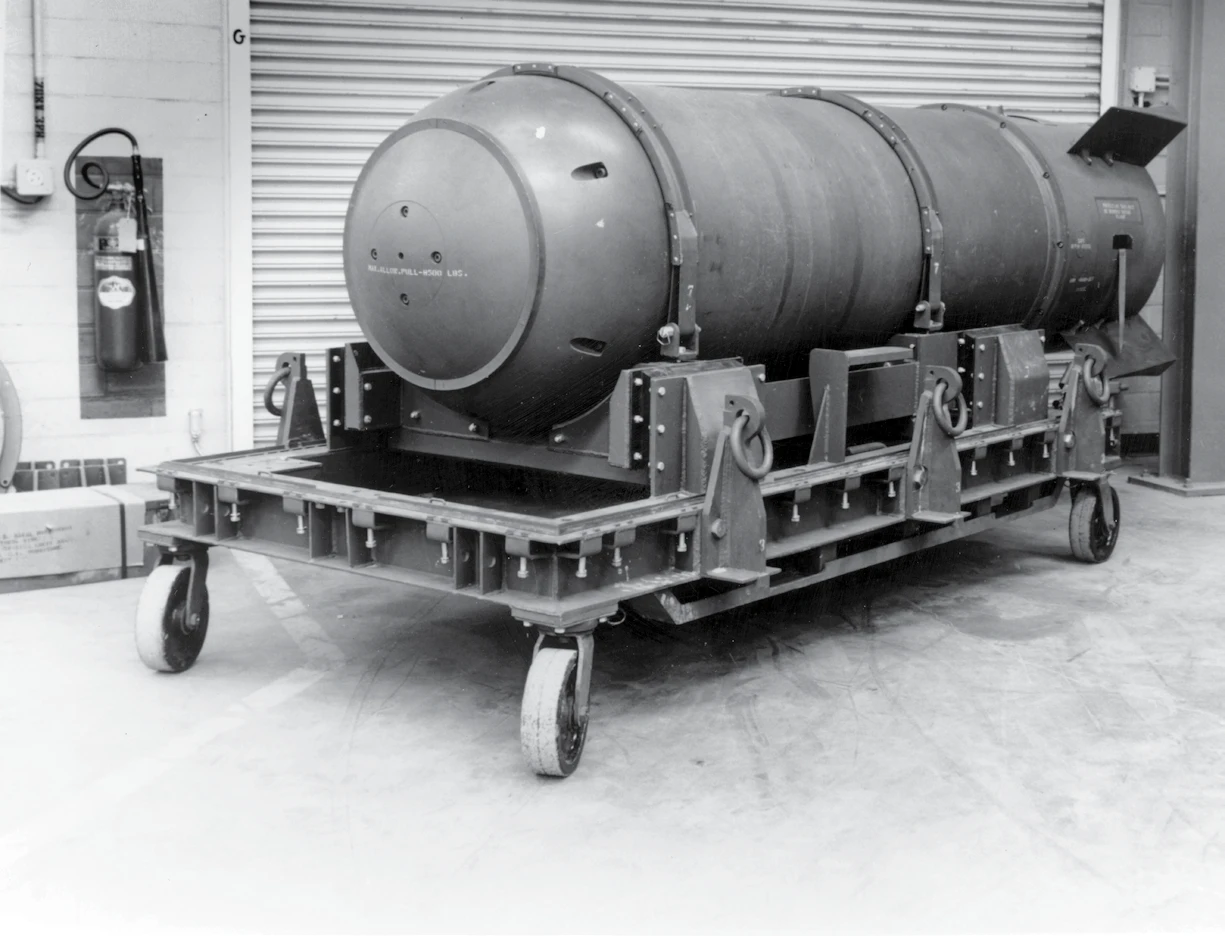

In the early hours of February 5, 1958, an Air Force B-47 bomber on a training flight collided with an F-86 fighter in the dark over South Carolina. The bomber limped toward Savannah, Georgia, and before landing its crew dropped the 7,600-pound weapon it was carrying into the water near Tybee Island. More than 60 years later the bomb is still there, and the question that has followed it is what exactly was inside.
According to the Air Force’s own 2001 assessment of the accident, the B-47 was flying a simulated combat mission from Homestead Air Force Base in Florida and carried a single Mark 15 Mod 0 bomb in what it calls a transportation configuration. The report says it was common practice to train with bombs in that state. A HistoryNet feature by Timothy Karpin and James Maroncelli names the crew as the aircraft commander, Major Howard Richardson, his copilot, First Lieutenant Robert Lagerstrom, and the radar navigator, Captain Leland Woolard. The arms control fact sheet discussed below calls Richardson a colonel.
A Collision in Good Visibility
The fighter belonged to an air defense squadron based at Charleston, and its job that night was to practice intercepting bombers. According to Karpin and Maroncelli, the pilot, First Lieutenant Clarence Stewart, had locked his radar onto the lead bomber of the pair and did not know he was diving toward the second one. When he looked up from his scope, he later recalled, he saw the sky “filled with airplane.” HistoryNet puts that moment at 12:33 a.m., matching the accident report’s 0533 Greenwich time, while the Air Force’s 2001 assessment gives approximately 2 a.m. for the collision.
The declassified accident report records that the weather around Savannah at the time was clear, “VFR in darkness with a full moon,” and that visibility “was exceptionally good.” Stewart ejected and, HistoryNet writes, came down in a swamp near Estill, South Carolina, after a long and freezing parachute descent. His fighter was destroyed, while the B-47 stayed in the air with a badly damaged right wing and a drooping engine. Five weeks later, HistoryNet writes, searchers found his radar recorder, which showed that the set had locked onto the wrong bomber, one more in a long line of failures of that technology. Air Force interceptor electronics had let pilots down before, as this site’s account of the Battle of Palmdale describes, when two F-89 Scorpions with a new fire-control system fired 208 rockets at a runaway drone in 1956 and failed to bring it down.
Why the Crew Dropped It
Richardson regained control at about 20,000 feet and headed for Hunter Air Force Base near Savannah. The 2001 report states that three attempts to land there were unsuccessful and that the bomb was jettisoned to avoid the possibility that its conventional charge would detonate in a crash landing. HistoryNet adds that the runway at Hunter had an unfinished 18-inch concrete lip at the end where the bomber would touch down.
The drop was made at about 7,200 feet and roughly 200 knots, according to the Air Force, and the crew saw no explosion. In the version of the accident report released in 2017, the passage around the drop is still partly blacked out, but one surviving line notes that “the unit jettisoned off Tybee Beach southeast of Hunter Air Force Base.” HistoryNet writes that the tower then passed on permission from Strategic Air Command to drop the weapon, but only 20 miles out over the Atlantic, and that Richardson replied it was too late.
The bomber finally landed safely at Hunter, and the crew walked away from it. Within hours, HistoryNet writes, the commander of Strategic Air Command, General Thomas Power, had flown in with his staff to deal with the incident. Karpin and Maroncelli write that the drop points recorded by Richardson and Woolard later showed little match, and they quote an explanation from the documentary America’s Lost H-Bomb that the damaged engine had supplied half the power to the radar. “So we ended up with a very distorted radar picture.”
Nine Weeks of Searching
The Air Force report says the search ran from February 6 to April 16, 1958, over a three-square-mile area in water between about 8 and 40 feet deep. The Air Force’s 2700th ordnance disposal squadron and roughly 100 Navy personnel worked with hand-held sonar and with galvanic drag and cable sweeps. On April 16 the bomb was formally written off as irretrievable.
The men in the boats had very little to go on. HistoryNet writes that the bomb struck the water at a little less than 500 miles per hour and plowed into the silty bottom. Art Arseneault, a former officer in one of the Navy’s ordnance disposal units, recalled years later that a general showed him a map with a pencil mark off Savannah. “The only problem with that was the pencil mark was a half mile wide and four miles long,” he said, as quoted by HistoryNet. Department of Energy specialists, cited in the 2001 assessment, later estimated that the bomb had probably buried itself nose down, perhaps 5 to 15 feet under the seabed.
What Was Inside
The heart of the dispute is the nuclear capsule. The Air Force explains that the Mark 15 used a removable capsule, which was needed for a nuclear explosion and was not present in a transportation configured bomb. It cites an Atomic Energy Commission transfer of custody receipt dated February 4, 1958, as confirming that no capsule was aboard. The report does say that the casing held a conventional charge of about 400 pounds as well as uranium, which it treats as a heavy metal hazard.
HistoryNet quotes the receipt Richardson signed, which committed him to “allow no assembly or disassembly of this item while in my custody, nor will I allow any active capsule to be inserted into it at any time.” It adds that the word “simulated” was written on the line reportedly used for the capsule. The Air Force also argues that the weapon was a Mod 0. Conversion kits for the later Mod 2, which had a non-removable capsule, were not ready until December 1957, and conversions did not begin until March 1958.
Doubts about that conclusion have persisted for decades, and some of them came from inside government. HistoryNet reports that in April 1966 the assistant to the secretary of defense for atomic energy wrote to the Congressional Joint Committee on Atomic Energy that the bomb was a complete weapon, then retracted the claim after the Air Force gave him further data. The Center for Arms Control and Non-Proliferation, in the 2023 fact sheet, reads the same episode more darkly and says documents released in 1994 showed a fully functional bomb. The two sources also disagree on its potential yield, with HistoryNet giving 1.69 megatons and the fact sheet up to 3.8.
Why It Was Left There
The issue returned in August 2000, when Representative Jack Kingston of Georgia asked the Air Force to look again. Its 2001 assessment drew on the Navy, the Department of Energy, the Army Corps of Engineers and the Skidaway Oceanographic Institute. Its conclusions were firm. The Energy Department found that there is “no current or future possibility of a nuclear explosion,” that the risk from the heavy metals was low, and that the conventional charge posed no hazard if left undisturbed.
The same report warned that disturbing it would be another matter. An intact charge, it said, would pose a serious explosion hazard to anyone trying to recover the bomb. The Navy’s salvage chief estimated a “very low possibility of successfully locating the bomb,” and a search and recovery would probably cost more than $5 million. The Air Force recommended leaving the bomb where it lay. Karpin and Maroncelli reach a similar view by another route, arguing that the impact must have caused massive internal damage and that decades of seawater would have corroded the casing.
That decision looks striking when set beside other recoveries of Cold War hardware from the sea. As this site’s account of Project Azorian describes, the CIA built a giant claw to lift a Soviet missile submarine from a seabed 16,500 feet down. The Tybee bomb lies under no more than about 40 feet of water, yet the Air Force concluded that finding and raising it would be more dangerous than leaving it buried.
Private Searches
Some local residents and amateur investigators were never satisfied with the official answer. According to the arms control fact sheet, the retired Air Force pilot Derek Duke took up the search in 2004 and detected radiation seven to ten times higher than normal about a mile off Tybee. The fact sheet says the readings were later put down to naturally occurring minerals, and that a government search of the area in 2004 found nothing.
The Tybee bomb is also far from the only weapon of its era to go astray. As this site’s account of how the US misplaced six nuclear bombs describes, the Savannah accident was one of several Cold War incidents, beginning in 1950, in which American aircraft dropped or misplaced weapons or their nuclear components.
Richardson received the Distinguished Flying Cross for bringing his aircraft home, HistoryNet writes. The official record says the bomb could never produce a nuclear explosion, and the arguments about its capsule rest on paperwork that cannot be tested against the weapon itself. Until someone finds the casing in the silt of Wassaw Sound, the documents are all anyone has.
Get the Historic Mysteries newsletter, free
Unsolved cases, strange sightings and hidden history, straight to your inbox.
Sources
- Air Force Nuclear Weapons and Counterproliferation Agency. Air Force Search and Recovery Assessment of the 1958 Savannah, GA B-47 Accident. April 12, 2001. The Black Vault (PDF).
- Department of the Air Force. B-47/F-86L aircraft mishap report, February 5, 1958, 2017 release. The Black Vault.
- Karpin, Timothy, and James Maroncelli. Feature on the 1958 Tybee broken arrow, subtitled “Should You Be Worried?” HistoryNet.
- Schumann, Anna. Fact Sheet: The Missing Tybee Bomb. Center for Arms Control and Non-Proliferation, June 20, 2023.
