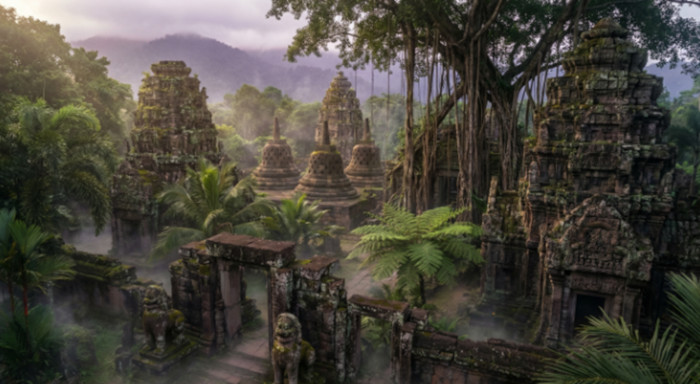
Within the dense tropical jungles of Johor, Malaysia, near the Linggiu Reservoir, lies a mystery that has captivated many in the region and beyond. Is it possible that a massive ancient city, perhaps even older than the famed Angkor Wat in Cambodia or Borobudur in Indonesia, remains hidden beneath the dense canopy? This is the legend of Kota Gelanggi, an alleged ancient site that has sparked intense debate and tantalizing theories. While some claim it was a crucial capital of the mighty Srivijaya Empire, others argue it might be nothing more than a myth. What exactly is Kota Gelanggi, who built it, and what secrets might it hold?
The Discovery of a Lost City
The modern fascination with Kota Gelanggi began in earnest in 2004 when Raimy Che-Ross, an independent researcher based in Canberra, Australia, published a paper titled The “Lost City” of Kota Gelanggi in the Journal of the Malaysian Branch of the Royal Asiatic Society.
Che-Ross, an accredited translator of ancient Malay manuscripts, was led to the site by an old Malay manuscript once owned by Sir Stamford Raffles, the founder of Singapore. Using aerial photographs and remote sensing satellite imagery from the Malaysian Centre for Remote Sensing (Macres), he claimed to have identified unusual vegetation patterns and potential structures buried beneath the jungle floor. He suggested these structures were far more extensive than anyone had previously imagined, covering an area of around 140 square kilometers (54 square miles) of forest reserve surrounding Sungai Madek and Sungai Lenggiu.
This revelation sent shockwaves through the historical community. According to Che-Ross and ancient folklore, the city (also known as Klang Kiu or the “City of Black Stone” (Kota Batu Hitam)) was a significant trading post and a center of sacred learning. The Sejarah Melayu (Malay Annals), revised in 1612 by Tun Seri Lanang, the Bendahara of the Royal Court of Johor, also mentions a city on the upper reaches of the Johor River with a fort made of black stone.
The name “Kota Gelanggi” itself is believed to derive from the Malay mispronunciation of the Thai word Ghlong-Keow, meaning “Box of Emeralds”. Ancient Chinese manuscripts also referenced the city, describing it as a place of shining black stone, while Chinese maps dating to 1600 AD placed it somewhere on the Malay Peninsula.
- Read more: The Lost Kingdom of Gangga Negara: Reality or Fiction?
- Read more: Ban Chiang: How did Farming arrive in South East Asia?
The Builders: The Srivijaya Empire
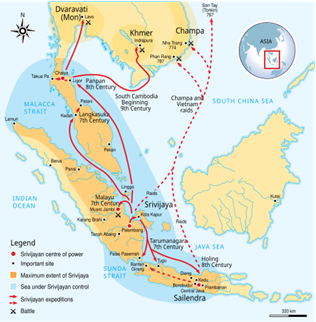
If Kota Gelanggi does exist, who were its builders? The prevailing theory links the city to the Srivijaya Empire, a powerful Buddhist kingdom that dominated the Malay-Indonesian archipelago from around 650 to 1377 AD. Srivijaya was renowned as a critical center for the expansion of Buddhism and a major maritime trading hub connecting China, Southeast Asia, and India. The Chinese often referred to it as Jinzhou, or the “Gold Coast,” because of the great reserves of gold found there. Some speculate that Kota Gelanggi might have been the very first capital of this ancient empire, making it one of the oldest kingdoms in the Malay Peninsula.
The Srivijaya Kingdom was also famous for its practice of Vajrayana Buddhism, the Tantric school of Mahayana Buddhism, and it produced many notable scholars. A Tang dynasty Chinese monk, I-tsing, wrote that he visited Srivijaya in 671 AD and found more than 1,000 Buddhist priests in its capital city. If Kota Gelanggi was indeed a Srivijayan city, it would have been a vibrant center of commerce and religion, filled with Hindu and Buddhist statues, figurines, and epigraphic inscriptions carved in granite. The empire’s decline began in 1025 AD after a series of raids by the South Indian Chola Dynasty conqueror Rajendra Chola I, who, according to ancient Tamil inscriptions, raided the city after destroying the Malay Kingdom of Gangga Negara.
- Read more: Ciudad Perdida: Colombia’s Lost City of the Tairona
- Read more: Who Built the My Son Sanctuary, and What did they Believe?
What Was Found and Why Is It Special?
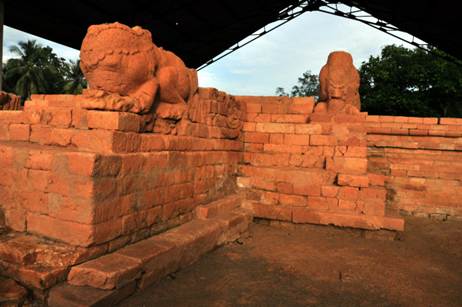
The physical evidence for Kota Gelanggi remains a subject of intense controversy. While Che-Ross pointed to satellite imagery and aerial photos showing potential structures, a government-appointed research team conducted a month-long study in July 2005 and reportedly found no trace of the “Lost City”. However, the authorities did not categorically deny its existence, only stating that research carried out until then had not found any evidence. Notably, three elder Orang Asli headmen from the Linggiu Dam area insist the city exists. Tuk Batin Abdul Rahman, 85 at the time, stated:
“The city is very large, I have seen it myself because it was located near my village. I estimate its fort to be approximately forty feet square, with three holes like windows along its walls”.
He said he first stumbled across the fort in the 1930s while foraging for jungle produce.
Despite the lack of formally excavated ruins, tantalizing clues persist. Artifacts found downstream from the alleged site, kept by the Johor Heritage Foundation, confirm that the area was once a trading post. Furthermore, an intriguing connection has been made to a 1,000-year-old manuscript from Nepal, The Perfection of Wisdom in 8,000 Lines (Astasahasrikaprajnaparamita), dated 1015 AD. This Sanskrit palm-leaf manuscript – one of the oldest dated illustrated manuscripts in the world – contains an illustration of a former Buddha, Dipamkara, standing in a temple in “Java” (a term that then encompassed Sumatra and the Malay Peninsula). R.C. Jamieson, Keeper of Sanskrit Manuscripts at the University of Cambridge, suggested that this unidentified temple could possibly be Kota Gelanggi, stating:
“If they were the one and the same, it would be a fabulous discovery”.
The city was also mentioned in the book Strange Countries from the Cambridge Library Rare Books Collection, which described a stupa-like, multi-tiered structure 32 zhang high (approximately 107 meters) surrounded by 300 graves.
Whether Kota Gelanggi is a tangible ruin waiting to be unearthed or a captivating legend woven into the fabric of Malaysian history, it remains a compelling enigma. The convergence of ancient manuscripts, satellite imagery, indigenous testimony, and historical records suggests that something significant lies beneath the jungle canopy of Johor – something that, if properly excavated, could rewrite our understanding of Southeast Asian civilization.
Top image: A representation of how the ruins of Kota Gelanggi might look, if found and excavated. Source: AI Generated
By Gary Manners
References