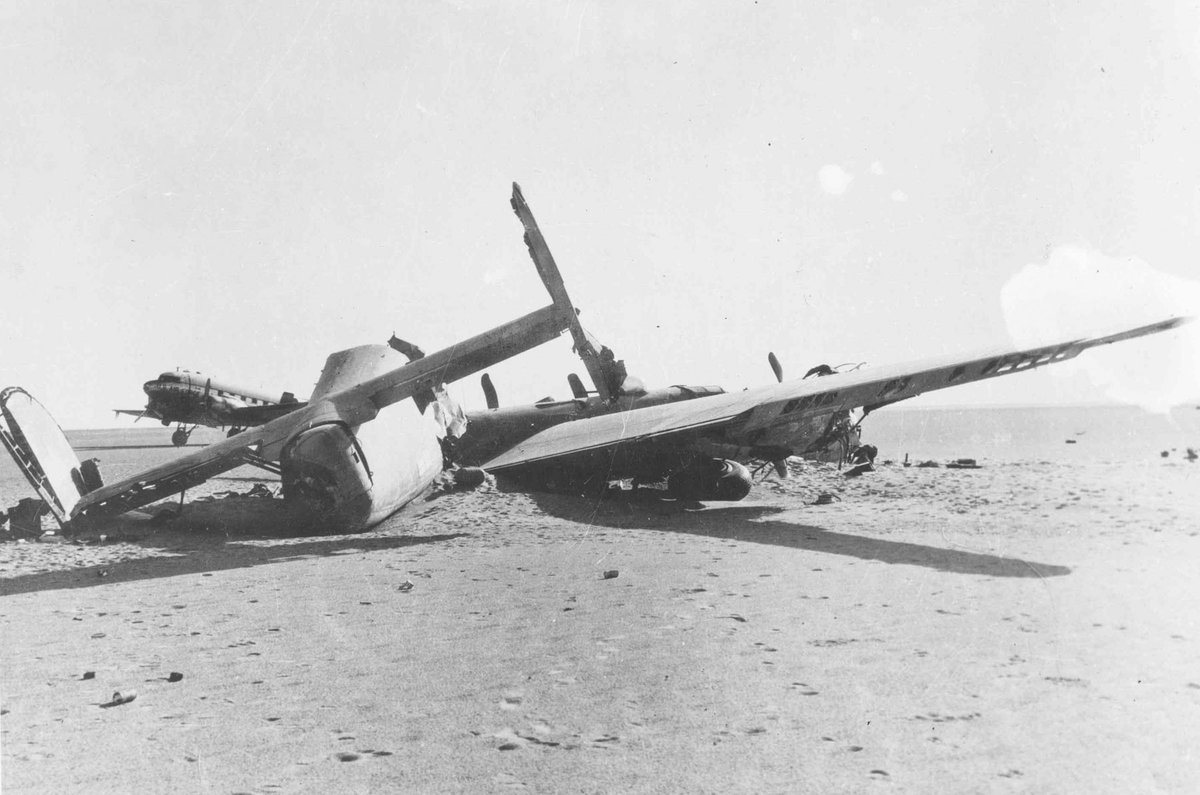
The Lady Be Good is one of the most haunting stories of the Second World War, a brand new American bomber that took off for Italy in April 1943 and never came home. Her crew of nine was presumed to have gone down somewhere in the Mediterranean. Then, 15 years later, oil prospectors flying over the Libyan Sahara spotted the shape of a B-24 lying on the sand hundreds of miles from the sea.
The wreck was in such good condition that one searcher fired its machine guns and its radio still worked, yet the men themselves were gone. Writing in the Air University Review in 1973, the Air Force analyst William Holder put the disaster down to “a weird combination of mistakes and circumstances, a one-in-a-million fatal combination.” He also repeated tales of a jinx that seemed to follow her salvaged parts. But did the Lady Be Good fall victim to bad luck, or to a navigation error that nobody on the ground thought to question?
Mission 109 to Naples
The so-called Lady Be Good was a B-24D Liberator, serial number 41-24301, flown by a new crew of the 514th Bomb Squadron, 376th Bomb Group. She was based at a desert airstrip at Soluch near Benghazi in Libya. According to the National Museum of the United States Air Force, 25 B-24Ds took off from Soluch at 2:50 that afternoon on April 4, 1943, to bomb the harbor at Naples. “All planes but one returned safely to Allied territory that night,” the museum’s fact sheet says.
The aircraft was so new that she had flown only a few test flights, and Holder recorded that Mission 109 was her first combat mission. The pilot was Lieutenant William Hatton, with Lieutenant Robert Toner as copilot, Lieutenant DP Hays as navigator and Lieutenant John Woravka as bombardier. Technical Sergeants Harold Ripslinger and Robert LaMotte and Staff Sergeants Guy Shelley, Vernon Moore and Samuel Adams made up the rest of the crew.
Only 11 of the Mission 109 planes ever reached Naples, and the other 14 turned back to Soluch or landed on Malta. The Lady Be Good is believed to have turned around some 30 minutes short of the target, and then, as Holder put it, “the great mystery begins.”
A Heading of 330 Degrees
Later that night Hatton radioed for help, and according to the National Archives he reported that the bomber’s automatic direction finder was “no longer operating correctly.” The control tower at Benina gave him a heading of 330 degrees, north by northwest. That heading should have brought a plane over the sea straight back to the coast. However, Holder explained that the direction finder on the ground could not tell a signal coming from 330 degrees from one coming from the reciprocal position of 150 degrees.
Because Hatton thought he was still over the water, the correct fix of 150 degrees was never considered. In fact, wrote Holder, the Lady Be Good “was already over the desert south by southeast at 150 degrees when the pilot radioed the tower.” At night it is extremely difficult to tell sea from sand. The wind had also shifted during the mission, so a strong tailwind was probably mistaken for a headwind and the crew had little reason to worry about how long the trip home was taking.
The cruelest detail of all is that people on the ground heard her go. Holder wrote that her engines “were apparently heard droning overhead by several ground personnel as she flew south to her end.” Yet the air-sea rescue effort was sent out over the sea along the same 330-degree course, and he asked a pointed question:
“Since the Lady was heard flying south, why didn’t the search extend south as well as north?”
As the fuel ran down, the engines died one at a time, and investigators later found the propellers of engines 1, 2 and 3 set to feathered. With only one propeller turning, the crew bailed out into the dark. The empty bomber carried on alone until it struck a gravel plain and skidded for about 700 yards (640 m), breaking its back just behind the wings.
Found in the Sand Sea
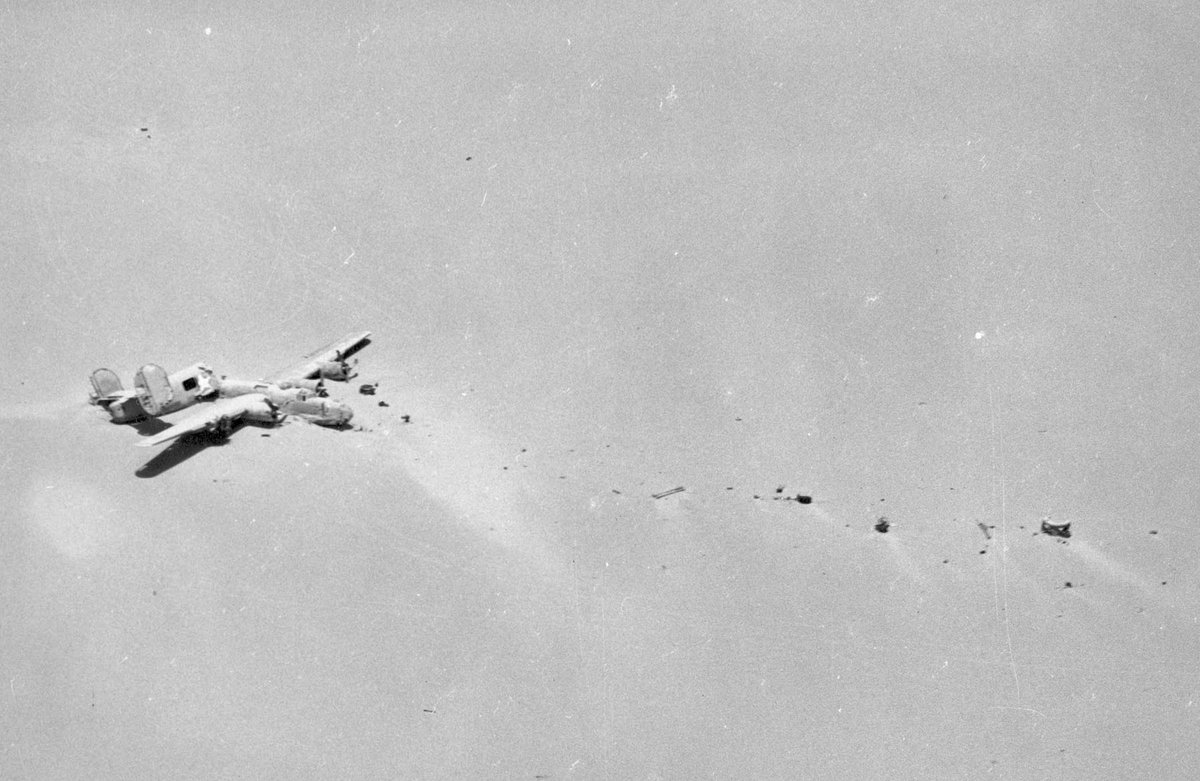
In 1958 British geologists working for the D’Arcy oil company spotted a B-24 on the hardpan of the Libyan Sahara, about 440 miles (708 km) southeast of Benghazi according to Air and Space Forces Magazine. The Air Force museum puts it at about 400 miles (644 km) south of Soluch. The sources disagree on the date, with the museum giving November 9, 1958 and the Army’s Quartermaster Foundation giving May, though a ground party reached the plane early in 1959.
The men who drove out to the site found the bomber broken in two and otherwise in remarkable condition. Holder wrote that its radio was later fitted to the recovery C-47, where it worked perfectly, and that when one searcher pulled the trigger of a machine gun, “tracers went zooming out across the desert.” A thermos jug three-fourths full of coffee sat on the floor at the flight engineer’s position. However, there was no sign of the crew.
The search for the men began in May 1959. It was led by Captain Myron Fuller and the civilian anthropologist Wesley Neep of the Quartermaster mortuary in Frankfurt. In heat that reached 130°F (54°C), searchers found a pair of flight boots 19 miles (31 km) north of the wreck, left close together with their toes pointing north. Further on were parachutes cut into arrowheads and weighted down with stones, and one harness section had Moore’s name stenciled inside. The final report of that search concluded that “the crew members perished in the sand dunes and have been covered by the sands.”
The Diaries in the Dunes
In February 1960 a team working for British Petroleum came across the remains of Hatton, Toner, Hays, Adams and LaMotte, about 78 miles (126 km) from where they had jumped by the Air Force museum’s count. The Army’s accounts give 85 miles (137 km). But it didn’t end there. Among their belongings was a small diary kept by Toner, and its brief entries recorded what had happened after the jump.
The men had come down at about 2 o’clock in the morning on April 5, and in his first entry Toner wrote that there was “no one badly hurt, can’t find John, all others present.” The eight who found each other had half a canteen of water between them, rationed to “1 cap full per day” as they walked northwest. They walked by night and rested in the heat, and by Wednesday Toner was recording “prayers all the time.”
On Thursday they reached the sand dunes, and Ripslinger, who also kept a diary, wrote “Can’t hold out much longer without aid.” The next day Toner recorded that the three strongest would go on alone, writing “Shelley, Rip, Moore separate and try to go for help, rest of us all very weak, eyes bad.” His final entry was dated Monday, April 12, and it read simply “No help yet, very cold nite.”
Desert survival experts had predicted that the airmen could only have moved 25 or 30 miles (40 to 48 km) on foot. The Air Force museum later noted that “they had lived eight days rather than only two expected of men in this area with little or no water.” In May 1960 Shelley was found by a British Petroleum work party. Five days later the Army and Air Force search known as Operation Climax found Ripslinger in the dunes. According to Air and Space Forces Magazine, Shelley had walked a total of 115.5 miles (186 km) from the bailout point.
In August another oil team found Woravka about 12 miles (19 km) north northeast of the wreck. He was still in his flying suit, attached to a parachute that the Quartermaster Foundation said appears to have failed to open properly.
A Navigator’s Error, a Jinx or a Flak Hole?
Holder was blunt about where much of the blame should fall. He wrote that the nearly blank log sheet kept by Hays for the return leg “certainly indicts him.” The National Archives account puts more weight on the failed direction finder, and Hays, like everyone else aboard, was flying his first combat mission. Holder also believed that the men would probably have survived if they had stayed with the bomber, its radio and its stores.
A more peculiar clue surfaced long after the crash. McDonnell Douglas technicians examining one of the recovered engines found a flak hole “probably caused by a 20-mm cannon shell” in the rocker box cover. According to Holder, this “suggests that the Lady may have made it to the target area and encountered enemy fire.” That sits awkwardly with the accounts that she turned back short of Naples, and it has never been explained.
Then there is the so-called jinx that clung to her salvaged parts. According to Holder, her radio went into a C-47 that, the story goes, later crashed. Servomotors went into a C-54 that had to dump its cargo after an engine failed, and an Army Otter carrying her armrests crashed into the Gulf of Sidra with its ten men. Holder offered these as stories rather than findings, and he added that “it is said that native caravans skirt the site of the crash because they believe it is haunted.”
The remains of Staff Sergeant Vernon Moore have never been found, even though the 1960 search covered about 6,300 square miles (16,300 sq km). In 2001 a former British serviceman told the author Mario Martinez that his army convoy had photographed and buried a skeleton in the Calanscio Sand Sea in 1953. Martinez sent the photograph to London’s Natural History Museum, where an osteologist concluded that “Unfortunately it is not possible to determine with certainty whether the human remains shown in the photograph are those of Staff Sergeant Vernon L. Moore.”
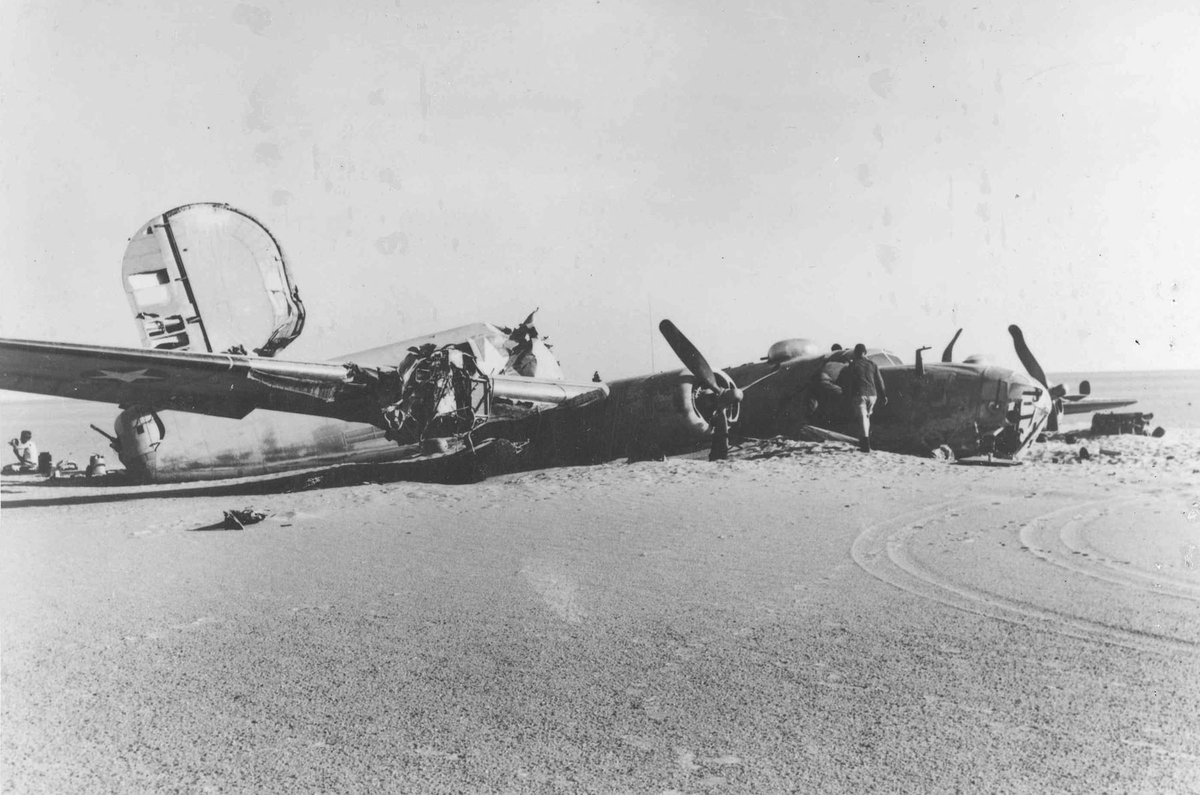
The wreck itself was removed from the desert in August 1994 and taken to a military barracks in Tobruk. A stained glass window dedicated to the crew at Wheelus Air Force Base was later sent to the Air Force museum in Ohio. How a crew on its first mission flew so far past home, and where the ninth man lies in the sand, still remains a mystery.
Established: The Lady Be Good failed to return from the Naples raid of April 4, 1943, overflew her base into the Libyan desert and was spotted there by oil geologists in 1958. Eight of her nine crew were found in 1960, and Toner’s and Ripslinger’s diaries record their walk. The ninth, Vernon Moore, has never been found.
Disputed: Whether the faulty direction finder, the misread bearing from Benina or the navigator’s record keeping did most to send the bomber south. Holder blamed the navigator’s log, while the National Archives account stresses the failed direction finder.
Unverified: That a flak hole found in one engine means the bomber reached the target area and came under fire, which conflicts with accounts that she turned back short of Naples.
Unverified: That a skeleton buried by a British army convoy in the Calanscio Sand Sea in 1953 was Vernon Moore. A photograph of it could not be identified.
Unverified: That salvaged parts from the Lady Be Good carried a jinx into the C-47, C-54 and Otter aircraft that later crashed or failed.
Fringe: That the crash site is haunted, as caravan legends are said to claim.
By Historic Mystery
Read next: The Valentich Disappearance
Sources
- National Museum of the United States Air Force, Lady Be Good, fact sheet 196178
- Kaitlyn Crain Enriquez, on the story of Lady Be Good and her crew, The Unwritten Record, National Archives blog (June 16, 2017)
- William G. Holder, Epitaph to the Lady, 30 Years After, Air University Review (March and April 1973)
- US Army Quartermaster Foundation, Lady Be Good B-24 Bomber, Quartermaster Graves Registration Search and Recovery
- Lady Be Good, Air and Space Forces Magazine (2014)
- The Diaries, transcripts of the diaries of Robert Toner and Harold Ripslinger, LadyBeGood.net
- Mario Martinez, Are These the Remains of Vernon Moore? (2002)
- Wikimedia Commons, Tail view of the crashed Consolidated B-24D Lady Be Good, U.S. Air Force photo
- Wikimedia Commons, Lady Be Good Wreckage Discovery, U.S. Air Force photo
- Wikimedia Commons, Side view of the crashed Consolidated B-24D Lady Be Good, U.S. Air Force photo


