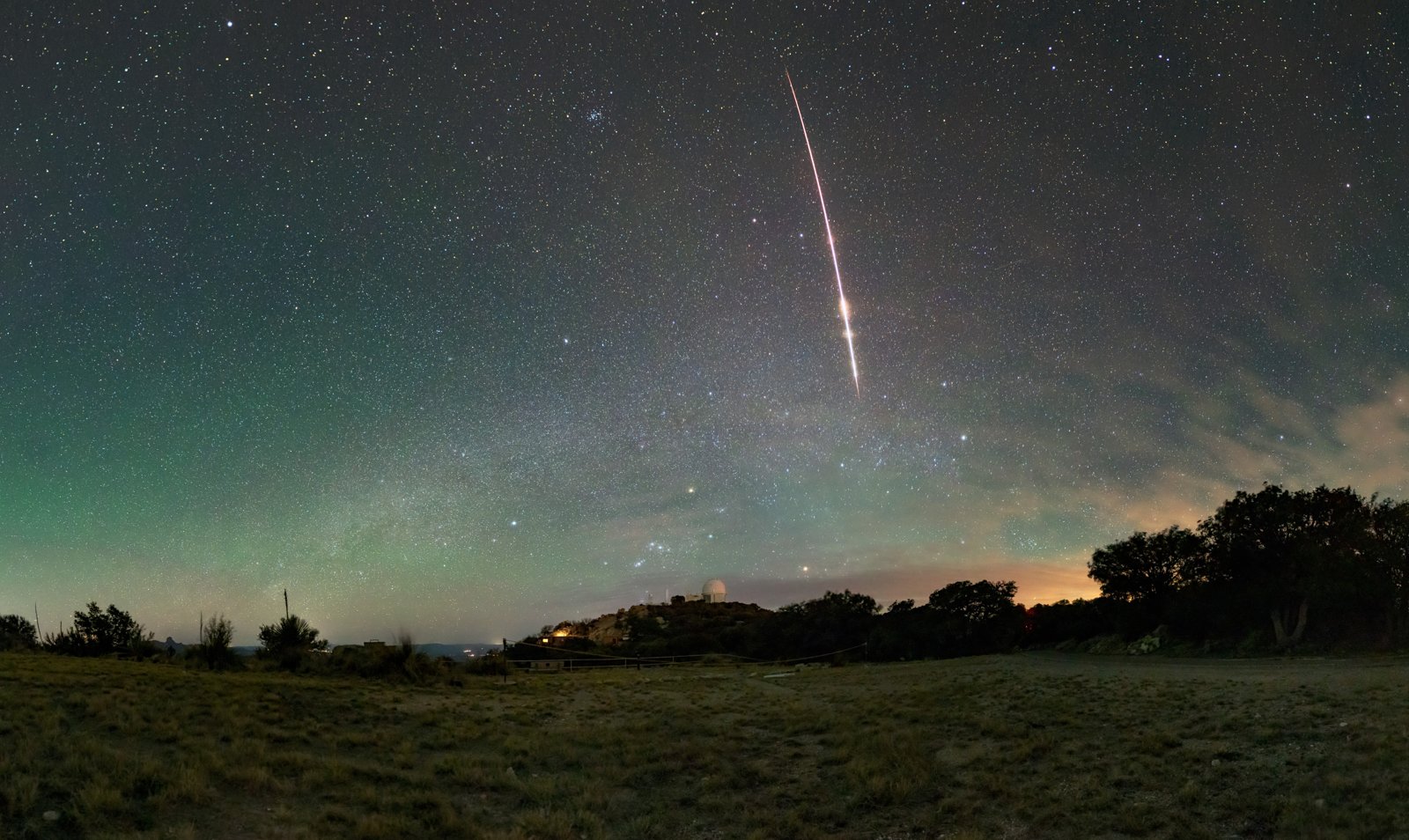

On December 9, 1965, a fireball blazed across the late afternoon sky over Ontario and several US states, and people in the small Pennsylvania village of Kecksburg said something came down in the woods outside town. Armed men roped off the area that night, and an Air Force memo later recorded that the search turned up nothing at all. So why has the story of an acorn-shaped object hauled away on a military truck refused to fade for more than 60 years, and what, if anything, was actually recovered?
According to an Air Force memo quoted by the Associated Press in 2007, the late-night search on December 9, 1965 ended empty-handed. “They could not find anything,” the memo stated, a line that has sat at the center of the official account ever since. The Pittsburgh Post-Gazette put the problem plainly in 2015 when it noted that the authorities called the object a meteorite, adding “That official claim has been challenged but never changed.”
The case matters because it pits careful astronomy and thin government paperwork against vivid local memory, and because a federal court eventually had to order NASA to look harder for its own records. The caveat is that much of what is told about Kecksburg rests on recollections gathered years or decades after the event, and those accounts do not always agree with one another.
What Did People See on December 9, 1965?
The fireball itself is not in doubt, and a NASA record for the Soviet spacecraft Cosmos 96 describes a fireball seen over southwestern Ontario and at least eight states from Michigan to New York at 4:43 p.m. Eastern time that day. The Pennsylvania Center for the Book at Penn State notes that sightings came in from places as far apart as Indiana, New York, Virginia and Ontario. It adds that the Associated Press reported small fires in Ohio and Pennsylvania blamed on falling debris.
In Kecksburg, about 40 miles southeast of Pittsburgh by the Associated Press count, residents reported that the object landed in a wooded hollow. As reported by the Post-Gazette, the first people on the scene described something made of metal, between 10 and 12 feet long and generally shaped like an acorn, with strange markings on a band near the bottom that resembled hieroglyphics. One local account recorded by the Pennsylvania Center for the Book says the object turned in the sky “just like it was controlled” before it came down.
The same Post-Gazette report noted that the years have muddled some recollections, and the accounts diverge on basic details. A newspaper reporter sent to the scene that night told the paper the object he saw leaving on a truck was far smaller than the popular description. “It was small, the size of two suitcases,” he recalled, while others described something closer to the size of a Volkswagen bus.
Why Did the Military Go to Kecksburg?
The armed presence is the part of the story that residents found hardest to forget. The Post-Gazette reported that more than two dozen armed military men arrived and took charge, and the Pennsylvania Center for the Book notes that people who walked into the woods were turned back before the Army announced that nothing had been found. Pittsburgh’s Post-Gazette also recorded claims that men in radiation suits carried a box down into the hollow, although those claims come from witness memories rather than any released document.
The paper trail that does exist sits partly in the files of Project Blue Book, the Air Force UFO investigation that closed in 1970. Journalist Leslie Kean, who later sued NASA over the case, quoted a Blue Book memo for the record dated December 10, 1965, in which the Pentagon asked what it could tell the public. The memo reads “Major Quintanilla said that it was Ok to call it a meteor that entered the atmosphere. He said that investigation is still under way. There was no space debris which entered the atmosphere on 9 December 1965.”
Kean argued that the memo showed a habit of labeling events as meteors before investigations were finished. Neither reading is proven by the memo itself, which records a search, a meteor explanation and an open file all at once. That leaves the military visit indicative rather than conclusive, since soldiers checking a reported crash would leave much the same footprint whether they found something or nothing.
Was It a Meteor, a Soviet Probe or a Spy Capsule?
The meteor explanation has the strongest scientific footing. Von Del Chamberlain of the Abrams Planetarium at Michigan State University and his colleague David J. Krause gathered more than 150 descriptions, sent questionnaires to witnesses and used photographs of the smoke trail taken from two spots in Michigan to calculate the path of the fireball. Their method was summarized by amateur astronomer Tim Printy in 2006. Their work, published in 1967 in the Journal of the Royal Astronomical Society of Canada, concluded that many of the reports of debris falling in Ohio and Pennsylvania were wrong.
NASA’s own record for Cosmos 96 echoes that work. It states that the path was “probably too steep to be consistent with a spacecraft re-entering from Earth orbit” and was more likely a meteor that ended over western Lake Erie. The same record warns that “estimating the impact point of fireballs from eyewitness accounts is notoriously inaccurate,” which is the core of the case for a distant fall mistaken for a nearby one.
Cosmos 96 entered the story because the stranded Soviet Venus probe fell back to Earth on December 9, 1965, the very same day. NASA’s record notes that US Air Force tracking data indicate its orbit decayed earlier than the fireball, although it concedes that uncertainties in the orbital data make the question hard to close. The Post-Gazette reported that Kean, drawing on an interview with an expert at NASA’s Johnson Space Center, concluded that Cosmos 96 came down over Canada earlier the same day.
Wired reported in 2007 that NASA had muddied its own position, since a NASA official told a documentary team in 2003 that the object could not have been a satellite. Two years later, in 2005, the agency announced that it was one. Kean quoted NASA spokesman David Steitz telling the Associated Press that agency experts had studied fragments, adding “Unfortunately, the documents supporting those findings were misplaced.” Kean noted that Nicholas Johnson, NASA’s chief scientist for orbital debris, had found no satellite that fit.
A third idea surfaced in 2015, when two local researchers proposed that the object was a General Electric Mark 2 reentry vehicle from a secret American spy program. John Ventre, state director of the Mutual UFO Network, told the Post-Gazette “But I really have to say that we have an extremely good theory that this was a spy satellite.” The paper added that Ventre acknowledged he could not prove it.
What Did the NASA Lawsuit Uncover?
Kean filed a Freedom of Information Act request with NASA in January 2003 as part of an initiative backed by the Sci Fi Channel, and then sued when the agency’s response fell short. In a March 2007 opinion, US District Judge Emmet Sullivan wrote that NASA admitted its first two searches were inadequate and ruled that the agency “has not yet met its burden of demonstrating that the search for documents was adequate.” The court also noted that three boxes of archived records had been missing for quite some time.
NASA agreed later in 2007 to search again, and Kean told the Associated Press “This is about the public’s right to know.” The final search ended in 2009, and Kean’s own summary of the outcome is blunt. “There was nothing at all related to Kecksburg here or in the many hundreds of pages released by NASA at earlier stages,” she wrote, adding that several missing boxes were never located and that one had been destroyed.
Stan Gordon, a UFO investigator who has researched the case for years and interviewed witnesses, told The Observer “I have no doubt the government knows a lot more about this than it has revealed to the public.” Kean herself blamed haphazard filing for the gaps rather than the NASA search team, however, and no released document shows that anything was recovered from the Kecksburg woods. Some enthusiasts go further and argue that an alien craft came down, a claim with no physical evidence behind it.
Read next: The UFOs of the Rendlesham Forest Incident: A British Roswell?
More than 60 years on, the best documented facts are a widely seen fireball, a nighttime search that officially found nothing and a federal agency that could not produce the files people asked for. Kecksburg remains less a story about what fell from the sky than a story about what officials chose to write down, keep and explain.
Established: A bright fireball was seen over Ontario and several US states on December 9, 1965, and military and police searchers combed the Kecksburg woods that night and officially reported finding nothing. NASA admitted in court that its first two records searches were inadequate.
Disputed: The fireball was a natural meteor that ended over western Lake Erie or southwestern Ontario, far from Kecksburg. This rests on a published trajectory analysis and NASA’s Cosmos 96 record, which still notes uncertainties in the orbital data.
Unverified: The military recovered an acorn-shaped object and drove it away on a flatbed truck. The object was Cosmos 96, as a NASA spokesman said in 2005, or a General Electric Mark 2 spy capsule. The government covered up what it found.
Fringe: The object that came down near Kecksburg was an alien spacecraft.
By Historic Mystery
Sources
- Pennsylvania Center for the Book (Penn State University Libraries), Acorn from Space: The Kecksburg Incident. pabook.libraries.psu.edu
- NASA National Space Science Data Center, Cosmos 96 spacecraft record (1965-094A), archived June 29, 2011. web.archive.org
- Kean v. National Aeronautics and Space Administration, Civil Action No. 03-2509 (EGS), Memorandum Opinion, US District Court for the District of Columbia, March 27, 2007. govinfo.gov
- Associated Press, NASA Court-Ordered To Search For UFO Docs, via CBS News, 2007. cbsnews.com
- Brandon Keim, NASA Will Re-Open Kecksburg UFO Files, Wired, October 2007. wired.com
- Coverage of the NASA Kecksburg records, The Observer (theguardian.com), November 11, 2007. theguardian.com
- Five decades later, the Kecksburg UFO is identified (probably), Pittsburgh Post-Gazette, December 6, 2015 (read via web.archive.org). post-gazette.com
- Leslie Kean, The Conclusion of the NASA Lawsuit Concerning the Kecksburg, PA UFO Case of 1965, November 2009 (plaintiff’s own account, via The UFO Chronicles). theufochronicles.com
- Tim Printy, Science has the answer, July 2006, summarizing Von Del Chamberlain and David J. Krause, The Fireball of December 9, 1965, Part I, Journal of the Royal Astronomical Society of Canada 61 (1967), 184 to 190 (read via web.archive.org). astronomyufo.com
