In the summer of 1946, barely a year after the end of World War Two, people across Sweden began reporting rocket-shaped objects racing across the sky, often low and often in daylight, some of them apparently diving into lakes. Swedish newspapers called them spökraketer, or ghost rockets. The Swedish military set up a special committee to investigate, the American intelligence service briefed President Truman, and divers and soldiers searched lake beds for wreckage. They found craters and slag but no rocket. What were the ghost rockets, and why did nobody ever catch one?
How did the wave begin?
According to Bo Berg, head of the Military Archives at Riksarkivet, the Swedish National Archives, the wave began on the night between May 23 and May 24, 1946, when people all over Sweden saw one or more fireballs with tails moving across the sky. Speaking on the archive’s podcast in 2023, Berg explained that several of those sightings could be pieced together into the track of an object flying at low altitude at roughly the speed of an airplane. The directions that witnesses gave rarely agreed, however, so if it was a single object it either changed course or some of the witnesses got the direction wrong.
The case file on the ghost rockets published by the Overclassified research site gives a slightly earlier start. It notes isolated reports from Finland as early as February 26, 1946, and dates the wave proper to May 21, when two witnesses near Örebro reported a rocket or zeppelin shaped object to the police. Whichever date is chosen, the reports grew through June and July and reached their peak in August.
The numbers that reached the Defence Staff were striking. Berg said that close to 1,000 ghost rocket reports reached the authorities, and that on August 11, 1946, alone more than 300 reports of unidentified flying objects came in. Many of them were judged very credible by both newspapers and the military, which helps explain why the matter was taken so seriously at the highest levels.
What did the Swedish military do about it?
The Swedish response was to form a dedicated investigating body, formally a committee on space projectiles and informally known as the ghost rocket committee. Berg explained that it was run from the air and air defense department of the Defence Staff and drew in the air force administration, the air staff, the naval administration, the National Defence Radio Establishment and the Defence Research Establishment. Its task was to gather reports, analyze them with expert help and recommend countermeasures.
A forerunner of the committee met on July 6 and concluded that the sightings did not fit a rocket so much as some kind of jet driven craft with wings. It recommended stronger radar and radio surveillance, with fighter aircraft ready to go up. The full committee met for the first time on July 10, after a single day with more than 250 reported sightings. Its chairman was Colonel Bengt Jacobsson of the air force administration’s materiel department.
The committee’s experts explained most of the reports as celestial phenomena, meaning meteors, fireballs and similar natural events. A large group of reports would not fit that explanation, though. Berg said these described objects shaped like rockets that moved at airplane speed at low altitude, sometimes seemed to be steered and often landed or crashed in lakes.
What was found at Lake Kölmjärv?
The most famous lake impact took place on July 19, 1946. According to Berg, many independent witnesses reported projectiles striking four different lakes in northern Sweden that day, among them Kattisträsket, Kölmjärv, Marmen and Vasarajärvi. The impact at Kölmjärv was seen by a large number of people, and one of them, Knut Lindbäck, reported it to the police, who passed it up to the Defence Staff.
On the morning of Saturday, July 20, a lieutenant of the Boden engineer corps, named by Riksarkivet as Karl-Gösta Barthold, was ordered to Kölmjärv with four men to seal off the area and examine the site. Barthold and his men found a detonation crater about 30 meters across on the bottom of the lake. The lake was then searched with metal detectors and some 3,500 samples were taken from the bottom, without result. A proposal to drain the whole lake was dropped because it was expected to cost around 20,000 kronor.
Were the rockets Soviet weapons?
In 1946 the obvious suspect was the Soviet Union. German rocket engineers had built the V1 and V2 weapons at Peenemünde on the Baltic coast, and Soviet forces had taken over that territory. Berg said the Swedish committee leaned toward the theory that the Soviets had rebuilt the German rocket base at Peenemünde or possibly set up a new one on the Baltic island of Dagö. Radio monitoring picked up traffic that might mean the rockets were remotely guided.
Some of the evidence pointed toward technology far beyond anything known. At the committee meeting on July 22, Berg said, a Defence Staff captain reported that a coastal defense radar station had tracked an object moving at about 400 meters per second, which would be faster than sound. Yet the pattern matched neither the V1 nor the V2, and nobody could explain how such weapons could be aimed at lakes. Swedish newspapers were asked to stop publishing the locations of sightings so as not to help whichever power was behind the intrusions.
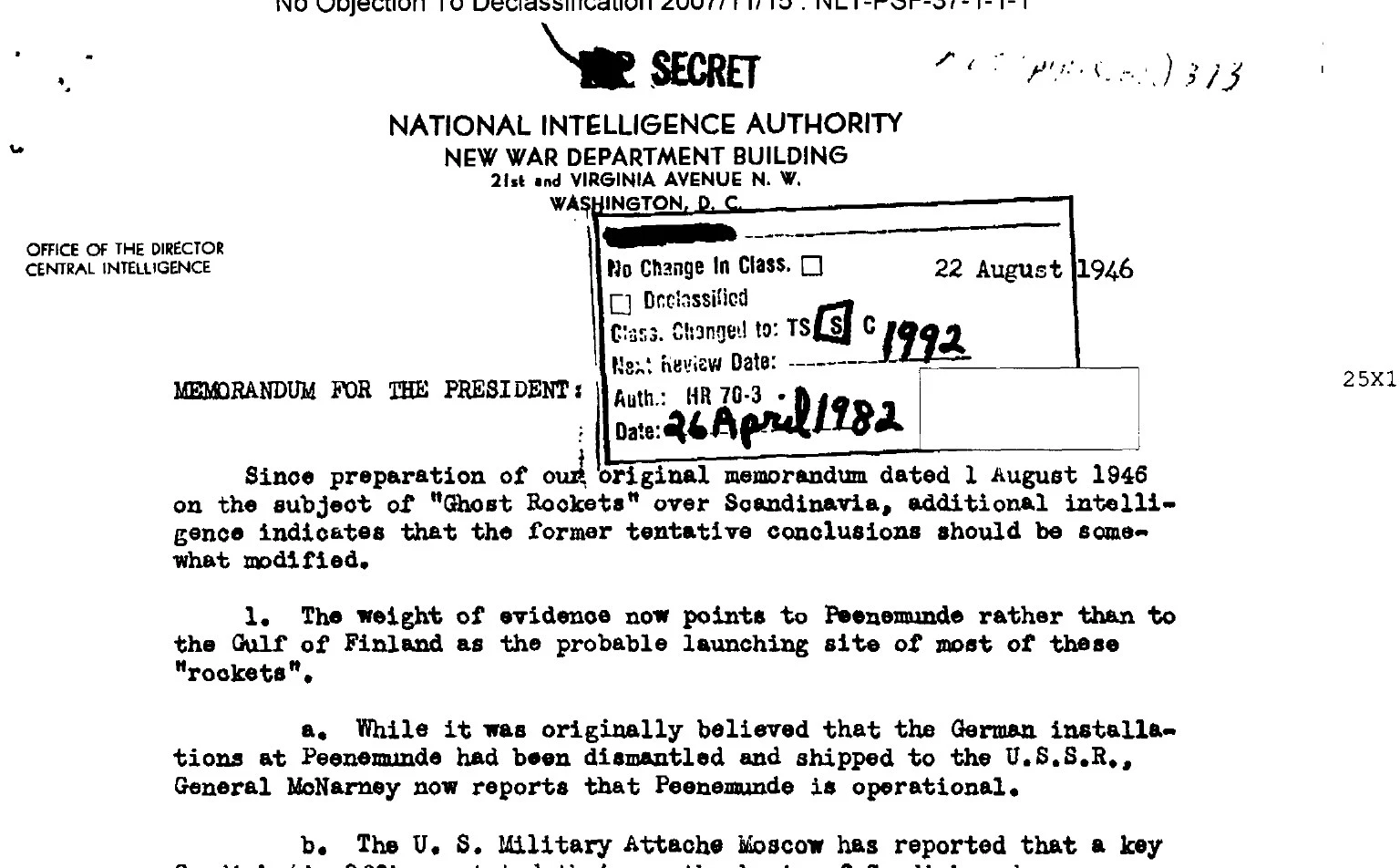
The United States was following the Swedish reports closely by late summer. On August 22, 1946, Lieutenant General Hoyt S. Vandenberg, director of the Central Intelligence Group, sent President Truman a Top Secret memorandum on the subject, which was forwarded the next day by William D. Leahy at the White House. The memo revised an earlier assessment. “The weight of evidence now points to Peenemunde rather than to the Gulf of Finland as the probable launching site of most of these,” it said.
The memo cited a report from the United States military attaché in Moscow that a key Swedish air officer had said Swedish radar plotting linked most of the launches to the Peenemünde area. It concluded that the Soviet Union seemed to be testing guided missiles around the Baltic and stated, “It is the belief of CIG that scientific experimentation is the primary Soviet objective and that political considerations, although thoroughly appreciated, are secondary.”
That was an intelligence judgment, not a finding. No wreckage was ever produced to support it, and the Overclassified case file notes that the Soviet test program has been widely suspected but never confirmed.
Why did nobody find a rocket?
The search for physical proof kept coming up empty. On August 14, Berg said, the crew of a Swedish B18A bomber tried to chase a projectile that had a body like an aircraft but no wings or rudder, and it easily outran them. According to the Overclassified case file, a committee memo of December 3, 1946, recorded nearly 100 reported impacts and some thirty debris fragments that had been examined, which were identified as ordinary slag, coke or probable meteorite material.
The Defence Staff’s public statement of October 10, 1946, as quoted in that case file, confirmed that radar had registered readings but said the instruments “gave no clue as to the nature of the objects.” By late November, the same file reports, the Defence Staff had judged 225 of its nearly 1,000 vetted reports to be observations of “real physical objects.”
The same case file also points to a natural factor in the busiest days. The twin peaks of August 9 and August 11 fell inside the active window of the annual Perseid meteor shower. A sky full of bright meteors would have produced exactly the kind of fast, fiery streaks that many witnesses described, though it does not account for the radar tracks or for objects reported moving slowly at low altitude in daylight.
As autumn came the reports faded, and so did the committee’s hopes. Berg said the committee grew increasingly resigned to finding no proof that the projectiles existed at all, and it held its last meeting on December 12, 1946. It never presented a lasting explanation.
What did the ghost rockets leave behind?
The episode changed Swedish defense policy even without an answer. According to Berg, the expansion of Swedish radar surveillance was speeded up, and the National Defence Radio Establishment began signals intelligence work against the Soviet Union and its allies using specially adapted aircraft.
The story also did not end in 1946. Berg described how the Swedish commander in chief, General Helge Jung, recorded in his diary that he saw a projectile flying over the Stockholm archipelago on July 18, 1948, and another on August 6 that year. Jung believed he had seen Russian rocket weapons. Navy divers searched the bay where he believed one had come down for weeks in the autumn of 1948, and the salvage ship’s diving log repeated day after day that the search had found nothing.
Berg himself concluded that the case raises more questions than answers. The ghost rockets came in the first months of the Cold War, and they set a pattern that later waves of sightings would follow. Many witnesses, some radar returns, official concern at the highest level and no physical evidence that anyone could hold up and identify.
Established: Swedish authorities received close to 1,000 reports of rocket-like objects in 1946, set up a committee to investigate them and searched Lake Kölmjärv after a reported impact on July 19, 1946.
Established: The Central Intelligence Group told President Truman in August 1946 that it believed the objects were probably Soviet missile tests launched from the Peenemünde area.
Disputed: That the ghost rockets were Soviet guided missiles. Suspected by Swedish and American officials at the time, but no wreckage or Soviet record has confirmed it.
Fringe: That the ghost rockets were craft of unknown or nonhuman origin.
Disputed: How many of the reports were meteors. The August peaks coincided with the Perseid meteor shower, while the Defence Staff judged 225 reports to describe real physical objects.
Sources
- Riksarkivet (Swedish National Archives), Arkivpodden: Spökraketer, episode 33, April 27, 2023, with transcript, conversation between Jim Hedlund and Bo Berg, head of the Military Archives. Swedish text paraphrased in English by the author. riksarkivet.se
- Central Intelligence Group, memorandum for the President, Ghost Rockets, August 22, 1946, signed by Lt. Gen. Hoyt S. Vandenberg, with forwarding memo by William D. Leahy, August 23, 1946. CIA Reading Room, read via the Internet Archive. cia.gov
- Overclassified, The Swedish Ghost Rockets, case file. overclassified.org
