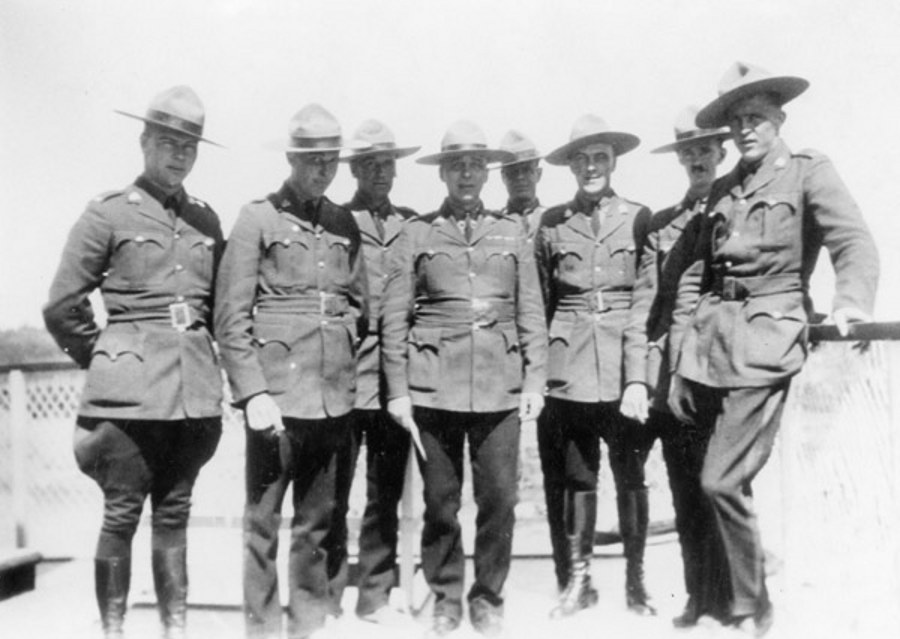

In the summer of 1931 a quiet stranger walked into Fort McPherson in the Northwest Territories, bought supplies and headed up the Rat River to build himself a cabin. Local trappers came to know him as Albert Johnson, although nobody could say where he came from. By the following February he had wounded two men, killed a Mountie and led police, Special Constables, local trackers and a bush pilot on one of the largest manhunts in Canadian history. When he was shot dead on the ice of the Eagle River, he took his real name with him.
The Canadian Encyclopedia sums up the result plainly: “No motive for Johnson’s crimes has ever been established, and his identity remains a mystery.” DNA and isotope tests carried out on his exhumed remains in the 2000s ruled out several of the theories about who he was. However, they still failed to match him with any of the families who believed he might be their missing relative.
Who Was the Stranger at Fort McPherson?
According to the Canadian Encyclopedia, two trappers named William and Edward Snowshoes met the newcomer at a camp on the Peel River on July 7, 1931, and called him Albert Johnson by mistake, and it was the name by which he would be known from then on. On July 21, while Johnson was buying supplies, RCMP Constable Edgar Millen questioned him in Fort McPherson. Johnson said little and gave no direct answers, so Millen simply advised him to buy a trapper’s license and let him go.
The RCMP’s own history of the case records that the man told Millen he had spent the previous year on the prairies and wanted to live entirely alone. The Northwest Territories Timeline describes him as a man of very few words and a secretive nature, and says he disappeared up the Rat River about a week later. There he built a small log cabin beside the Rat River in the Mackenzie Delta region.
Why Did the Police Go to His Cabin?
The trouble began with a complaint about traplines. On Christmas Day 1931, the Northwest Territories Timeline says, William Nerysoo walked into the RCMP post at Tsiigehtchic, then known as Arctic Red River, to report that Johnson had tampered with his traplines. The Canadian Encyclopedia describes the complaint as coming from local First Nations trappers. The police took the complaint seriously enough to send officers out to the cabin within days.
Constable Alfred King and Special Constable Joe Bernard went to the cabin, but Johnson refused to open the door or speak to them. The two men then made the 128 kilometer trip to Aklavik to obtain a search warrant. On December 31 they came back with Constable Robert McDowell and Special Constable Lazarus Sittichinli. When King knocked, Johnson fired through the door and hit him in the chest. The Northwest Territories Timeline credits Bernard with pulling King to safety, and the party then raced him by dogsled to the hospital in Aklavik, where he survived.
How Did the Siege Unfold?
Inspector Alexander Eames now led a larger party to the cabin, which it reached on January 9, 1932. The RCMP history lists 42 dogs and 20 pounds of dynamite among its supplies. Johnson had fortified his cabin and answered Eames’s call to surrender with gunfire. The Northwest Territories Timeline describes a 15 hour siege in which hundreds of shots were fired into the cabin. The police eventually used dynamite to blow off part of the roof, yet Johnson kept firing. With the temperature at minus 43 degrees Celsius and food for the dogs running low, Eames withdrew to Aklavik.
By the time a search party returned, Johnson had gone, and fresh snow had covered his tracks. News of the standoff traveled south through the Royal Canadian Corps of Signals station at Aklavik, and the newspapers began calling him “The Mad Trapper of Rat River.” Eames himself disagreed with the label the press had chosen. According to the Canadian Encyclopedia, he described the fugitive as “a shrewd and resolute man” and “a tough and desperate character.”
How Was Constable Millen Killed?
Search parties fanned out from a base camp about 15 kilometers from the ruined cabin. Gwich’in people provided many of the supplies for the search, according to the Northwest Territories Timeline. A Gwich’in elder named Sarah Peters later recalled her part in a 1973 CBC recording quoted by a Northwest Territories exhibition on the RCMP: “When they landed I would haul the stuff up the bank and store it away for the police until they came back again to keep on their search for Albert Johnson.”
Constable Millen led one of the search parties that stayed out after Eames returned to Aklavik. A First Nations hunter reported hearing a rifle shot near the Bear River, and Millen headed that way, guessing that Johnson was hunting for food. On January 30 the posse found him, and when Millen called on him to surrender, Johnson opened fire with a rifle. In the shootout that followed, the Canadian Encyclopedia says, Johnson shot and killed Millen, then escaped in the dark by climbing an almost vertical cliff. A cairn commemorating Millen’s death is now a Territorial Historic Site in the Northwest Territories.

What Role Did Wop May and the Special Constables Play?
Johnson proved an exceptional woodsman, doubling back on his own tracks, laying false trails and following caribou paths to disguise his footprints. In the extreme cold he could risk only small fires under the shelter of snowbanks, and he had to stop to snare small game for food. As one veteran trapper put it, according to the Canadian Encyclopedia, “It is rough enough just staying alive under those conditions let alone having to be on the run.”
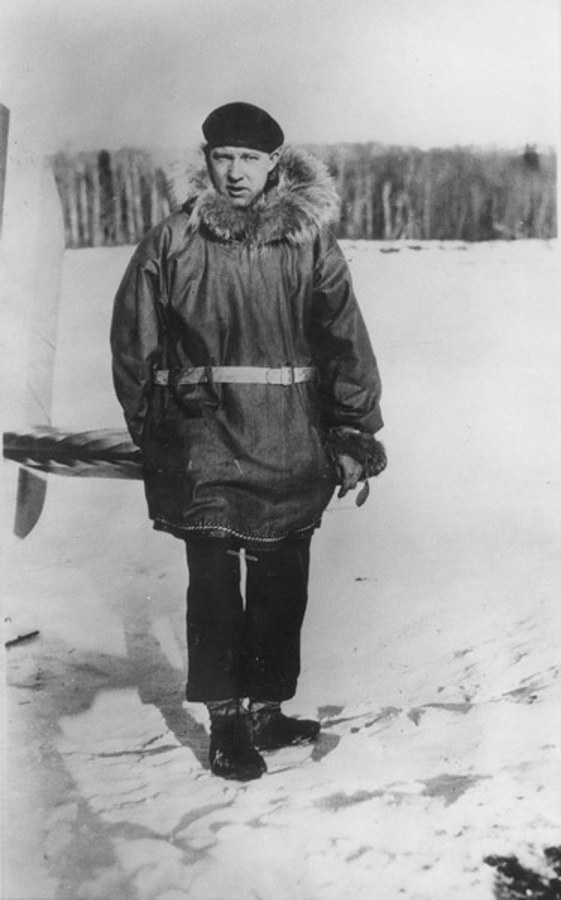
After Millen’s death Eames asked for an airplane, and on February 5 the famous bush pilot Wilfrid “Wop” May landed at Aklavik in a Bellanca monoplane. It was the first time the RCMP had used an aircraft in a manhunt. May ferried men and supplies to strategic points and searched for tracks from the air, sparing the ground parties from following every false trail. However, a blizzard on February 9 grounded him, and three days later the police learned that Johnson had crossed the Richardson Mountains into the Yukon. On February 14 May found his trail where the Eagle and Bell rivers meet.
On February 17 the posse overtook Johnson on a hairpin bend of the frozen Eagle River while May circled overhead. Johnson dropped into the snow behind his pack and fired, wounding Staff Sergeant Earl Hersey of the Royal Canadian Corps of Signals. Directed by signals from May, the posse spread out and caught him in a crossfire, and he was killed. The Globe and Mail and the Northwest Territories Timeline both credit the fatal shot to Special Constable John Moses. The Timeline adds that “It is not until recently that the role of the Special Constables in the story has been told.”
What Was Found on His Body?
After a postmortem examination in Aklavik, Johnson was buried in the local cemetery. The Canadian Encyclopedia says he was carrying $2,410 in Canadian currency, $10 in American money, five pearls of low value and some gold that included pieces of dental work. The RCMP history adds 32 kidney pills, three rifles and more than 120 rounds of ammunition. No papers or personal belongings identified him, and his fingerprints matched none in Canadian or American police files.
The Globe and Mail notes that nobody came forward even after the Mounties published photographs of the dead man’s emaciated face. Theories about his identity multiplied in the decades that followed, in books, articles and films. The Canadian author Dick North argued in his 1989 book Trackdown that Johnson was an American fugitive named Arthur Nelson, and Hollywood turned the chase into the 1981 film Death Hunt.
What Did the DNA Tests Reveal?
For decades the hamlet of Aklavik refused requests to exhume the body, saying the dead should be respected. In 2007, CBC News reported, it granted permission to the Edmonton company Myth Merchant Films after producer Carrie Gour and her team promised a culturally respectful exhumation. Some elders in the area were still uncomfortable with scientists examining the dead. “When you bury someone, you just leave it there,” Inuvik resident Winston Moses, the son of Special Constable John Moses, told CBC News. “Even the dead people get respect.”
The results were aired on Discovery Channel in the 2009 documentary Hunt for the Mad Trapper. “Albert Johnson grew up in the northern United States or northern Scandinavia,” Gour told CBC News, explaining that isotopes in his teeth had pointed scientists to those regions. The tests also showed that he was in his thirties when he died. The Globe and Mail reported that the analysis placed him in Iowa, Indiana or Ohio before he came north, and described him as “a man of means” because of the cash he carried and his expensive dental work.
However, the DNA produced no match with samples from 12 families whose claims the filmmakers considered credible. Gour told the Globe and Mail that Johnson’s DNA, which she called “the golden nugget,” is now stored at the Bureau of Legal Dentistry at the University of British Columbia, so any new claimant could still be tested against it. The Canadian Encyclopedia says the results put several theories about his identity to rest.
Read next: Eight of the Strangest Unsolved Murders of the 20th Century | Tamám Shud! The Somerton Man: Solved at Last?
Almost a century later the man in the Aklavik cemetery still has only a borrowed name. The RCMP now lists the chase among its famous cases, while the Northwest Territories Timeline notes that the part played by the Special Constables has only recently been told. Johnson’s reasons for shooting at the men who came to his door over a trapline complaint are no clearer today than they were in 1932, and neither is the name his family would have known.
Established: A man known as Albert Johnson wounded Constable Alfred King on December 31, 1931, killed Constable Edgar Millen on January 30, 1932, and was shot dead on the Eagle River on February 17, 1932, after a manhunt that used an aircraft for the first time in RCMP history. Tests on his remains reported in 2009 found no DNA match with the families tested.
Unverified: His true name, nationality and motive are still unknown. Isotope results point to the northern United States or Scandinavia, and the claim that he was Arthur Nelson remains unproven.
By Historic Mystery
Sources
- Edward Butts, Albert Johnson, “The Mad Trapper of Rat River,” The Canadian Encyclopedia, 2008, last edited 2019. thecanadianencyclopedia.ca
- CBC News, Mad Trapper not a Canadian, scientific tests discover, 2009. cbc.ca
- The Globe and Mail, The Mad Trapper of Rat River: A cold case that’s still cold, 2009. theglobeandmail.com
- Royal Canadian Mounted Police, Famous cases, events and people. rcmp.ca
- Northwest Territories Timeline, The Mad Trapper of Rat River. nwttimeline.ca
- Prince of Wales Northern Heritage Centre, RCMP Special Constables exhibition, The Mad Trapper. nwtexhibits.ca
