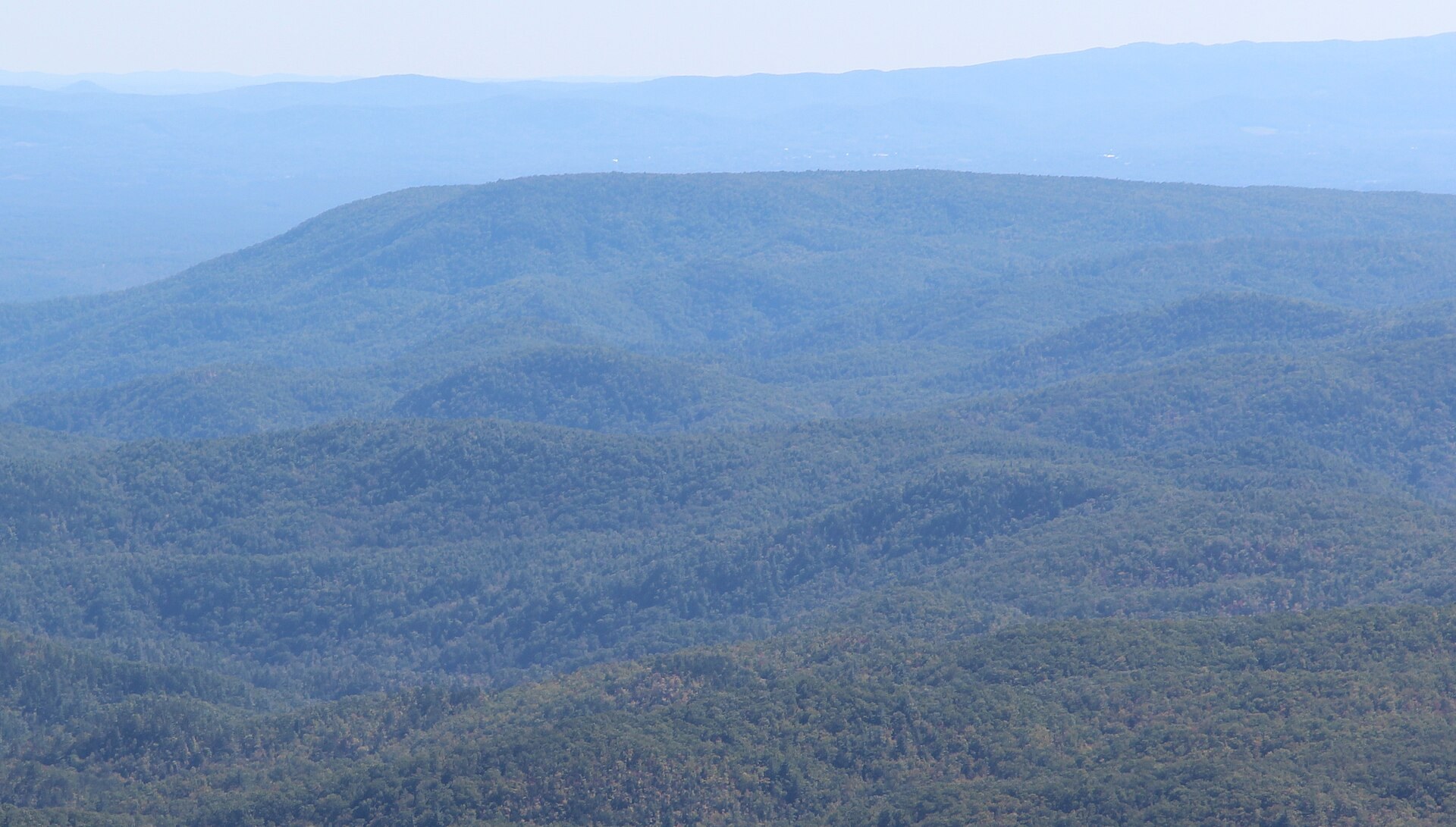
Brown Mountain is not much to look at. Seen from almost any direction, it is a long ridge with a nearly level skyline on the border of Burke and Caldwell counties in western North Carolina. For more than a century, though, people have gathered at overlooks after dark to watch for glowing balls of light that are said to rise above it, hang in the air and fade away. Two federal geologists came to study them, and a physics professor spent years filming the ridge. Most of what people see has a plain explanation. A small part of it still does not.
What do people say they see?
The Encyclopedia of North Carolina, in an entry by Robert J. Dodge republished by NCpedia, describes the lights as “unexplained phenomena that appear low in the air under favorable atmospheric conditions, grow in size, and then linger for a few minutes before fading away.” It adds, “As few as one and as many as a dozen lights might be seen at one time.” The entry goes on, “They are mostly white but occasionally show a red, blue, or yellowish tinge.”
According to the same entry, the lights appear most often on clear, warm summer evenings, starting shortly after dark, and the best place to look is an overlook on the Blue Ridge Parkway near Milepost 310. The entry says the lights have been documented since 1833, although researchers who later searched the record could not find good evidence for the oldest claims.
Folklore offers its own explanations, and NCpedia notes that folklorists tell of a Native American man searching for his beloved by torchlight, and the entry says the lights have inspired song and story as well as scientific investigation.
When were the lights first reported?
The earliest printed account that the Geological Survey could find came from a dispatch sent from Linville Falls to the Charlotte Daily Observer, dated September 23, 1913. As the geologist George Rogers Mansfield later recorded, that article credited the discovery to members of the Morganton Fishing Club. They had seen the lights “more than two years ago” but had been “laughed at and accused of seeing things at night” for their trouble.
Interest grew quickly, and in October 1913, at the request of Representative E. Y. Webb of North Carolina, the Geological Survey sent one of its members, D. B. Sterrett, to observe the lights and find their source. According to Mansfield, Sterrett concluded after a few days that the lights were simply the headlights of locomotives seen over the mountain from the surrounding heights.
That answer did not satisfy everyone, and Mansfield wrote that it was too simple for anyone hoping for something unusual, and that a flood soon seemed to undermine it. In the summer of 1916 a great flood swept down the valley of the Catawba River, washing out bridges and railroad track and halting rail traffic around Morganton for several weeks. When people kept reporting the lights during that time, even some who had accepted the train explanation gave it up.
What did the 1922 investigation find?
The questions kept coming, and North Carolina’s two senators, Simmons and Overman, persuaded the Geological Survey to try again. This time the job went to Mansfield, who spent two weeks near Brown Mountain in March and April 1922 and watched for the lights on seven evenings, four of them until after midnight. His report was released to the press that year and reprinted by the Survey in 1971 as Geological Survey Circular 646.
Mansfield approached the problem as a surveyor would. From viewing points on the surrounding hillsides he trained an instrument on each light as it appeared, noted the time and measured its direction and vertical angle. He then compared those lines with maps of the roads, railroads and settlements beyond the ridge, and with railroad timetables.
His conclusion was blunt, and Mansfield wrote that the lights were not of unusual nature or origin. Of the lights he was able to study with his instruments, he attributed about 47 percent to automobile headlights, 33 percent to locomotive headlights, 10 percent to stationary lights and 10 percent to brush fires.
The geology of the ridge helped his case, because Brown Mountain has such an even crest, lights from distant towns, roads and railroads beyond it can seem to float just above the ridge when seen from the overlooks. Mansfield noted that this placement of the lights above the crest, rather than on its face, had been described from the very first published account onward.
Why did the explanation not settle the matter?
Mansfield’s report was thorough, but it explained the lights he could measure, not every light anyone claimed to have seen. Many accounts of the Brown Mountain Lights describe something different from a distant headlight, a glowing ball that moves, changes size or appears close at hand. NCpedia’s entry, written decades after the Survey reports, still states that “no entirely satisfactory scientific explanation has been offered.”
Other ideas have been suggested over the years. NCpedia records that the National Geographic Society has said discharges of static electricity might be the source. A 2016 report by WLOS television in Asheville noted theories ranging from ball lightning to naturally occurring gases rising from the mountain.
What did a modern scientist find?
The most sustained recent study came from Daniel Caton, a professor of physics and astronomy and director of observatories at Appalachian State University. Writing in the News and Observer of Raleigh in August 2016, Caton said he became interested after a student asked him about the lights. After dozens of viewing trips, he wrote, “I went from skeptical to cynical.”
He had already concluded “that the vast majority of sightings are just misidentified natural and man-made lights seen by a public increasingly disconnected from the nightscape.” His research group also checked the history behind the legend. “No clear record exists of the Cherokees’ seeing them,” Caton wrote. He added that the 1770s surveyor Gerard de Brahm, often cited as an early witness, did not record seeing the lights and did not travel into North Carolina.
Caton offered a plain account of how the modern legend grew. “The first light was probably a CSX Railroad train, since it was seen the same time of the night as the train ran,” he wrote. “The appearance of multiple lights is correlated with the electrification of the region.” He added that a local promoter had used the lights to draw guests to his hotel.
A few reports kept him interested, however, and some came from people who said they had seen a light at close range in the parking lot of a viewing site, and their descriptions resembled ball lightning. Caton and his colleague Lee Hawkins set up cameras to photograph the mountain all night. For years they caught nothing unusual.
Then, on the night of July 16 to 17, 2016, both cameras recorded the same unexplained light. “It appeared high over the ridge and background town lights, four times over about 20 minutes,” Caton wrote. “It did not streak like a plane or rising star.” He also noted that it came on a night with lightning. Two cameras mattered, because a light seen on both can be told apart from a flaw in a single camera.
Speaking to WLOS, Caton was careful about what the footage showed. “This is the first time we’ve had a dual detection,” he said. “It’s the first time we’ve captured something that we can’t easily explain.” Burke County tourism director Ed Phillips was more enthusiastic. “Does this verify the Brown Mountain Lights? I believe it does. Do we have an explanation? No, we don’t.”
So what are the Brown Mountain Lights?
The evidence points to two different things sharing one name. The first is the bulk of the sightings, which two Geological Survey investigations and a modern physicist all traced to ordinary sources such as trains, cars, town lights and fires seen across a level ridge at night. That explanation is well supported and accounts for most of what visitors report.
The second is a small group of observations that do not fit so easily, including close range reports and the single light that Caton’s two cameras recorded in 2016. Caton has suggested a natural cause such as ball lightning is a possibility worth testing, but no study has yet shown what produced that light. Until someone does, the overlooks along the Blue Ridge Parkway will go on drawing visitors who want to see the lights for themselves.
Established: Lights have been reported above Brown Mountain since at least 1913, and U.S. Geological Survey investigations in 1913 and 1922 attributed the lights they studied to trains, automobiles, stationary lights and brush fires.
Disputed: That the lights were seen before the 20th century. NCpedia dates them to 1833, while Caton’s research group found no clear record of Cherokee accounts or of a sighting by Gerard de Brahm.
Disputed: That some of the lights are a natural electrical phenomenon such as ball lightning. Suggested by Caton after close range reports and a 2016 dual camera detection, but not demonstrated.
Fringe: Supernatural explanations from folklore, including the tale of a man searching by torchlight.
Sources
- George Rogers Mansfield, Origin of the Brown Mountain Light in North Carolina, Geological Survey Circular 646, U.S. Department of the Interior, 1971 (report written in 1922). pubs.usgs.gov
- Robert J. Dodge, Brown Mountain Lights, Encyclopedia of North Carolina, University of North Carolina Press, 2006, via NCpedia. ncpedia.org
- Daniel Caton, Are the Brown Mountain Lights real?, The News and Observer, August 7, 2016. newsobserver.com
- Jennifer Saylor, ASU scientists think they’ve captured images of WNC’s unexplained Brown Mountain Lights, WLOS, August 13, 2016. wlos.com
