HMS Daedalus was a Royal Navy warship heading home from the East Indies in 1848. Late on the afternoon of August 6, somewhere between the Cape of Good Hope and St. Helena, several of her officers reported watching a large animal pass the ship. Their accounts became one of the best-known sea serpent reports of the nineteenth century. The sources examined here offer competing explanations, not a demonstrated identification. What can those accounts establish about the animal?
The case rests on more than one written record. Captain Peter M’Quhae sent an official report to the Admiralty in October, and Lieutenant Edgar Drummond, the officer of the watch, sent a journal extract signed October 28. Both texts were reprinted in The Zoologist in 1848, and that printed volume is the version read for this article. Read side by side, they describe what is clearly the same encounter, yet they do not agree on several points that matter.
The newspaper account preceded the captain’s official reply. The Zoologist reprinted a short October 1848 item from The Times, which put the sighting at four o’clock one afternoon and described the jaws as “full of large jagged teeth” in its account. The same item claimed there was “about 60 feet of its body in a straight line on the surface.”
The Admiralty asked M’Quhae whether the newspaper story was true, and his reply was dated October 11 from Hamoaze. It was published in The Times on October 13 and reprinted in The Zoologist. In it the captain gave the time as five in the afternoon and the position as latitude 24° 44′ S and longitude 9° 22′ E. He said the first person to notice something unusual was a midshipman named Sartoris, who reported it to Drummond while the ship’s company were at supper.
What Captain M’Quhae Reported
The captain’s letter described “an enormous serpent, with head and shoulders kept about four feet constantly above the surface of the sea” as the object he believed he had seen. He judged its length by comparing it with the maintopsail yard and concluded there was “at the very least 60 feet of the animal” at the surface.
M’Quhae described the head as “without any doubt, that of a snake” before giving the body’s width as about 15 or 16 inches behind the head. Its color, he wrote, was dark brown with yellowish white about the throat. He said it had no fins, only something like a mane or “a bunch of seaweed” washed about its back. He estimated its speed at 12 to 15 miles per hour and said it stayed in sight of the ship’s glasses for twenty minutes.
He also wrote that it passed close enough for him to have recognized the features of an acquaintance with the naked eye. Those length, distance and speed figures are estimates made from a moving ship, not measurements, and the captain himself framed the length as an approximation.
What Lieutenant Drummond’s Journal Says
Drummond’s extract, signed at Southampton on October 28, 1848, gives a slightly different position of latitude 25° S and longitude 9° 37′ E. He also put the sighting at about five o’clock. His first description was “a most remarkable fish” before he detailed the head as “long, pointed, and flattened at the top, perhaps ten feet in length” in the extract.
Here the two records begin to part company. Drummond saw a back fin about twenty feet behind the head, visible occasionally, while M’Quhae said the animal had no fins at all. Drummond wrote that the head disappeared “occasionally beneath a wave for a very brief interval,” but the captain insisted it was never below the surface during the whole time it was watched.
Distance is another gap between the two accounts. However, Drummond put the animal at perhaps one hundred yards when it was nearest, while the captain supplied a comparison with recognizing a face rather than a distance in yards. Drummond’s journal also says the captain “asserted that he saw the tail, or another fin,” so that detail was not an independent observation by the lieutenant. The lieutenant still closed with a comparison of his own: “in fact it gave one quite the idea of a large snake or eel.”
The records do agree in several places, and this matters as much as the differences. M’Quhae estimated 12 to 15 miles per hour and Drummond 12 to 14. Both describe dark brown upper parts with a paler throat or jaw, and both describe a steady course to the southwest. Drummond’s five minutes with the naked eye and perhaps fifteen more with a glass match the captain’s twenty minutes in total.
Drawings, Doubts and a Reply
In his October 11 letter M’Quhae said he was having a drawing made “from a sketch taken immediately after it was seen” for the Admiralty. According to the anatomist Richard Owen, whose response is also reprinted in The Zoologist, the captain certified that the drawing was accurately copied in the Illustrated London News for October 28, 1848. The 1887 illustration has been visually matched to the plate in Gibson’s 1887 book. Its creator is not named on the plate. It is a later published engraving, not the sketch the captain said was taken immediately after the sighting.
Owen proposed that the animal was a large seal, and he argued that “A calculation of its length was made under a strong preconception of the nature of the beast.” He also acknowledged that the observations were inadequate to determine the animal’s genus or species. M’Quhae answered in The Times of November 21, 1848, writing that the head “was flat” and that he had never read Pontoppidan’s older account of a maned sea serpent before reaching London. He concluded: “I deny the existence of excitement or the possibility of optical illusion.”
Writer Matthew Willis, writing in The Appendix in 2014, describes how the case drew public enthusiasm and scientific dismissal almost at once. He notes that questions were raised in Parliament about the report, and that a letter signed by “An Officer of Her Majesty’s Ship Daedalus” defended the sighting in The Times in 1858. That letter is known here only as quoted by Willis and by later writers.
The Whale Hypothesis
Biologist Gary Galbreath of Northwestern University revisited the case in Skeptical Inquirer in 2015, calling it one of the most famous and puzzling maritime mysteries. He gave extra weight to Drummond’s journal because it was written closer to the event, and he pointed out that the captain’s report came more than two months later.
Galbreath also drew on two sketches from Drummond’s diary that, he writes, were first published in 1997 through The Log of Mystic Seaport. As he describes them, they show a long, flat head and a low dorsal fin. Those drawings are known here only through his article, which reproduces them.
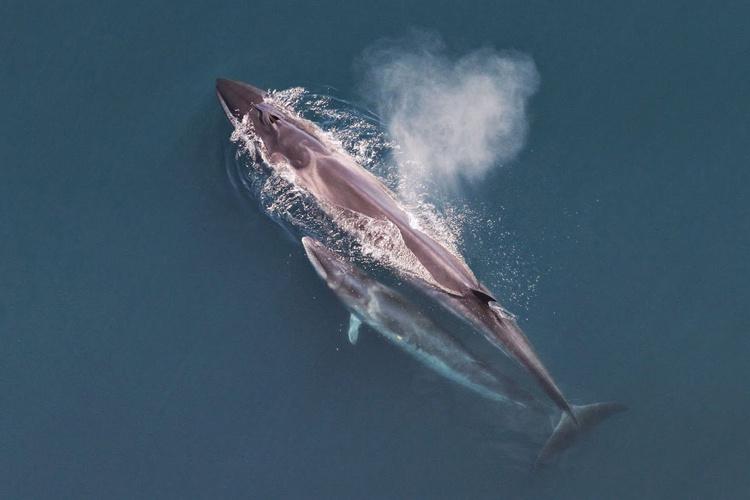
His proposal is that the animal was a rorqual, a baleen whale, feeding at the surface with its upper jaw raised and its mouth open. He prefers the sei whale, a slender species that can skim feed at the surface, and he argues that the pale baleen could explain the light color the witnesses saw under the jaw. A whale was already among the usual suspects, since the 1902 Encyclopaedia Britannica list of things mistaken for sea serpents quoted by Willis includes one.
Galbreath describes the identification as almost certain. However, the sources consulted here provide no photograph or physical specimen of the animal, the witness figures are estimates, and the whale idea rests on matching drawings and descriptions made by people who believed they had seen a snake. Galbreath acknowledges that the sei whale normally has a sickle-shaped dorsal fin, unlike the low fin in Drummond’s drawing. He suggests damage or a poor view could account for the difference, but neither possibility is established for this sighting. It is a plausible hypothesis, not a demonstrated identification.
What the Records Can and Cannot Show
The two written records establish what experienced naval officers reported seeing on August 6, 1848, which was a large, dark animal with its head held above the water and watched for around twenty minutes. They are testimony and estimates rather than a specimen, so by themselves they cannot establish what the animal was, how long it was, how far away it passed or whether it had a fin.
Sea serpent reports from ships did not end with the Daedalus, and Willis cites a sighting reported in 1907 by the chief officer of the RMS Campania. What survives from 1848 is a newspaper item, two officers’ accounts transmitted through later publication and a set of published engravings, and the points where the two accounts disagree are as informative as the points where they match.
Sources
- M’Quhae, Peter. Report to Admiral Sir W. H. Gage, dated October 11, 1848, from The Times, October 13, 1848, as reprinted in The Zoologist, vol. 6 (1848), pp. 2307 to 2308. Internet Archive scan. The newspaper issue itself was not consulted.
- Drummond, Edgar. Journal extract, signed October 28, 1848, in The Zoologist, vol. 6 (1848), pp. 2306 to 2307.
- The Times, October 1848 item reprinted in The Zoologist, vol. 6 (1848), p. 2307.
- Owen, Richard. Letter on the Daedalus animal, reprinted in The Zoologist, vol. 6 (1848), pp. 2312 to 2316.
- M’Quhae, Peter. Reply to Professor Owen, from The Times, November 21, 1848, reprinted in The Zoologist, vol. 6 (1848), pp. 2323 to 2324.
- Willis, Matthew. 2014. Where Be Monsters? The Daedalus Sea Serpent and the War for Credibility. The Appendix. Full online essay consulted. The 1858 newspaper letter is known here only through later quotation.
- Galbreath, Gary J. 2015. The 1848 “Enormous Serpent” of the Daedalus Identified. Skeptical Inquirer.
- Gibson, John. 1887. Monsters of the Sea, Legendary and Authentic. Thomas Nelson and Sons. Historical illustration reference, unnumbered plate at PDF page 49, independently viewed in the scan.
