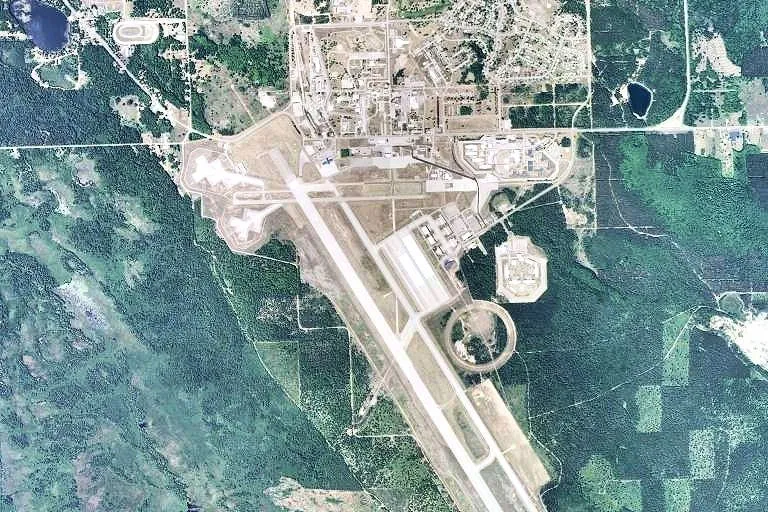

On the evening of November 23, 1953, an American jet interceptor took off from Kinross Air Force Base in Michigan’s Upper Peninsula to identify an unknown aircraft over Lake Superior. About half an hour later, the two blips on a radar screen came together. One of them carried on across the lake. The other, an F-89C Scorpion with two young officers aboard, was never seen again. The Air Force concluded that the unknown aircraft had been a Canadian transport plane. Within two years, a very different story had taken hold, one in which the jet was swallowed by a flying saucer.
More than seventy years later, no wreckage has been confirmed and no one knows what brought the jet down. What does the official record say, and where did the more dramatic version come from?
What did the Air Force report say?
The fullest account of the flight comes from the USAF Report of Aircraft Accident, of which the Air Force Safety Agency released portions in reply to a Freedom of Information Act request made in December 1993. Some lines in the copy are excised. According to its summary, the aircraft was F-89C serial number 51-5853A, assigned to the 433rd Fighter Interceptor Squadron at Truax Field in Wisconsin. The crew, First Lieutenant Felix Moncla Jr. and Second Lieutenant Robert Wilson, were on temporary duty at Kinross while the base’s regular personnel were away for gunnery training in Yuma, Arizona.
The jet was scrambled by the ground control intercept station known as Naples to identify an unknown aircraft and became airborne at 6:22 p.m. Eastern Standard Time. At 6:41 control passed to a second station, Pillow. Six minutes later, at Pillow’s request, the jet came down from 30,000 feet to 7,000 feet to begin the interception, about 150 miles northeast of Kinross over northern Lake Superior.
The pilot was then told to turn onto a new heading and advised that the unidentified aircraft was at eleven o’clock, ten miles away. The report continues: “Radar returns from both aircraft were then seen to merge on Pillows radar scope.” It adds that the return from the other aircraft “was continuing on its original flight path, while the return from the F-89 disappeared from the GCI stations radar scope.” Elsewhere the report records the last radio and radar contact at 6:55 p.m.
The report then names the other aircraft, in plain terms. “The unknown aircraft being intercepted was a Royal Canadian Air Force Dakota (C-47), Serial No. VC-912, flying from Winnipeg to Sudbury, Canada.” It was crossing the north of the lake from west to east at 7,000 feet, the same height the Scorpion had been sent to.
How hard did the searchers look?
The search for the two men began that same night. American and Canadian aircraft and Coast Guard vessels joined in, but the weather worked against them. The Wisconsin State Journal reported on November 24 that the crews “were hampered by snow and poor visibility.” The accident report says the search was “greatly hampered by bad weather and icing conditions” and was suspended on the evening of November 28.
The report’s conclusion on the search runs to one sentence. “An extensive aerial search has revealed no trace of the aircraft.” According to the summary, about 80 per cent of the area was covered, heavy snow prevented an effective search on land, and every civilian report of seeing or hearing the jet was checked “with negative results.” The aircraft and crew had still not been found by January 1, 1954.
What did people think at the time?
The first newspaper reports did not mention anything unearthly. The State Journal wrote that the jet vanished from radar as it neared the other plane, “later identified as a Canadian C-47 transport 30 miles off its course.” It quoted the Truax commandant, Lieutenant Colonel Shoup, who believed the two lieutenants “must have suddenly overtaken the slower transport plane and” turned away hard to avoid a collision. In his words they had “peeled off,” and the jet “perhaps stalled and went into a spin, crashing into the lake.”
Shoup also said he did not believe the men could have survived a night on the frigid lake, even if they had reached their rubber rafts. The same newspaper noted that no distress signal was radioed. It was a grim week for the base. Only hours before the Lake Superior flight, another Truax F-89C had crashed near Lake Wingra in Madison, killing both men aboard.
Where did the UFO story come from?
The idea that the Scorpion met something other than a Canadian transport plane grew in the years after 1953. The Open Skies Project, a historical group that has gathered the documents on the case, traces many of the dramatic details to a single book, The Flying Saucer Conspiracy by Major Donald Keyhoe, published in 1955. Keyhoe was a well-known UFO writer of the period.
In Keyhoe’s version, the unknown object first appeared over the Soo Locks at Sault Ste. Marie and the jet chased it out across Whitefish Bay. At the moment of interception, he wrote, “The two blips had suddenly merged into one.” He went further. In his account, “the huge, ominous blip remained on the glass. Then it quickly went off the scope.” That detail, the Open Skies Project points out, contradicts the official report, which says the second aircraft continued on its course.
The group also questions Keyhoe’s understanding of radar. Early sets of the 1950s had low resolution, and two aircraft close together could appear as one return. Merging blips, the project argues, did not necessarily mean a collision. It adds that Keyhoe misspelled the base as “Kimross” throughout the book.
Has the wreck ever been found?
Several claims of wreckage have surfaced since then. In October 1968, according to Open Skies, prospectors found part of an aircraft tail section on the Ontario shore of Lake Superior. A local newspaper of the time reported that a Major J. H. Parker at “Kincheloe Air Base (formerly Kinross AFB)” identified it as part of a high performance military jet, but the same report said it later appeared unlikely to be the F-89. No further record of the find has turned up.
A more elaborate claim followed in 2006, when a man calling himself Adam Jiminez of the Great Lakes Dive Company, announced that his team had located the missing jet on the lake floor in about 500 feet of water, with an unknown metallic object half buried nearby, and released what he said was a sonar image. The Northern Express newspaper in Michigan printed a recap of the story with an editor’s note that “The existence of the Great Lakes Dive Co. could not be verified at press time.”
The maritime historian Brendon Baillod, as described by Open Skies, could find no one in the Great Lakes diving community who had heard of the company or the man, and no company registered under that name. He doubted the equipment described could have produced the image. Open Skies treats the episode as a hoax, and no wreck has been confirmed since.
So what happened to Moncla and Wilson?
The documents point to a familiar kind of tragedy. A jet was sent out at night in snow, at low altitude over a vast cold lake, with poor radio reception, to identify a transport plane that had strayed off course. It closed on its target and then disappeared from radar. The Air Force’s own explanation, given by Shoup within a day, was a sharp turn to avoid a collision followed by a stall and a spin into the water. That remains a theory, since no wreckage has been confirmed and parts of the investigation board’s findings were never released.
The UFO version rests on a later book that adds details not found in the records and contradicts them on the central point. The Air Force went on to investigate thousands of UFO reports under Project Blue Book until 1969, and the National Archives now holds those files. For the families of the two lieutenants, the outcome was the same either way. Neither the Scorpion nor its crew has ever been found.
Established: F-89C 51-5853A, crewed by Lt. Felix Moncla Jr. and Lt. Robert Wilson, disappeared over Lake Superior on November 23, 1953, while intercepting an aircraft the Air Force identified as RCAF Dakota VC-912. No trace was found.
Unverified: That the jet stalled and spun into the lake after turning away from the transport. This was the base commander’s theory and no wreckage has been confirmed.
Fringe: That the jet collided with or was taken by a UFO. The claim traces largely to a 1955 book and conflicts with the official report.
Disputed: The 2006 Great Lakes Dive Company sonar find. The company’s existence could not be verified, and the Open Skies Project, citing maritime historian Brendon Baillod, treats it as a hoax.
Sources
- United States Air Force, Report of Aircraft Accident, F-89C 51-5853A, 23 November 1953, releasable portions issued under FOIA by the Air Force Safety Agency, 1994. Transcription hosted by NICAP, read via the Internet Archive copy.
- June Dieckmann, Lake Superior Hides Jet’s Fate During Storm, Wisconsin State Journal, November 24, 1953, as transcribed by the UFO*BC Kinross Incident archive. ufobc.ca
- The Capital Times (Madison), report on the Truax crashes, November 24, 1953, as transcribed by the UFO*BC Kinross Incident archive. ufobc.ca
- Open Skies Project, The Kinross Incident. openskiesproject.org
- Harley L. Sachs, Truth or Hoax: Disappearance of F89, Northern Express (Traverse City, Michigan), read via the Internet Archive copy.
- National Archives, Project BLUE BOOK, Unidentified Flying Objects. archives.gov
