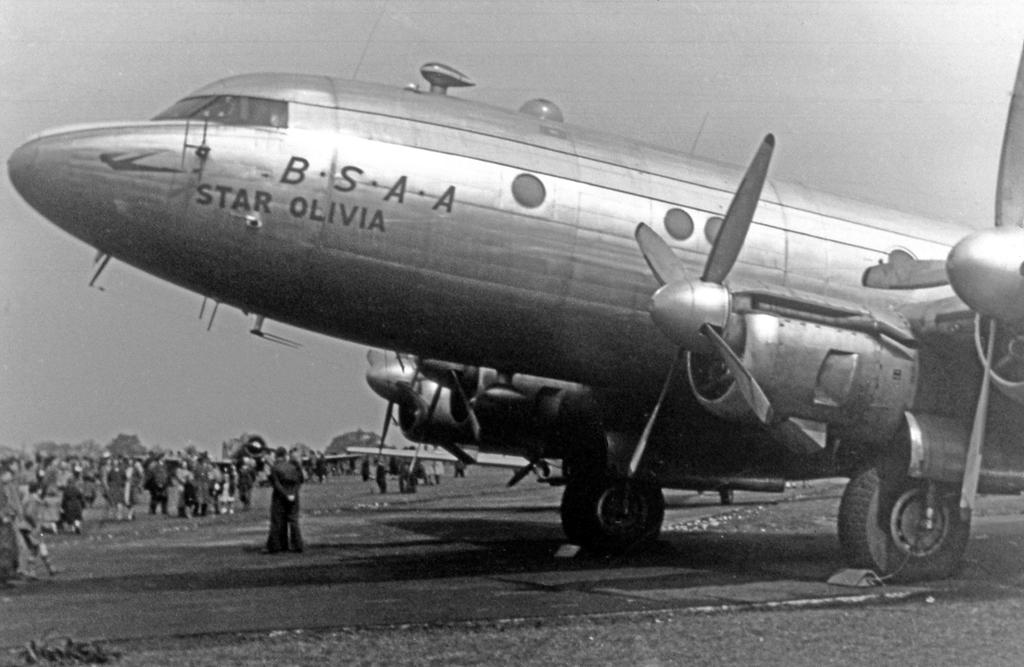

At 15.34 Greenwich time on 29 January 1948, the Avro Tudor IV airliner Star Tiger took off from Santa Maria in the Azores for Bermuda. She belonged to British South American Airways, carried a crew of six and twenty-five passengers, and was on the third stage of a scheduled flight from London to Havana. Nearly twelve hours later she asked Bermuda for a radio bearing, received it, and acknowledged it, and nothing more was ever heard from her.
Almost a year later a second Tudor of the same airline, Star Ariel, left Bermuda for Kingston, Jamaica, and disappeared in the same way. The two cases are often told together, but the surviving records show how much was known, how much was not, and how an official admission of uncertainty took on a second life.
A Hard Route and a Tired Crew
The court that later investigated the disaster found that Star Tiger left London Airport on 27 January after a complete overhaul, and that a compass and the cabin heater gave trouble on the way. At Lisbon the port inner engine would not start until a failed priming pump was replaced, and on the flight from Lisbon the compass and the heater failed again, with only the compass put right before the Atlantic crossing.
At Santa Maria the captain, McMillan, received an unfavorable weather forecast and chose to wait overnight rather than set off at once. The report records that he went to bed at about 21.00, saying he was very tired. Another aircraft of the same airline, a Lancastrian freighter commanded by Captain Griffin, was also waiting for better conditions. The two crews agreed a plan to fly at 2,000 feet, a height chosen to reduce the headwind and to keep the aircraft below the cloud base.
The route itself was a severe test of men and machines, because the great circle distance from Santa Maria to Kindley Field in Bermuda was 1,961 nautical miles, entirely over open ocean, with no islands on the way and no weather ships stationed along it.
The Last Hours
All times in the report, and here, are Greenwich time. The Lancastrian took off at 14.22 and Star Tiger followed at 15.34, and through the night the two aircraft passed messages to each other. The winds were stronger than Santa Maria had forecast, and the Lancastrian’s navigator found that his aircraft had been carried about 68 miles north of its intended track in a single hour. Star Tiger revised her own estimated arrival time at Bermuda from 03.56 to 05.00.
Her hourly position reports gave her height as 20,000 feet, which puzzled the investigators. The court thought this was obviously an error for 2,000 feet, but concluded that it was impossible to say with certainty how high she was flying when communications ceased.
At 03.15 Star Tiger asked the Bermuda radio station for a bearing and was given one of 72 degrees. She acknowledged it, and in the report’s words, “This acknowledgment was the last message received from her.” She was then about 340 nautical miles from Bermuda, while the Lancastrian flying an hour ahead of her landed safely at Kindley Field at 04.11.
The Bermuda radio operator called Star Tiger at 03.50 and received no reply, and when he called again later there was still no answer. Only 95 minutes after the last contact did he declare a state of emergency. The court criticized that delay and said the emergency should have been declared an hour earlier, although it also recorded that he was working a very long spell of duty. No distress message of any kind was heard from the aircraft at any point.
A Search That Found Nothing
Once the alarm was raised, the United States Army Air Force at Kindley Field directed the search. A Fortress aircraft equipped with radar was airborne by 07.16, and 25 other aircraft joined in that day. The search continued until nightfall on 3 February, and in all 104 flights were made and 882 aircraft hours were flown, and surface vessels took part as well. No trace of Star Tiger, her passengers or her crew was found.
The Minister of Civil Aviation appointed Lord Macmillan to hold a formal investigation, with Professor Arnold Hall and Captain John James as assessors. The court sat in public at Church House, Westminster, for eleven days between 12 April and 7 May 1948. Its report, presented to the Minister with the shorthand record of the evidence, is dated 21 August 1948.
What the Court Could and Could Not Rule Out
With no wreckage to examine, the court had to work by a process of elimination. It found no grounds to suspect a structural defect in the aircraft. It also found no grounds to suppose that a weather hazard, such as severe icing or a dangerous gust, had brought her down, and it thought an error in the altimeters very unlikely. It could not exclude fire, though it thought it most improbable and noted that fire in normal steady flight had become very rare. It also could not exclude a mechanical disruption of the airframe, a loss of control, or a loss of engine power. One possibility it examined in detail was fuel starvation if a fuel cock had been left closed, since the cocks for two tanks were placed in a cupboard in the passenger cabin.
The court also considered that if the radio had failed soon after 03.15, the navigator would have had to find Bermuda, some 340 nautical miles away, without radio bearings, and the aircraft might have run out of fuel. The alternative was an accident so sudden that no distress message could be sent.
The report’s conclusion has been quoted in almost every account of the case since 1948. It begins, “In closing this Report it may truly be said that no more baffling problem has ever been presented for investigation.” The court reflected that any accident involving people and aircraft has two elements, the human and the mechanical, and added, “Or some external cause may overwhelm both man and machine.” It ended, “What happened in this case will never be known and the fate of Star Tiger must remain an unsolved mystery.”
That last sentence is an admission of the limits of the evidence, not a suggestion of anything unnatural. The court followed it with practical recommendations on crew training, ditching instructions, fuel reserves, rest for crews, flight plans, maintenance, and the organization of the radio service at Bermuda.
Star Ariel
Star Tiger was not the first aircraft British South American Airways had seen go missing. In August 1947 its Lancastrian Star Dust had vanished over the Andes on a flight from Buenos Aires to Santiago. Its wreckage was not found until climbers reached it on Mount Tupungato more than fifty years later.
Then, on 17 January 1949, it happened again near Bermuda, and on 19 January the government told both Houses of Parliament that it must now presume the loss of the airline’s Tudor IVB, G-AGRE, known as Star Ariel, on a flight from Bermuda to Kingston, Jamaica. She had carried 13 passengers and seven crew, the search was continuing with the full cooperation of the United States authorities, and the airline had suspended its Tudor IV aircraft from service pending a special investigation of each aircraft.
An account published in 2011 by Bermuda’s Royal Gazette quotes the last reports of her pilot, Captain McPhee, after he left Kindley Field. He said he was flying in good visibility at 18,000 feet, and he later reported passing 30 degrees north and changing to another radio frequency, after which nothing further was received. The Ministry’s report on Star Ariel was not available in the sources consulted for this article, so its findings are not summarized here.
From Inquiry to Legend
The two Tudors did not become part of a wider story until more than a year after Star Ariel disappeared. Writing in 2013, Bernews traced the genesis of the modern legend to a September 1950 Associated Press dispatch by the reporter E.V.W. Jones, who grouped together several disappearances between Florida and Bermuda, including the US Navy’s Flight 19 training mission of five Avenger torpedo bombers in December 1945, Star Tiger in 1948, and Star Ariel in 1949.
HistoryExtra notes that the name Bermuda Triangle was popularized by a 1964 article by Vincent Gaddis in Argosy, and that it became a household term after Charles Berlitz’s book of 1974.
The official record is narrower than the legend, since a British court heard eleven days of evidence on Star Tiger, considered fuel, fire, radio, weather and navigation, and declined to guess. Read in full, its famous closing line is an admission by careful investigators that the evidence had run out over a very wide stretch of ocean.
Sources
- Ministry of Civil Aviation. 1948. Report of the Court investigation of the accident to the Tudor IV aircraft Star Tiger G-AHNP on the 30th January, 1948. Cmd. 7517. London: HMSO. Consulted as a scanned PDF via the Edinburgh Research Archive.
- House of Commons. 19 January 1949. Missing B.S.A.A. Aircraft. Hansard.
- House of Lords. 19 January 1949. Loss of the Star Ariel. Hansard.
- The Royal Gazette. February 4, 2011. Exploring the Bermuda Triangle.
- Bernews. March 2013. Origins of the Bermuda Triangle myth.
- Marking, Stacy. March 1, 2000. Search for the Star Dust. The Guardian.
- HistoryExtra. Enter the zone of terror: the truth about the Bermuda Triangle is going to shock you
