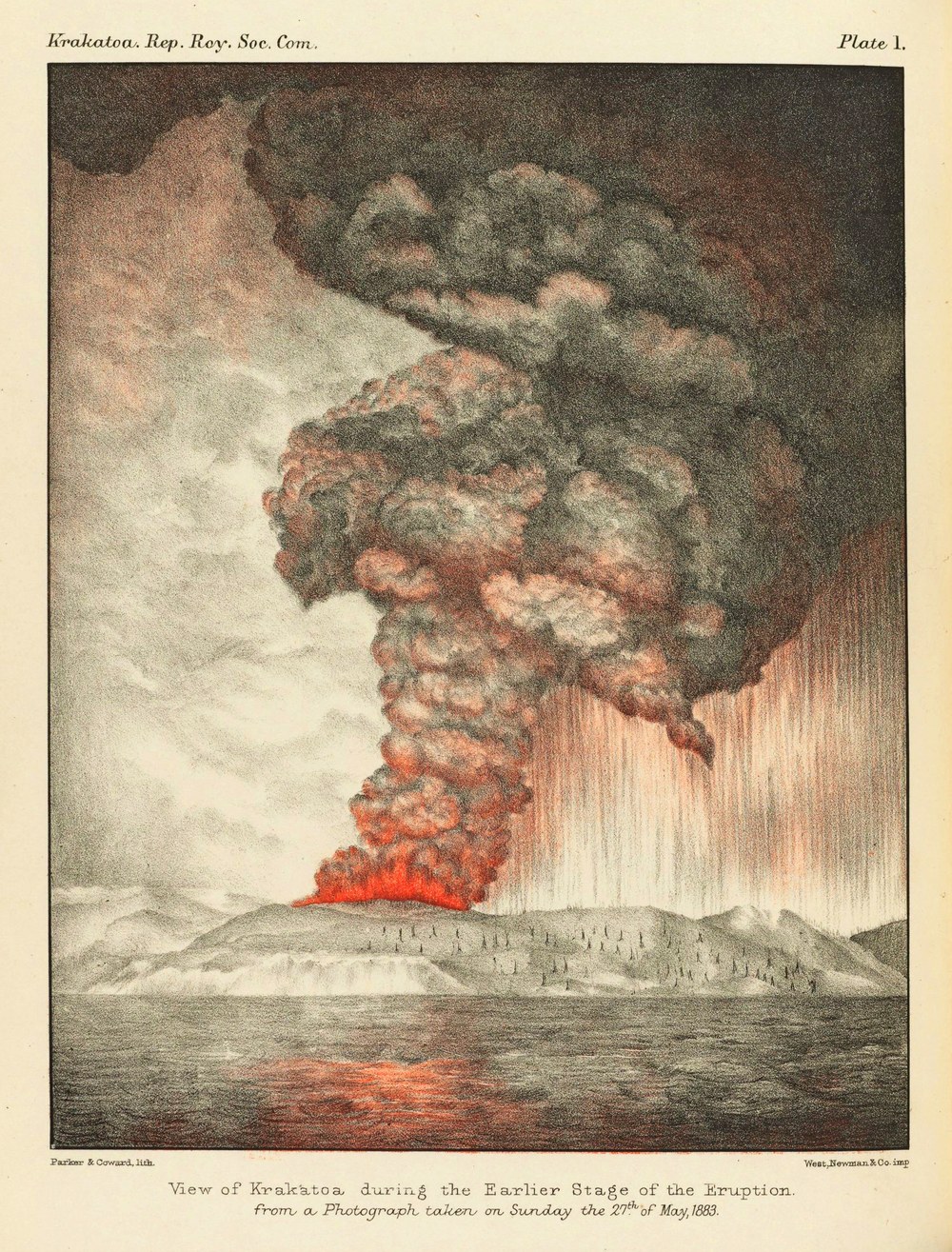

Krakatoa was a small volcanic island in the Sunda Strait, the channel that separates Java from Sumatra in what was then the Dutch East Indies. When it erupted in August 1883, the ships passing through the strait and the towns along its shores became the first witnesses.
Two pieces in Nature, written within five months of the disaster, show how quickly those witnesses were heard. In January 1884 E. Metzger, who had once directed a survey linking Java with the Sumatra coast, gathered the Dutch reports into a long letter. A month earlier, General Strachey had told the Royal Society that barometers on the far side of the world had felt the eruption too.
Three Months of Warning
The volcano gave months of notice, and Metzger quoted a report in the Java Courant, the Dutch government paper, which said that “There are now two craters on Krakatoa, 3 km. distant from each other, which are continually working.” The western crater lay at the foot of Mount Perbuatan and had been “working since May 20,” and the report added that most of the trees on the island had been burnt.
As this site’s account of the Mount St. Helens eruption points out, “there were many warning signs leading up to the eruption” in 1980 as well. In Krakatoa’s case the warnings had become so familiar that Metzger thought the people of the coast, who “had been accustomed for three months to the noise of Krakatoa,” saw nothing on the evening of 26 August to startle them.
Ashes and Fire at Sea
The ships in the strait saw the climax begin. The Berbice reported the sky dark by two in the afternoon of 26 August, with thunder and lightning by six. On the Charles Bal at 4.15 p.m. the crew watched an eruption at the east of the island, the masses driven out to the east looking, in Metzger’s summary, like a furious squall. At 5 p.m. her log recorded “detonations stronger, pumice-stones pouring down, rather big pieces, had to cover skylights.”
As the night went on, the Charles Bal described “chains of fire appearing to descend and ascend between the sky and the island,” a hot and sulphurous wind, and “the sky one second intense blackness, and the next a blaze of fire.” On the Berbice fireballs fell on deck, the helmsman and captain were struck by electric discharges, and by 2 a.m. on 27 August the crew were shovelling ashes that lay about 3 feet thick on deck.
The Waves of 27 August
The first wave reached Anjer, on the Java shore, at about six in the morning. One survivor told the Dutch papers that he saw the wave “still far off, rapidly making way towards us,” ran from it and fell exhausted on a hill. “Before my eyes all the houses along the beach were destroyed,” he said.
Across the strait, at Telok Betong in Sumatra, passengers on the steamer Loudon watched an immense wave strike the town at about 7 a.m. The report said that “The place where Telok Betong had been before was changed into a violent sea,” and three more waves followed. At Merak the chief of the works put the height of the waves at 30 to 40 metres.
Darkness followed the waves across the strait later that morning, and at about 11.15 the Charles Bal heard “a dreadful explosion in the direction of Krakatoa,” and soon afterwards mud and sand began to fall. “At noon the darkness was so intense that we had to grope our way about the decks,” her log said, “and although speaking to each other on the poop, yet could not see each other.” On the Loudon, at anchor in Lampong Bay, lightning struck the ship seven times.
Heard Across the Indies
The sound of the eruption carried for great distances across the islands, and Metzger noted that at Acheen, in northern Sumatra, the detonations “were so distinctly heard that military forces were sent out, since it was supposed that a fort had been attacked.”
A note added to Strachey’s paper recorded that a surveying ship off the north of Borneo heard the explosions on the morning of 27 August, “at a distance of 1200 miles from the volcano.” It added that the sounds were also said to have been heard in Ceylon, “at a distance of about 2000 miles.”
A Wave in the Air
The most surprising evidence came from instruments far from the volcano. In December 1883 R. H. Scott presented to the Royal Society a set of barometer records from stations across Europe and North America, all showing a disturbance at the end of August. Strachey argued that they had a single cause, and in his words, “Any shock of sufficient violence might be expected to produce an atmospheric wave, advancing from the place where it was caused in a circular form round the globe.”
His figures were remarkable, because the wave traveling from east to west moved at 674 miles an hour and the one traveling the other way at 706. The barometers picked it up “until about 122 hours after its origin,” by which time it “had travelled before its extinction more than 82,200 miles.” Working backwards from the times, he placed the origin at about 9.32 a.m. local time on 27 August.
Strachey was open about the one conflict in his evidence. The only eyewitness time he had came from a Mr. Watson, whose ship was within a few miles of the volcano and who put an unusually severe explosion at 11.15 a.m. local time, well after the time the barometers pointed to. Strachey wrote that it “can only be surmised” that Watson’s shock matched the second main feature of the wave, because an origin at 11.15 did not fit the speeds he had measured.
Strange Skies
That same December issue of Nature carried letters about extraordinary skies seen around the world. A letter from Hobart in Tasmania spoke of “the loveliest after-glow which was spread over the sky on the other side of the water where the sun had set.” A passenger three days out from Honolulu wrote that on 5 September “The sun set perfectly blue,” and in Stockholm on 30 November the western sky was covered by “an intense purple after-glow.”
Writers in the same issue were already discussing how fine dust high in the atmosphere might stay there for years. On this site, the video on the Year of Darkness of 536 AD describes a much earlier sky in which “the sun appeared dimmed and obscured,” and the modern explanation offered there is that “an enormous volcanic eruption or a series of concurrent eruptions may have been responsible.”
The Count of the Dead
Metzger’s letter ends with its plainest facts and numbers. When the Loudon passed the island it was seen “that the greater part of the island had disappeared,” and floating pumice in Lampong Bay was 14 feet thick in September. Then he gave the figure that mattered most: “Up to November 1 they counted 32,635 persons killed by the eruption, &c.”
Less than twenty years later another eruption brought a death toll of the same order. As this site’s story of Ludger Sylbaris recounts, Mount Pelée on Martinique erupted on 8 May 1902, “Leaving 30,000 people dead in its wake.”
The accounts in Nature were incomplete, and Metzger said so himself, calling his gleanings “far from being complete” and promising to try to complete them. They still record a disaster seen at once from ships’ decks, from shore towns and from barometers thousands of miles away, and Strachey’s tables turned a distant explosion into something that could be timed and measured.
Sources
- E. Metzger, “Gleanings from the Reports Concerning the Eruption of Krakatoa,” Nature 29 (10 January 1884), pp. 240 to 244. Scan via Internet Archive.
- “The Krakatoa Air-Wave,” abstract of a paper by General Strachey read to the Royal Society, with notes on the sunsets, Nature 29 (20 December 1883), pp. 181 to 183. Scan via Internet Archive.
- Plate 1, The Eruption of Krakatoa, and Subsequent Phenomena (London: Royal Society, 1888), Houghton Library 71-1250. Wikimedia Commons.
