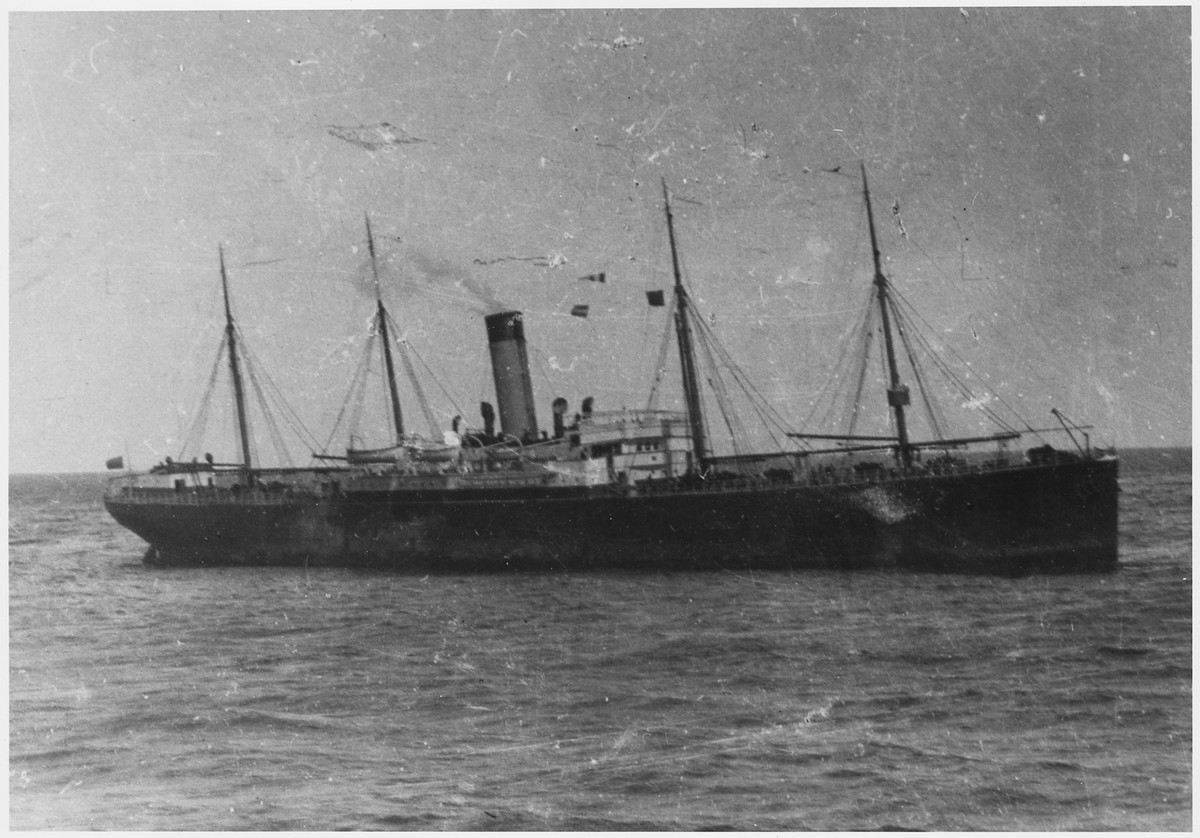

On the night of 14 April 1912 the Leyland Line steamer Californian was bound from London to Boston with no passengers aboard. At 10.20 p.m., ship’s time, she ran into field ice and stopped for the night. Later that night the Titanic struck an iceberg, and at 2.20 the next morning she sank, with the loss of 1,490 lives by the British count and 1,517 by the American one.
Two official inquiries followed within weeks, one on each side of the Atlantic. A committee of the United States Senate heard 82 witnesses, and in Britain the Wreck Commissioner, Lord Mersey, sat with five assessors in London from May to July. Both inquiries spent a large part of their time on one question about the Californian. What did her officers see that night, and could she have helped? This article sets out what the two reports found, in their own words wherever possible.
A Warning About Ice
The Californian’s first contact with the Titanic came hours before the collision. According to the British report, her captain, Stanley Lord, sent a wireless message at 7.30 p.m. to the steamer Antillian reporting “Three large bergs, 5 miles to southward of us.” The Titanic’s operator, who overheard it, told the Californian’s operator, Evans, that he already had it. The American report counted this message among several ice warnings that reached the Titanic that Sunday.
Later that evening, with the Californian stopped, Evans sent another message to the Titanic on Lord’s instructions: “We are stopped and surrounded by ice.” The Titanic’s operator was busy working the wireless station at Cape Race and cut him short. The British report explained that the Californian’s signal was so much stronger than the distant station that it drowned out what Cape Race was sending. Evans listened for a while longer and then turned in at about 11.30 p.m., so nobody was on watch at the Californian’s wireless set when the Titanic began calling for help.
Lights and Rockets in the Night
The British report gave the most detailed account of what the Californian’s officers saw. At about 11 p.m. a steamer’s light was seen approaching from the east, and Lord thought she was a medium-sized ship, “something like ourselves.” The third officer, Groves, had a different impression. Asked if she had much light, he answered, “Yes, a lot of light. There was absolutely no doubt of her being a passenger steamer, at least in my mind.” He said she stopped, and that her lights seemed to go out, at about 11.40 p.m.
Groves tried to signal the steamer with a Morse lamp but received no reply, and he handed over the watch to the second officer, Stone, just after midnight. Some time after 12.30 a.m. a donkeyman named Gill saw two rockets, and at about 1.10 a.m. Stone reported to Lord by voice pipe that he had seen five white rockets from the direction of the steamer. Stone told the inquiry that Lord asked whether they were company signals and told him to go on signaling by Morse lamp.
Stone and an apprentice named Gibson kept watching the steamer through their glasses. Gibson told the inquiry that Stone remarked, “A ship is not going to fire rockets at sea for nothing.” Stone accepted that he may have said it. Altogether they counted eight white rockets before the firing stopped. At about 2 a.m. Stone sent Gibson down to report to Lord, and at about 2.40 a.m. he called Lord again to say that the ship had disappeared. Lord’s own evidence differed on these points, and the report recorded that he remembered being told of one white rocket at about 1.15, and that between 1.30 and 4.30 he had no recollection of anything being reported to him at all.
At about 4.30 a.m. the chief officer, Stewart, woke Lord and told him about the rockets. Evans was called to the wireless, and at about 6 a.m. the Californian heard from the Virginian that the Titanic had struck a berg and was sinking. Lord then took his ship through the field ice at full speed to the position given. By the time she reached the scene, the Carpathia had already picked up the survivors from the boats.
Two Inquiries, Two Sets of Findings
The American committee’s report did not rely on the Californian alone. Sixteen witnesses from the Titanic, it said, testified to seeing the light of a ship in the distance. It also found, “There is no evidence that any rockets were fired by any vessel between the Titanic and the Californian.” Its conclusion was that the Californian “was nearer the Titanic than the 19 miles reported by her captain,” and that her officers and crew “saw the distress signals of the Titanic and failed to respond to them in accordance with the dictates of humanity, international usage, and the requirements of law.” The committee added that if her wireless operator had stayed at his post a few minutes longer, the ship might have been able to rescue those aboard the Titanic.
Lord Mersey reached a similar conclusion by a different route. He did not accept the Californian’s recorded position for the night, and wrote, “I am satisfied that this position is not accurate.” He acknowledged “contradictions and inconsistencies in the story as told by the different witnesses.” He then listed the points that matched one another. The Titanic struck the iceberg at 11.40, and the vessel seen by the Californian stopped at that time. The Titanic fired about eight distress rockets between about 12.45 and 1.45, and the Californian saw eight rockets over the same period. When it was suggested that the rockets came from some other ship, Mersey replied that “no other ship to fit this theory has ever been heard of.”
Mersey was advised that the two ships were probably more than the five miles Lord had estimated, “though not more than eight to ten miles.” He found that the ice around the Californian was loose and extended no more than two or three miles toward the Titanic, and that the night was clear and the sea smooth. In his view the Californian could have pushed through the ice to open water without serious risk when she first saw the rockets. Had she done so, he wrote, “she might have saved many if not all of the lives that were lost.”
The formal findings at the end of the British report were brief and direct. Asked which vessels had the opportunity of helping the Titanic, the court answered:
The “Californian.” She could have reached the “Titanic” if she had made the attempt when she saw the first rocket. She made no attempt.
What the Inquiries Examined
The Californian was only one part of a much larger inquiry in each country, and both heard evidence on the Titanic’s speed, her ice warnings, her lookouts and her boats. Frederick Fleet, the lookout who first saw the iceberg, told the inquiry that binoculars would have helped him see the ice sooner, and the British court found that they were not provided for the look-outs. The American report found that the Titanic’s lifeboats had room for 1,176 people while only 706 were saved, and that many boats left the ship partly filled. The shortage of lifeboats for everyone aboard was itself a central finding of both inquiries, whatever any other ship might have done.
The British court’s main finding was that the Titanic foundered after a collision with an iceberg, “brought about by the excessive speed at which the ship was being navigated.” Its account of the Californian is a separate section of the report, and it is built almost entirely from the evidence of her officers and crew, set against what the Titanic’s survivors saw and the times of her rockets.
Both reports are records of what two official bodies concluded in 1912 from the testimony in front of them. They show the gap between Lord’s evidence and that of his officers, and they show the inquiries choosing between them. More than a century later, those findings and the evidence behind them are still the starting point for anyone who wants to understand what happened on the Californian that night.
Sources
- British Wreck Commissioner’s Inquiry. 1912. Report: Circumstances in Connection with the SS Californian. Titanic Inquiry Project transcription.
- British Wreck Commissioner’s Inquiry. 1912. Report on the Loss of the Titanic and Finding of the Court. Titanic Inquiry Project.
- United States Senate, Committee on Commerce. 1912. Report, sections Witnesses examined, Summary of Passengers and Survivors, Voyage, Pleas for Help, Abandoning Ship and The Rescue. Titanic Inquiry Project.
- Titanic Inquiry Project. Senate Inquiry report outline.
- United States Senate Inquiry and British Wreck Commissioner’s Inquiry. 1912. Testimony of Frederick Fleet, lookout, on binoculars: US and British. Titanic Inquiry Project.
- US National Archives, identifier 278339. Photograph of the Californian, Admiralty case file of the Oceanic Steam Ship Company limitation of liability petition. Via Wikimedia Commons.
