On the morning of Saturday, April 13, 1844, readers of the New York Sun found a short notice stopping the press. A private express from Charleston, it said, had brought news of “the most extraordinary adventure ever accomplished by man.” An Extra with full particulars would be on sale at ten o’clock. When it appeared, its headline promised “ASTOUNDING NEWS!” and announced that the Atlantic had been crossed in three days in Monck Mason’s steering balloon, the Victoria.
None of it had happened, and the author of the whole account was Edgar Allan Poe, then living in New York, in a piece now known as The Balloon Hoax. It is worth reading closely, since almost every name and technical detail in it was borrowed from the real world of ballooning in the 1830s and 1840s.
A Voyage That Read Like a Report
The Extra claimed to print the joint diaries of Monck Mason and the novelist Harrison Ainsworth, tidied up by an agent in Charleston named Forsyth. Eight people were said to have been aboard, among them Monck Mason and Robert Holland, described as “the well-known æronauts,” and Henson, “the projector of the late unsuccessful flying machine.” According to the story, the balloon rose from the courtyard of a house in North Wales on Saturday, April 6, at seven minutes past eleven. While the crew were dealing with a mishap to the screw, a strong east wind carried the balloon out to sea, and some seventy-five hours later it came down on Sullivan’s Island, near Charleston.
The opening paragraph of the Extra set the tone for everything that followed. “The great problem is at length solved.” It then widened the claim: “The air, as well as the earth and the ocean, has been subdued by Science, and will become a common and convenient highway for mankind.” What followed was not a breathless adventure. However, it was something more persuasive, a long and patient description of a balloon fitted with a rudder, a propelling screw and a guide-rope, written in the manner of a technical report.
Real Aeronauts, Borrowed Names
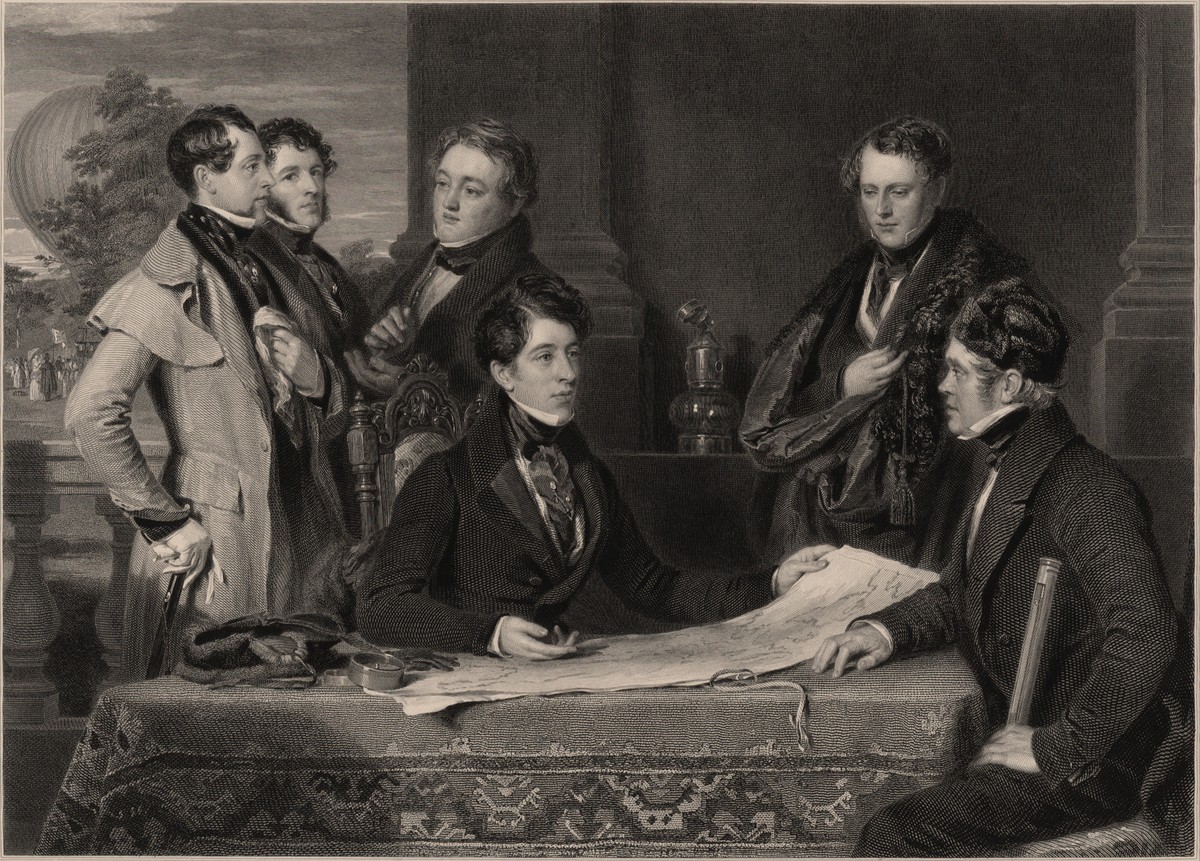
The people in the story were chosen with care, and most of them were real. Thomas Monck Mason, Robert Hollond and the professional aeronaut Charles Green had made one of the most celebrated balloon flights of the age. Mason’s own book, published in London in 1836, describes how the party left the Vauxhall Gardens at half past one on the afternoon of November 7, 1836, and came down the next morning in the Grand Duchy of Nassau, about two leagues from Weilburg. He gave the duration of the voyage as “exactly eighteen hours.” The balloon was afterward named “The Great Balloon of Nassau” at a ceremony after the landing, and the engraving above shows the three men with their friends, gathered over a map before that flight.
Poe’s hoax refers to this real voyage, though not quite accurately, and the errors are revealing. It credits Mason with a “voyage from Dover to Weilburg” in the balloon Nassau, which it says “occasioned so much excitement in 1837.” Mason himself had written that the flight began in London in 1836. The hoax also spells Hollond’s name as Holland throughout. Small slips like these were the kind of detail few readers could check on a busy Saturday morning, and they did nothing to slow the story down.
The technical detail came from the same world of published ballooning. Mason’s account explains at length how a guide-rope trailing on the ground could hold a balloon near one level, since the ground took more or less of the rope’s weight as the balloon rose and fell. The Victoria in Poe’s story carries one too, and the narrator stops to explain that it is “of the most indispensable importance.” That idea had a long life beyond the hoax. In 1897 the Swedish engineer Salomon August Andrée set out for the North Pole in a balloon steered partly by long ropes dragging on the surface, and the Andrée balloon expedition went wrong almost at once when some of those ropes came away.
The Crowd Outside the Sun
Poe described the reaction himself a few weeks later, in a letter dated May 21, 1844, that he sent as New York correspondent to the Columbia Spy of Pennsylvania. The Balloon-Hoax, he wrote, “made a far more intense sensation than anything of that character since the “Moon-Story” of Locke.” He said the square around the Sun building was “literally besieged” from soon after sunrise until about two in the afternoon. In his account, the Extra was promised for ten but not delivered until nearly noon, newsboys resold the first copies at almost any price, and he saw a half dollar paid for a single copy. He added, “I tried, in vain, during the whole day, to get possession of a copy.”
The comparison with Locke was pointed, and Poe knew exactly why. Nine years earlier the same paper had run the series of articles about life on the Moon now known as the Great Moon Hoax, usually credited to the journalist Richard Adams Locke. Poe noted that one reason for doubt in 1844 was precisely that the story had appeared in the Sun, which he called “the organ of the Moon-Hoax” The other reason was practical, since it was hard to see how an express could have outrun the mail from Charleston.
In the same letter Poe argued that the more intelligent readers believed the story while the rabble, for the most part, rejected it. He insisted that the Balloon-Story contained nothing “which is not in full keeping with the known facts of æronautic experience” He even predicted that a balloon might soon make the crossing for real, within a month or two. However, that boast should be read as Poe writing about his own unsigned work, and not as a neutral report.
The Retraction
The Sun did not keep the fiction going for long, and on Monday, April 15, it printed a short notice. The mails from the South had not confirmed the arrival of the balloon, it said, and “we are inclined to believe that the intelligence is erroneous.” The same notice praised the account for its “minuteness and scientific ability” and added, “We by no means think such a project impossible.” The Edgar Allan Poe Society of Baltimore, which publishes the text, notes that the author of the retraction has not been identified and suggests it may have been Poe himself.
Poe’s authorship of the hoax itself is accepted, whoever wrote the retraction. A revised version, which the Poe Society believes he prepared for a collection that was never printed, appeared as “The Balloon Hoax” in the collected Works of 1850, introduced by a note explaining that it was “originally published, as matter of fact,” in the New York Sun. That edition came out after Poe’s death in Baltimore in October 1849, so the framing note was the version his readers inherited. According to the Poe Society, only two copies of the original Extra appear to survive.
Why It Worked
Poe had thought about this kind of deception long before he wrote about the Victoria. Writing in Godey’s Lady’s Book in 1846, he recalled that his own earlier Moon voyage story, Hans Phaall, had appeared three weeks before the Sun’s Moon series, and that both tried “to give plausibility by minuteness of scientific detail.” He also complained that his own attempt to expose Locke’s story had found few listeners in 1835, “so really eager were all to be deceived.”
The Balloon Hoax used that method with real people and a real flying machine in mind. Its boldest claim was the crossing itself, and yet the story asked its readers to believe only that men who had already flown from London to Nassau had gone a little further. For a few hours on a spring Saturday in 1844, a large part of New York did.
Sources
- Poe, Edgar Allan. April 13, 1844. Astounding News by Express, via Norfolk! New York Sun, Extra. Text and notes, including the April 15 retraction, from the Edgar Allan Poe Society of Baltimore.
- Poe, Edgar Allan. 1850. The Balloon Hoax (reading copy). Works. Edgar Allan Poe Society of Baltimore. See also the society’s index of texts.
- Poe, Edgar Allan. May 25, 1844. Doings of Gotham, Letter II. Columbia Spy. Edgar Allan Poe Society of Baltimore.
- Poe, Edgar Allan. October 1846. The Literati of New York City, No. VI. Godey’s Lady’s Book. Edgar Allan Poe Society of Baltimore.
- Mason, Monck. 1836. Account of the Late Aeronautical Expedition from London to Weilburg. London: F. C. Westley. Internet Archive.
- Library of Congress, Prints and Photographs Division. A consultation previous to an aerial voyage from London to Weilburg in Nassau on the 7th day of November, 1836 (LCCN 2002724817, ppmsca.02281). Image source, catalog data consulted via the Wikimedia Commons file page.
