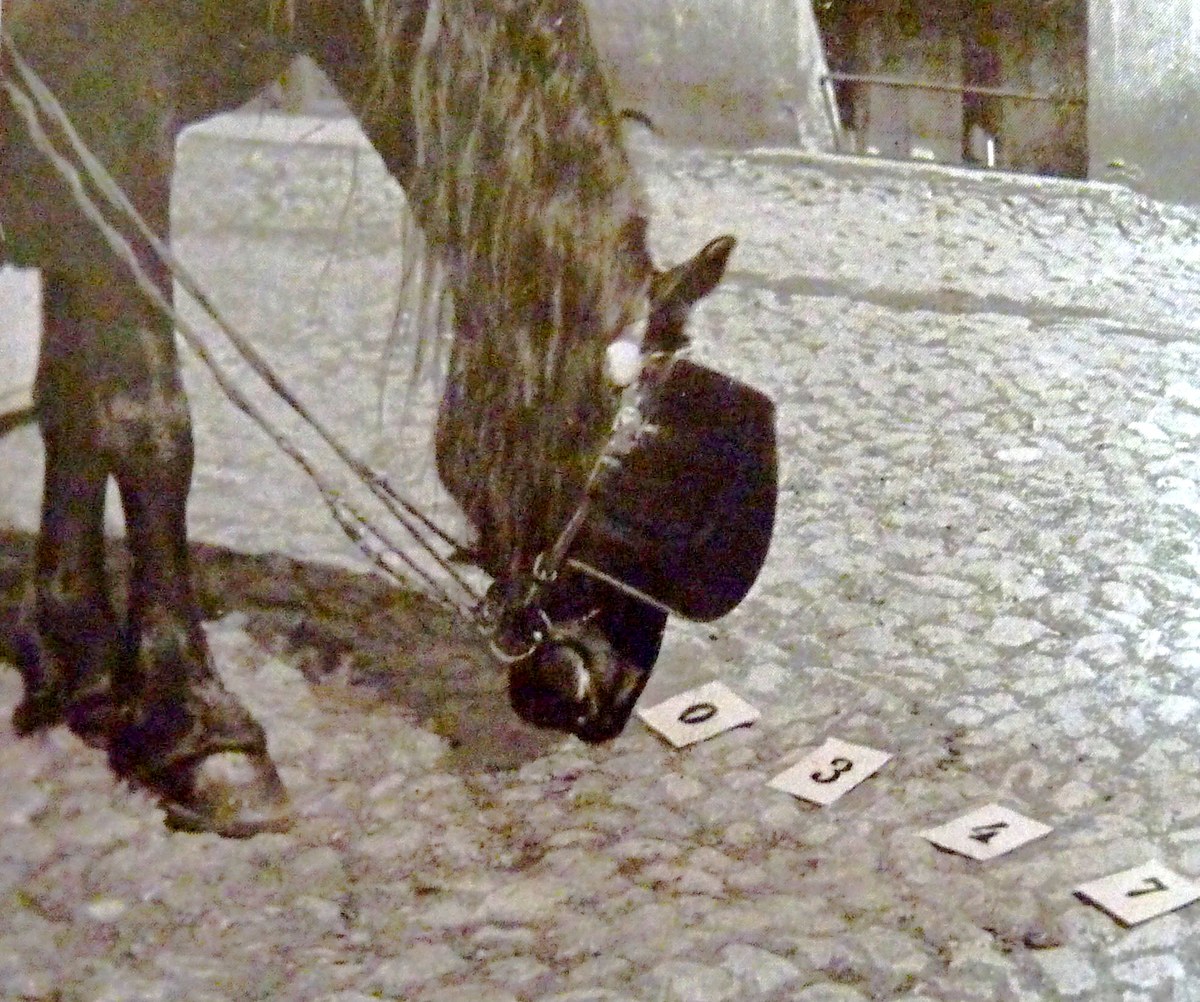

In the summer of 1904, visitors to a courtyard in the north of Berlin could watch a horse answer questions in arithmetic, name the days of the week and pick out colored cloths, all by tapping his right forefoot or nodding his head. His owner, Wilhelm von Osten, charged nothing to watch. The horse was called Hans, and to much of Germany he became Clever Hans.
According to the psychologist Oskar Pfungst, whose report on the case appeared in English in 1911, von Osten was “a man between sixty and seventy years of age” who managed the horse with rewards of bread and carrots instead of the whip, and “No fee was ever taken.” Pfungst described Hans as a Russian trotting horse. He also described his owner as a former mathematics teacher at a German gymnasium who had taught the horse with methods patterned, in the words of the expert commission that later examined him, on the instruction given in elementary schools.
A Panel of Experts Finds No Trick
What made Hans more than a curiosity was that he seemed to answer people other than his owner. The zoologist and African traveler Schillings arrived in the courtyard in July 1904 as a skeptic, according to the introduction by Carl Stumpf, director of the Psychological Institute at the University of Berlin. After receiving correct answers himself, Schillings became convinced and brought new visitors almost daily.
Public argument over the horse grew so fierce that a commission was formed to look for deliberate signals. On September 11 and 12, 1904, its thirteen members watched von Osten closely, with each assigned to a different part of his body, while the circus manager Paul Busch, the member most experienced in detecting tricks, studied his behavior as a whole. The panel included Stumpf, the director of the Berlin zoo, Ludwig Heck, and a physiologist from the University of Berlin.
Their report, dated September 12, found “that such signs are out of the question under the conditions which were maintained during this investigation.” The signatories went further and called Hans “a case which appears in principle to differ from any hitherto discovered,” worthy of serious study. They did not say the horse could think. They said they could find no trick, and that the question deserved a proper investigation.
Questions Nobody in the Room Could Answer
That investigation began on October 13, 1904, and ran until November 29. Stumpf worked with Dr. E. von Hornbostel, who kept the records, while Pfungst carried out the experiments. A canvas tent was put up in the courtyard to cut out distractions, and von Osten and Schillings were left out of most of the tests to head off any objection to the results.
The key idea was simple enough to state in one line, since a horse that could really count should be able to answer a question that nobody present knew the answer to. In one series, von Osten whispered a number into the horse’s ear, Pfungst whispered another, and Hans was asked to add them together. Neither man knew the total, and Pfungst recorded that in 31 such trials Hans gave the right answer only 3 times, and that when the same problems were repeated with the answer known, he got 29 of 31 right.
The same pattern held for counting objects and reading numbers that only the horse could see, and the tests with blinders gave a second, equally clear result. When large blinders kept Hans from seeing the questioner, his answers fell apart, and Pfungst recorded the “tragi-comic rage directed against the horse” from von Osten when the first of those trials failed.
What the Horse Was Really Watching
Pfungst then turned his attention from the horse to the people around him. Over many sessions he noticed that a questioner, having set a problem, would lean forward very slightly, and Hans would begin to tap. When the right number of taps was reached, Pfungst wrote, “the questioner would make a slight upward jerk of the head.” Hans stopped at that signal and brought his foot back to its resting place.
The movements were tiny, and in von Osten’s case they were the smallest of all, which helps explain why so many observers had missed them. Pfungst found similar cues in Schillings and in other people who had worked with the horse. Hans responded more or less readily to forty different people, but, Pfungst noted, “the horse would not react at all in the case of the greater number of persons.”
Stumpf’s report of December 9, 1904, set out the conclusion plainly. It stated that “The horse failed in his responses whenever the solution of the problem that was given him was unknown to any of those present,” and added: “Therefore he can neither count, nor read, nor solve problems in arithmetic.” When blinders hid the questioner from view, it said, the horse also failed. “He therefore required some sort of visual aid.”
Nobody Was Cheating
The most striking finding was that the cues were unintentional. Stumpf pointed out that Schillings and Pfungst had both received correct answers “without their being in any way conscious of having given any kind of signal.” Von Osten, by every account in the report, believed in his horse sincerely, and he went on believing even after the blinder tests failed.
To show how universal the movements were, Pfungst reversed the roles in the laboratory. He played the part of the horse himself, tapping with his right hand while a volunteer concentrated on a number, and stopping when he thought he saw the signal to end. He wrote that he “thus tested, all in all, twenty-five persons, of every age and sex (including children of five and six years).” With two exceptions, they made the same small involuntary movements that Hans had learned to read.
The chess-playing Great Chess Automaton of the 1770s also persuaded audiences that a thinking mind was at work, though it relied on a concealed human player. The case of Hans was different in kind, because nobody involved was trying to deceive anyone. James R. Angell, the University of Chicago psychologist who introduced the English translation, called it a tale of “credulity founded on unconscious deceit.”
What Pfungst Did Not Claim
Pfungst was careful about the limits of his result. In his conclusion he wrote that “The proof which was expected by so many, that animals possess the power of thought, was not furnished by Hans.” He added at once that “we must generalize this negative conclusion of ours with care,” because a domesticated horse trained in an unusual way could not stand for all animals.
His positive findings were about perception and attention. Hans, he concluded, had developed an extraordinary sensitivity to the slightest movements of the people questioning him, along with steady attention and a limited memory that tied those movements to a few habits of his own. In Pfungst’s words, “All higher psychic processes which find expression in the horse’s behavior, are those of the questioner.”
Hans did not vanish from the public eye after the investigation ended. Atlas Obscura reports that his next owner, the German merchant Karl Krall, went on to work with two later horses, Zarif and Muhamed, and that von Osten died in 1909 a disappointed man. Pfungst’s book, which Atlas Obscura dates to 1907 in the original German, gave the case the place it still holds in psychology textbooks.
Interest in thinking animals also reached the psychical researchers of the period. The Conversation notes that some of them began wondering about the possibility of telepathy in animals, and as late as 1935 the parapsychologist Harry Price looked into a family’s reports of a mongoose that could speak, as this site’s account of Gef the talking mongoose describes. Price never saw or heard the animal for himself.
The Clever Hans Effect
The horse’s name now stands for a problem in experimental design. Writing for The Conversation, the philosopher Matyáš Moravec defines the Clever Hans effect as one that “describes situations where the bad set up of an experiment causes the experimenter to unintentionally influence the subjects they are studying.” He notes that the same worry helped push researchers toward randomization, so that knowledge of the expected answer cannot shape the result.
Similar doubts have followed later claims about animal language. Atlas Obscura notes that popular interest in thinking animals remained vigorous throughout the 20th century, and as this site’s account of Koko the gorilla describes, questions over her signing turned on whether her handlers had emphasized the signs that made sense and whether she was simply copying their gestures to please them.
That is why the case still matters more than a century later. Hans never solved the sums put to him, yet he read the people around him well enough to baffle a commission of experts. The answer the 1904 tests found lay in the faces and shoulders of the people standing in front of the horse, who had no idea they were giving anything away.
Get the Historic Mysteries newsletter, free
Unsolved cases, strange sightings and hidden history, straight to your inbox.
Sources
- Pfungst, Oskar. Clever Hans (The Horse of Mr. von Osten): A Contribution to Experimental Animal and Human Psychology, translated by Carl L. Rahn, with an introduction by C. Stumpf and a prefatory note by James R. Angell (New York: Henry Holt, 1911). Includes the commission report of September 12, 1904, and Stumpf’s report of December 9, 1904. Project Gutenberg. Scan via Internet Archive.
- Moravec, Matyáš. How a ‘psychic’ horse named Clever Hans changed the way we do science. The Conversation.
- How Counting Horses and Reading Dogs Convinced Us Animals Could Think. Atlas Obscura, May 12, 2016.
