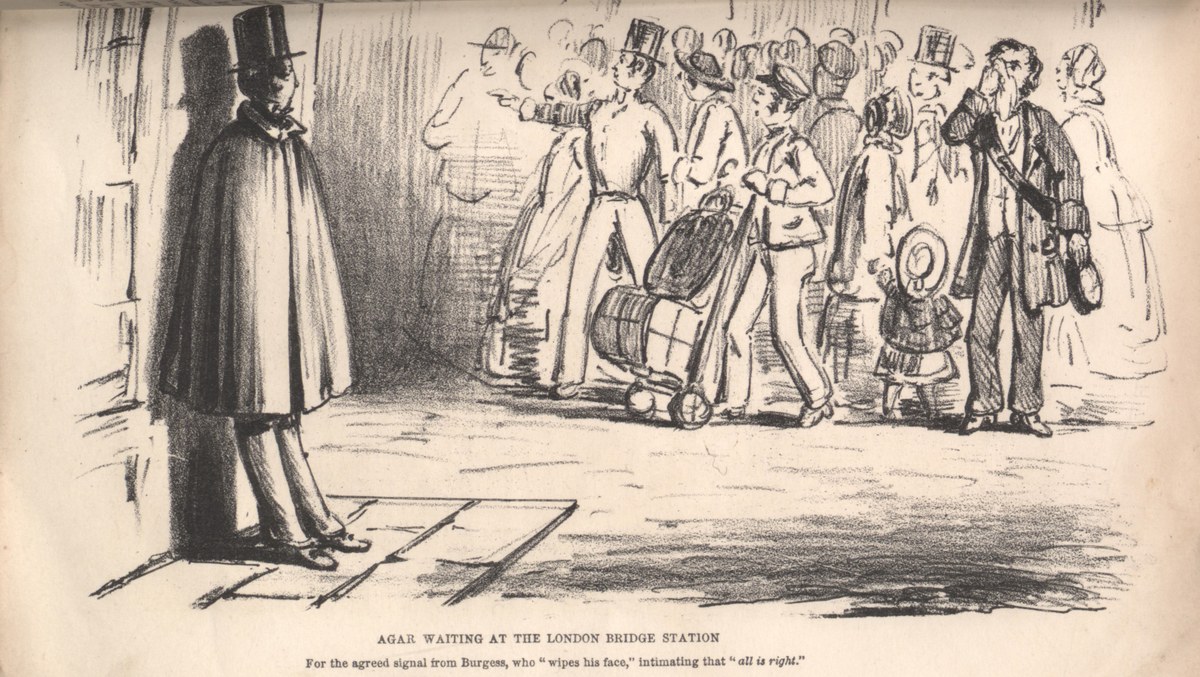

On the evening of May 15, 1855, three wooden boxes of gold bars and coins were delivered to the South Eastern Railway’s station at London Bridge to be sent to Paris. They were bound with iron bands, weighed and sealed, then locked inside iron safes for the journey by mail train to Folkestone and by steamer to Boulogne. When the boxes were opened in Paris, much of the gold had been replaced with shot, and nobody could say where on the journey it had gone.
The answer, when it came more than a year later, was a story of copied keys, a corrupt guard and a team of thieves who did their work inside a moving train. Most of what is known comes from the trial of January 1857 and the evidence of the man who planned the job and then turned on his partners.
A Robbery Nobody Could Place
The Annual Register for 1857, which printed a long account of the trial, sets out how the theft was discovered. The boxes were weighed in London, again at Boulogne and again in Paris. The weights at Paris matched those at Boulogne but differed from those taken in London, so the robbery had to have happened somewhere between London and Boulogne. Beyond that, the Register says, the investigation for some time appeared to afford no clue to the criminals.
The haul was large by the standards of any period. The indictment charged the thieves with stealing 200 pounds weight of gold worth £12,000, the property of their employers, the South Eastern Railway Company. The Science Museum Group still holds a South Eastern Railway bullion box containing lead shot that it describes as coming from the robbery.
The precautions had seemed sound to the railway. According to the Register, the safes were secured by Chubb’s patent locks, and the keys were entrusted to confidential servants of the company. The guard usually took the safes into his own van to watch over them.
Four Men and Two Keys
The plan began with William Pierce, who had worked for the railway as a ticket printer until he was dismissed in 1850. He brought it to Edward Agar, a career criminal who knew locks. Agar testified that when Pierce first proposed the robbery he declined, because “I thought that the thing was impracticable.” When they met again after Agar’s return from America, he told Pierce that it “would be impossible to do it unless an impression of the keys could be procured.”
Pierce had two railwaymen in mind to solve that problem. James Burgess was a guard on the mail trains, and William Tester was a clerk in the superintendent’s office who, according to the South East Community Rail Partnership, arranged the roster of guards and knew when gold was on board.
Getting copies of the keys took months of patient work. Agar said he and Pierce took rooms in Folkestone and watched the bullion chest arrive and leave, until “the police took notice of us, and the inspector followed Pierce.” The breakthrough came when the chest went to Chubb’s for repair after a key went missing, and Tester produced the keys at a beer shop in Tooley Street, where Agar took an impression of one in a bedroom. The second key was copied in Folkestone when Pierce slipped into the railway office and lifted it from a cupboard while the clerks were out, and Agar took the impression at the door.
When Agar told Burgess about the Folkestone key, he said the guard replied, “It is a good job, and I will do my best to assist you.” Agar then filed blank keys to match and rode seven or eight times with Burgess to test them on the lock before they worked.
Inside knowledge did as much work as skill, which is often the case in a successful theft. As this site’s account of the theft of the Mona Lisa describes, the man who took the painting from the Louvre in 1911 had previously worked in the museum.
The Night of May 15
Agar and Pierce bought lead from the shot tower near Hungerford Bridge and divided it into small bags, which they hid in courier bags and carpetbags. On the night itself, Agar said, he waited near London Bridge station until “Burgess came out of the station and wiped his face. This was the appointed signal to indicate that bullion was going down.” Earlier, Tester had told him “All right” in a hurried manner.
Pierce took a first-class seat while Agar jumped unseen into the guard’s van, where “Burgess threw his apron over me.” Once the train was moving, Agar opened the first safe, forced a box and took out gold bars, replacing them with shot. At Reigate, as Agar named the stop, he handed a bag of gold to Burgess and heard Tester on the platform asking for it. He then opened a box of American gold coins and a box of small bars, filled the gaps with shot and resealed everything with seals and a wax taper he had bought for the purpose.
The safes came off at Folkestone as usual, while Agar and Pierce rode on to Dover with their bags. Agar said he went to the pier and “threw my chisels and other tools into the sea,” before the two men caught the night train back to London. The gold was melted down in a furnace built into the floor of a back bedroom at Agar’s house in Shepherd’s Bush, and some of it was sold. Agar said that he, Pierce and Tester took £600 each and Burgess £700.
Planning on that scale is what still sets the robbery apart from most thefts of its time. As this site’s account of the Acassuso robbery describes, thieves spent two years organizing their 2006 raid on a Banco Rio branch in Argentina.
How Fanny Kay Brought It Down
The case broke for reasons that had nothing to do with detective work. In October 1855 Agar was convicted of uttering a forged check and sentenced to transportation for life. According to the Register, he arranged for Pierce to take charge of his money on the understanding that a woman by whom he had a child would be provided for. Pierce did so for a time, then stopped, and the woman and her child fell into great distress.
She was Fanny Kay, who had once worked at the refreshment room at Tonbridge station and had lived with Agar in Shepherd’s Bush. At the trial she described the strange weeks after the robbery, when Agar and Pierce shut themselves upstairs. She told the court that the noise from the room was “like the roaring of a large fire” for several days. When she asked what they were doing, the only answer she ever got was “Leather-apron weaving.”
After Pierce refused her money, Fanny Kay went to the Governor of Newgate prison and told him what she knew. Agar, learning how she had been treated, gave a full account of the robbery. However, a thief’s word alone was a weak basis for a conviction, and the prosecution needed more. A stream of porters, waiters, cab drivers and bullion dealers corroborated parts of Agar’s story, and the company’s solicitor told the court he had found small bits of gold under the floorboards in the Shepherd’s Bush house.
The Verdict
The trial took place at the Central Criminal Court in January 1857 before Baron Martin. The defense argued that Agar’s account had been corroborated on the details of the robbery but not on who had taken part. However, the jury convicted all three. Pierce, who had left the railway’s service years before, was found guilty only of simple larceny, while Burgess and Tester were convicted on the first count of stealing from their employers.
The sentences reflected that difference in the verdicts. Pierce received two years of hard labor, and the judge said he regretted being compelled to pass a lighter punishment on him than on the others. Burgess and Tester were sentenced to 14 years’ transportation. According to the South East Community Rail Partnership, Fanny Kay later moved to Hastings with tuberculosis and died there in 1858, aged 27.
Moving gold safely remained a serious problem long after 1855. When bullion was sent to the United States depository, as this site’s account of the gold at Fort Knox describes, it went by mail with a team of sharpshooters armed with machine guns.
From Courtroom to Fiction
The robbery found a second life in 1975, when Michael Crichton made it the basis of his novel The Great Train Robbery. The London Bullion Market Association describes the book as a heavily fictionalized version of the 1855 theft and notes that Crichton went on to write and direct a 1978 film based on it. The historian Miriam Bibby, writing for Historic UK, calls the film a farcical comedy, with a cast including Sean Connery and Donald Sutherland.
The real story hardly needed any invention from a novelist. The Register observed that Agar’s evidence was not shaken by cross-examination beyond what could be inferred from his criminal character. Two trusted railway employees, a dismissed ticket printer and a check fraudster had emptied the safes on a moving train, and only a quarrel over money for a mother and child exposed them.
Get the Historic Mysteries newsletter, free
Unsolved cases, strange sightings and hidden history, straight to your inbox.
Sources
- The Annual Register, or a View of the History and Politics of the Year 1857, volume 99, Chronicle, January, pages 8 to 16. London, 1858. Internet Archive.
- Bullion box containing lead shot, object co224559. Science Museum Group Collection.
- Gray, Sharon. Railway 200 Blue Plaque: First Great Train Robbery. South East Community Rail Partnership, July 28, 2025.
- Sencicle, Lorraine. Great Bullion Robbery, parts I and II. Dover Historian, June 2014.
- Bibby, Miriam. The Great Gold Robbery of 1855. Historic UK.
- The Great Train Robbery (the novel). LBMA, Wonders of Gold.
