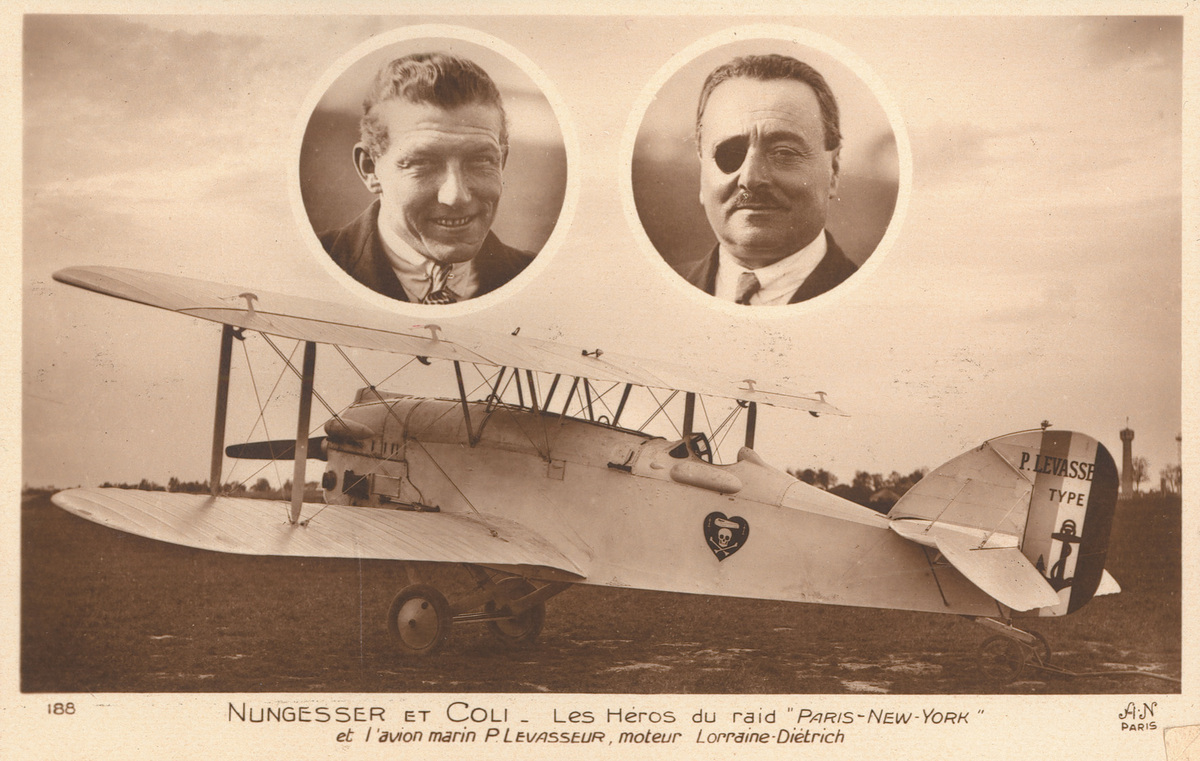

At 5:18 in the morning on Sunday, May 8, 1927, the pilot Charles Nungesser and the navigator François Coli took off from Le Bourget, outside Paris, in a heavily loaded white biplane called L’Oiseau Blanc, the White Bird. They were aiming to fly nonstop to New York, a crossing nobody had yet made. Minutes after takeoff, as planned, they dropped the plane’s landing gear over Gonesse. That landing gear is now on display at the Musée de l’Air et de l’Espace, which describes it as all that remains of the aircraft.
Nungesser and Coli were never seen again, and no confirmed trace of their plane has been found since that morning. Twelve days later Charles Lindbergh took off from New York and landed in Paris, and the race the two Frenchmen had entered passed into American legend. Nearly a century on, at least four different endings have been proposed for their flight, and none of them has been proven.
A Race Across the Atlantic
The prize at stake was the Orteig Prize, offered in 1919 for the first nonstop flight between Paris and New York in either direction and worth $25,000, according to an editor’s note in a 1983 French report on the flight that the aircraft search group TIGHAR has translated and published. The report, written by Clément-Pascal Meunier, describes a crowded field. Quotations from it here are TIGHAR’s English translation, not Meunier’s French. A Paris newspaper listed five crews preparing to fly from Paris to New York that spring and four more planning to go the other way.
Nobody had yet flown nonstop from Paris to New York, and Meunier notes that construction of the White Bird began in mid-February 1927, giving the builders little more than two and a half months before the flight. Speed mattered, because only the first crew across would win. In April, Meunier notes, La Presse openly asked whether Nungesser and Coli or an American crew including Bert Acosta would make the crossing first. The museum describes the Levasseur PL.8 as a single-engine aircraft with a flying boat hull, fitted with an ordinary landing gear designed to be released once it was airborne.
The Last Sighting
Escort planes followed the White Bird to the coast. According to Meunier, it passed over the cliffs at Étretat at 6:48 that morning, headed out over the English Channel toward England, and vanished from the escorts’ view. In the days that followed, reports placed it over England, Ireland, Newfoundland, Nova Scotia and Maine. Retractions followed almost as quickly.
One report went much further than a sighting, and it caused uproar in France. On May 10 some Paris newspapers, La Presse among them, announced that the aviators had landed in New York, and crowds celebrated in the streets. Meunier writes that the government ordered an inquiry into how the false news had spread, but that he could find no trace of its report. He also found that French official archives held almost nothing on the flight.
The search on the other side of the Atlantic proved no more conclusive than the French inquiry. TIGHAR’s overview of its own project, which it named Project Midnight Ghost, says a “frantic but fruitless search” for the two men dominated the headlines until Lindbergh took off on May 20. TIGHAR says the name comes from Lindbergh himself, who described the two men as having “vanished like midnight ghosts.”
Theory One: The Channel
The simplest explanation is that the overloaded plane went down soon after leaving France. Meunier writes that experts raised the idea of a crash in the Channel only two days after the departure, and that Léon Nungesser, the pilot’s half brother, said publicly that he feared it. A 1980 statement from Normandy claimed the plane had come down off Étretat and floated for some time before it sank, and Meunier writes that such statements made it seem desirable to re-examine the case.
However, Meunier did not believe the plane had come down so close to home. Weighing that statement against witnesses further along the route, including an Irish man who had watched a plane head out toward the Atlantic as an eight-year-old boy, he concluded, in TIGHAR’s translation, that “the probability of l’Oiseau Blanc’s crossing England and Ireland is very great.” His final line, as TIGHAR translates it, was blunt: “It is beyond Ireland, and not in the English Channel, that Charles Nungesser and François Coli very likely disappeared.” The Channel has swallowed other aircraft, as this site’s account of the disappearance of Glenn Miller describes, when his small plane vanished over it in fog in December 1944.
Theory Two: Newfoundland
If the White Bird crossed the ocean, Newfoundland lay in its path. Meunier collected reports published in May 1927 by the newspaper The Evening Telegram, many of them taken as depositions by a local magistrate. Several people in and around Harbour Grace said they had heard an aircraft engine at about half past nine on the morning of May 9, although fog kept them from seeing it, and one of them assumed it was a plane hunting seals.
The reports did not hold up for long. On May 17, Meunier notes, The Times reported that investigators at Harbour Grace now believed the witnesses had been “self-deluded.” TIGHAR’s translation gives that paragraph from the English original. However, Meunier adds that he never found a single French report of any witness withdrawing a statement. On his reconstruction, a White Bird over Newfoundland that morning would have had only about seven hours of fuel left, too little to reach New York.
The Newfoundland trail has drawn the most modern searching. CBC News reported in 2022 that residents of the Cape Shore said at the time that they had watched the plane fly overhead, and that some later spoke of wreckage in a body of water called Gull Pond. Ric Gillespie, the executive director of TIGHAR, told the broadcaster that there were “no active aircraft in Newfoundland on May 9, 1927,” so anything seen or heard that day must have been the White Bird. However, his group had found nothing conclusive in Newfoundland after searching there since 1992, apart from part of a blue-painted steel cylinder that Gillespie called of unknown origin.
Theory Three: Saint-Pierre and Miquelon
Close to Newfoundland lies the small French archipelago of Saint-Pierre and Miquelon. Meunier recorded the account of a Saint-Pierre fisherman, Pierre-Marie Lechevallier, as it was passed on through two other men. On the morning of May 9, in thick fog, the fisherman said he heard an aircraft engine grow louder and then, in TIGHAR’s translation of the account, “a great crash like something very heavy fell into the sea,” after which his dog began to howl.
Meunier treated the fisherman’s story with real caution, and he gave his reasons. Lechevallier first told it in September 1930, more than three years later, and he finished his day’s fishing before returning to port. Meunier found it hard to understand why a man who believed he had heard a crash did not hurry back to raise the alarm, and why he then kept silent for three years while the whole island followed the search. The French public broadcaster’s Saint-Pierre service reported in 2012 that the aviation enthusiast Bernard Decré had been searching the seabed off the islands since 2009, and that a sonar and magnetometer survey had found a mass of roughly 200 kilograms. Navy divers who examined the spot found nothing. Decré, quoted by the broadcaster, admitted that the target could be an anchor or a piece of fishing gear rather than the engine, and said the odds of it being the engine were about the same as winning the lottery.
Theory Four: Maine
The oldest of the modern searches began in Maine. TIGHAR writes that a 1980 magazine article by the writer Gunnar Hansen retold local stories about Anson Berry, a hermit in the woods of Washington County who was said to have heard an airplane crash on a foggy morning in 1927. The area lay on the flight’s planned route, and some thirty hunters later described finding a large engine partly buried in the ground.
Starting in 1985, TIGHAR says, it mounted twenty wilderness expeditions with more than 200 volunteers and found “no hard evidence that such a crash had ever occurred.” Gillespie put it more simply to CBC News, saying his group had looked in Maine for eight years and “found nothing but stories.” The same group has also spent years searching for Amelia Earhart, a trail that led it to the Pacific island of Nikumaroro, as this site’s account of Earhart’s last flight describes.
What Remains
Each ending has its witnesses, and each has the same gap. No piece of the aircraft found anywhere has been shown to come from the White Bird, and the documents Meunier hoped to find had mostly never been kept. As this site’s account of five aerial disappearances describes, the natural conjecture was that Nungesser ditched in the Atlantic, though others pointed to Newfoundland or Maine.
Near the end of his report, in TIGHAR’s translation, Meunier wrote a sentence that still stands: “The case of the disappearance of Nungesser and Coli is not closed.” Until something else turns up, the landing gear in the museum near Le Bourget remains the only confirmed part of the flight that ever came back to earth.
Get the Historic Mysteries newsletter, free
Unsolved cases, strange sightings and hidden history, straight to your inbox.
Sources
- CBC News. A researcher has spent decades trying to unravel the mystery of a 95-year-old missing plane, June 18, 2022. cbc.ca.
- Meunier, Clément-Pascal. The French Report, 1983, introduction and chapters 5 and 6, translated by TIGHAR. tighar.org.
- Musée de l’Air et de l’Espace. Train d’atterrissage du Levasseur PL.8 Oiseau Blanc. museeairespace.fr.
- Outre-mer La 1ère. Le mystère de l’Oiseau Blanc reste entier, June 29, 2012. la1ere.franceinfo.fr.
- TIGHAR. Project Midnight Ghost. tighar.org.
