The Olmec civilization, often called the “mother culture” of Mesoamerica, flourished along the Gulf Coast of present-day Mexico from roughly 1200 BCE to 400 BCE. They built monumental cities, carved colossal stone heads, and laid the spiritual foundations for the Maya and Aztec civilizations that followed. Yet despite this profound influence, the Olmec remain deeply mysterious, and nowhere is that mystery more striking than in their religion, a belief system we can only partially reconstruct from stone and silence.
At the center of that religion stands a haunting, half-human figure: the werejaguar. Part infant, part predator, this supernatural entity appears again and again in Olmec art – carved into jade, sculpted in basalt, and painted on cave walls. It is the most recognizable symbol of a lost faith, and scholars have been arguing about what it means for nearly a century.
What Was the Olmec Religion?
The Olmec left behind no written texts. Unlike the Maya or Aztec, who recorded their myths in codices and inscriptions, the Olmec had no known writing system capable of preserving theology. What we know of their religion comes entirely from archaeological evidence: monuments, figurines, altars, and cave paintings. Scholars piece together the picture using a method known as the “Continuity Hypothesis,” which works backward from better-documented later Mesoamerican cultures to interpret Olmec iconography. (Joralemon, 1971)
From this work, a picture emerges of a cosmos divided into three realms – sky, earth, and underworld – each populated by distinct supernatural beings. Scholar Peter David Joralemon identified at least eight Olmec deities, including the Olmec Dragon, the Maize God, a Rain Spirit, and a Bird Monster. These figures recur across Olmec art in ways that suggest an organized, sophisticated religious system, one that almost certainly involved ritual, sacrifice, and shamanic practice. The Olmec civilization was, in many ways, the template from which all later Mesoamerican religion was drawn.
The Werejaguar: Four Competing Theories
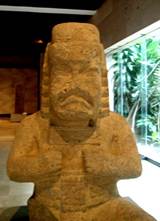
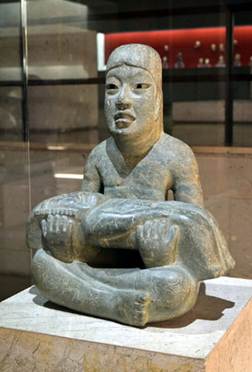
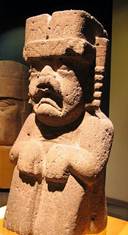
The werejaguar is defined by a distinctive set of physical features: a cleft or indented head, slanted almond-shaped eyes, a downturned mouth with thick lips, and often a toothless, infantile appearance, writes the Penn Museum. These figures appear across hundreds of Olmec artifacts, from tiny jade amulets to massive stone altars. What they represent, however, is fiercely debated.
The earliest theory, proposed by archaeologist Matthew Stirling, held that the werejaguar was the mythological offspring of a human woman and a male jaguar. Certain Olmec monuments, including carvings at Potrero Nuevo and murals in the Oxtotitlán caves, were interpreted as depicting this union. The resulting divine lineage, in this view, legitimized the rule of Olmec elites who claimed descent from the jaguar.
A more widely accepted modern interpretation sees the werejaguar through the lens of shamanism. In many indigenous American cultures, the jaguar is the apex predator and the spirit companion (nagual) of the shaman. According to this view, werejaguar figures depict not a mythological race but the moment of shamanic transformation, the shaman merging with their jaguar spirit to access the supernatural realm. This reading is supported by the werejaguar’s frequent association with ritual objects and its appearance in contexts suggesting trance and spiritual power.
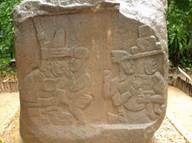
A third theory links the werejaguar specifically to rain and agricultural deities. The cleft head is associated with the indentation from which maize sprouts, connecting the figure to the Olmec Maize God. Werejaguar infants appear in the arms of adult figures on monumental altars – most famously on Altar 5 at La Venta – which some scholars interpret as rain-making rituals or offerings to water deities. The crying or weeping expressions seen on many figures reinforce this connection.
A fourth, more controversial theory suggests the werejaguar’s physical features (the epicanthic folds, flattened nose, and open mouth) were inspired by individuals born with congenital conditions such as Down syndrome. In this reading, such individuals may have been regarded as spiritually significant, their distinctive appearance seen as a mark of divine favor. While intriguing, this interpretation remains highly contested.
Why Do We Know So Little?
The silence surrounding Olmec religion is not accidental – it is the product of geography, time, and deliberate destruction. The Olmec heartland in the tropical lowlands of Veracruz and Tabasco is one of the most hostile environments on earth for the preservation of organic materials. High humidity and acidic soils have consumed any wooden carvings, textiles, or early written records that may once have existed. What survives are only the imperishable materials: basalt, jade, and stone.
The Olmec also experienced periods of dramatic upheaval. Cities like San Lorenzo were abandoned and their monuments deliberately mutilated or buried, a practice whose purpose remains unclear. This intentional destruction further erases the record. We are left with the statues but not the stories, the symbols but not the theology. The werejaguar stares out from jade and stone, silent about the world that created it.
The Olmec religion and the werejaguar remain among the great unsolved puzzles of ancient history. Whether the figure represents a mythological ancestor, a transforming shaman, or a deity of rain and maize, it endures as the most powerful symbol of Mesoamerica’s first great civilization, a silent guardian of a faith the world has lost.
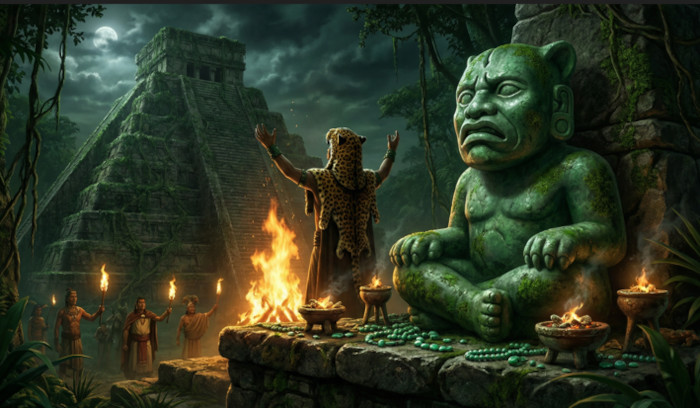
Top image: AI representation of an Olmec werejaguar ceremony. Source: AI Generated.
By Gary Manners
References