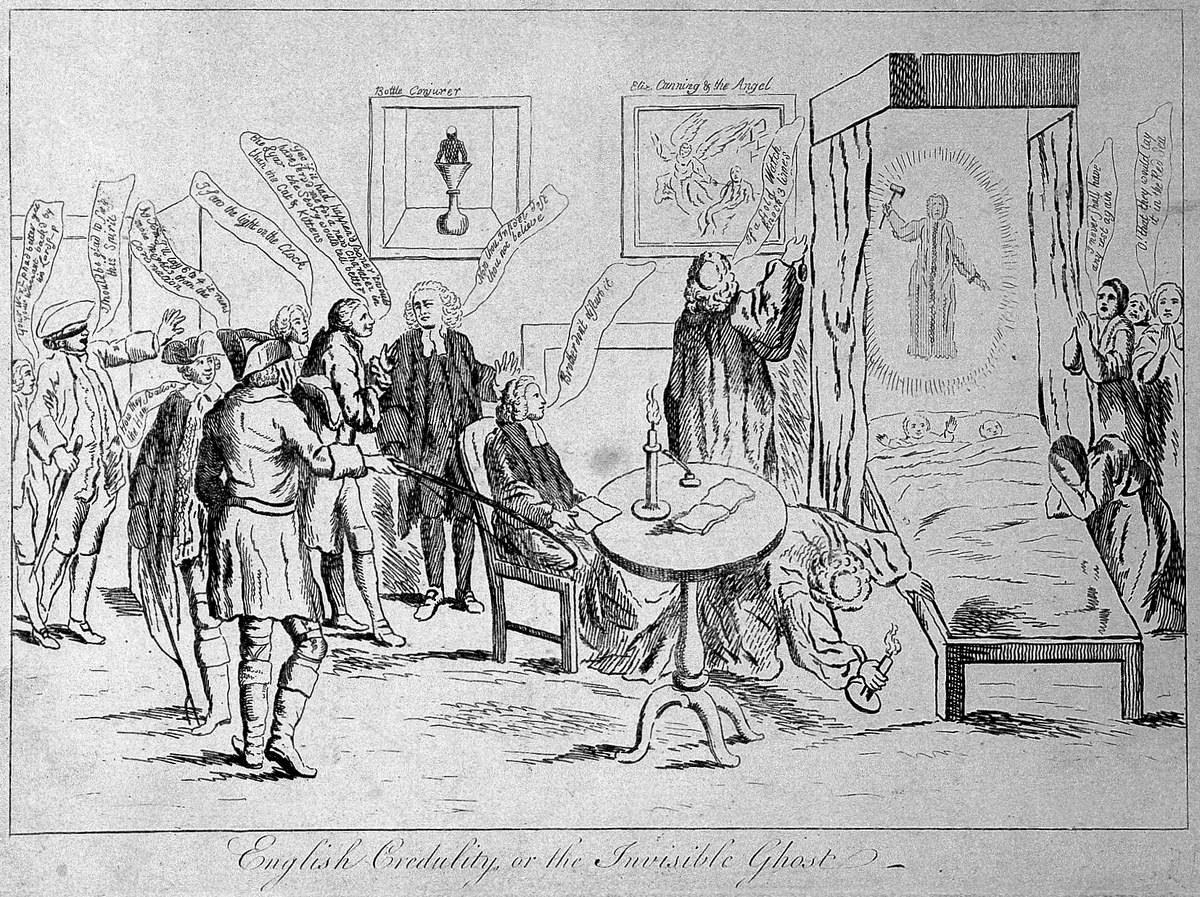

For a few weeks in early 1762, a small house in Cock Lane, in the City of London, became one of the most talked about addresses in the capital, as people queued in the street to sit in a child’s bedroom and listen for knocks and scratches. The noises, they were told, came from the ghost of a young woman named Fanny, and the ghost had a message. She had been poisoned, it seemed to say, by the man she had lived with.
That man was William Kent, and he was very much alive. The story of the Cock Lane ghost is often told as a comic tale of London credulity, but for Kent it was something far more serious. He was being accused of murder by a voice no court could cross-examine, at a time when murder was a hanging offense.
A Couple Who Could Not Marry
According to the Samuel Johnson Birthplace Museum in Lichfield, Fanny Lynes was the sister of Kent’s first wife, Elizabeth, who had died after the birth of their first child. Fanny came to help with the baby, who also died, and she and Kent fell in love. Church law at the time did not allow a man to marry his late wife’s sister, so the couple moved to London and lived together as husband and wife.
They took lodgings with Richard Parsons, a parish clerk in Cock Lane, near Smithfield Market. The Society for Psychical Research’s encyclopedia, drawing on earlier histories, describes Parsons as a “heavy drinker with a tendency to run into debt,” and says Kent lent him twelve guineas. While Kent was away, Parsons’s eldest daughter Elizabeth, then about eleven, was asked to keep Fanny company at night, and the two reported hearing knocks and scratching in the house.
The friendship between the two men soured when Parsons failed to repay the loan, and Kent and Fanny moved out to temporary lodgings while a house in Clerkenwell was made ready for them. There Fanny, heavily pregnant, fell ill. Her doctor and apothecary agreed that she had smallpox, and the museum records that she died on February 2, 1760.
The Noises Return
The knocking started again in the Parsons house in 1761, and it always seemed to center on young Elizabeth. Her father called in John Moore, an assistant preacher at the nearby church of St Sepulchre, who devised a code of one knock for yes and two for no. Through that code, the “spirit” identified itself as Fanny and said she had been killed with arsenic given to her by Kent, which would mean the smallpox diagnosis was wrong.
London’s papers took up the story with enthusiasm. The museum says the Public Ledger accused Kent of luring Fanny to London and poisoning her, and the encyclopedia notes that press reports called the ghost “Scratching Fanny.” By late January the General Evening Post was reporting that “Great numbers of people continue assembling before the Clerk’s house in Cock-lane.” Visitors included Prince Edward, the king’s younger brother, and the writer Horace Walpole, and Parsons charged them a fee to come in.
However, Walpole was not much impressed by what he heard. In a letter of January 29, 1762, quoted by the literary historian Sean Gaston, he noted that the ghost only knocked and scratched and “does not pretend to appear or speak.” Gaston adds that, apart from some Methodist sympathizers, few people at the time saw the affair as anything but a clear case of superstition.
Kent tried to meet the accusation head on. The museum says he attended a séance himself, at which the knocking “spirit” confirmed that he would hang. The sessions moved from house to house, and wherever Elizabeth was taken, the noises seemed to follow.
A Night in Clerkenwell
With crowds blocking the street, the Lord Mayor of London, Sir Samuel Fludyer, stepped in. According to Gaston, he ordered that no “Expence or Trouble” should be spared “in detecting the Fraud.” From the outset, Gaston writes, the authorities regarded the ghost as a fraud, and “They did not take the murder charge seriously.” The question was how the sounds were being made.
Samuel Johnson was among those invited to find out. On the night of February 1, 1762, a group of “many gentlemen eminent for their rank and character” gathered at the house of the Reverend Stephen Aldrich in Clerkenwell. Johnson’s account, published in the newspapers the next day, describes how the child had been put to bed “with proper caution” by several ladies, and how the men sat in the room for more than an hour without hearing anything.
When they went downstairs, they questioned Elizabeth’s father, who “denied, in the strongest terms, any knowledge or belief of fraud.” The ghost had supposedly promised to knock on Fanny’s coffin in the vault of St John’s Church, Clerkenwell, so at one in the morning the party went into the church, and the gentleman to whom the promise had been made went down into the vault with another member of the party. Nothing happened there either, and Johnson recorded that “no evidence of any preter-natural power was exhibited,” and the whole assembly concluded “that there is no agency of any higher cause.”
Johnson’s part in the affair was later turned against him. The poet Charles Churchill caricatured him as “POMPOSO,” a believer in the ghost. James Boswell, in his Life of Johnson, set out to correct the record, insisting that Johnson “was one of those by whom the imposture was detected.”
The Coffin and the Courtroom
The noises did not stop at once, and the affair dragged on for several more weeks. Gaston writes that toward the end of February the Annual Register reported a small piece of wood, “four inches broad, and six long,” found on the child as she lay in bed. Elizabeth was about eleven years old and in the care of the adults who had made her room a public spectacle, and it was those adults whom the authorities would hold to account.
On February 25 the coffin in the vault at St John’s was opened to settle a rumor that Fanny’s body had been removed. The museum records that it was still there, and John Moore, who was present, publicly withdrew his support for the ghost. The same day, according to the encyclopedia, a pamphlet titled The Mystery Revealed, probably written by Oliver Goldsmith, declared Kent innocent. Goldsmith complained, as Gaston quotes, that Kent had been “branded without an accuser,” and that the ghost “has served to make one man completely unhappy.”
With the ghost discredited, Kent turned to the courts to clear his name for good. Richard Parsons, his wife, John Moore and others were charged with conspiracy, and the case came to trial at the Guildhall on July 10, 1762, before Lord Mansfield, the Lord Chief Justice. The museum says the judge spent 90 minutes summing up and the jury took 15 minutes to find the defendants guilty.
Parsons was sentenced to two years in prison and to stand three times in the pillory, where, the museum notes, the crowd took pity on him and collected money for him. The encyclopedia adds that his wife received one year and a servant six months. Moore and another defendant paid Kent damages of several hundred pounds. In Gaston’s summary, the court cleared Kent of any wrongdoing.
Rumor Versus Record
The Cock Lane ghost quickly became a byword. Hogarth worked it into satirical prints, playwrights put it on stage, and the engraving English Credulity or the Invisible Ghost mocked the believers. London had a taste for this kind of public folly. In 1749, as this site’s account of the Great Bottle Conjuror explains, a promised performance that never took place ended with an angry crowd wrecking a theater.
However, later writers were reluctant to let the mystery rest. In 1841 Charles Mackay wrote that the “precise manner in which the deception was carried on has never been explained,” and in 1896 the folklorist Andrew Lang concluded that “from the true solution of the problem we are as remote as ever.” In the twentieth century the author Colin Wilson went further and argued that it had been a genuine poltergeist, a view that rests on belief more than on anything in the 1762 record.
Ghost scares in London could have deadly results. In 1804, as described in this site’s account of the Hammersmith Ghost, fear of a phantom ended with an innocent man shot dead and a murder trial. More recently, the knocking noises reported by two girls in a north London council house were at the heart of the Enfield haunting of 1977.
What the contemporary record shows about Cock Lane is clearer than the legend. A ghost that only knocked was used to accuse a man of murder in the press and in crowded rooms, a committee of respected men found no sign of anything supernatural, and a jury convicted the adults responsible. The knocking has long since faded from Cock Lane, but the record of how close it came to costing an innocent man his name, and possibly his life, still survives.
Get the Historic Mysteries newsletter, free
Unsolved cases, strange sightings and hidden history, straight to your inbox.
Sources
- Gaston, Sean. An Event Without An Object: The Cock Lane Ghost, London 1762 to 1763. The Literary London Journal, 12:1 to 2 (Spring/Autumn 2015). PDF.
- Samuel Johnson Birthplace Museum. The Strange Case of Samuel Johnson and the Cock Lane Ghost Affair, with Johnson’s 1762 account as an addendum. Samuel Johnson Birthplace Museum.
- Boswell, James. The Life of Samuel Johnson, vol. 1, on the Cock Lane ghost. Classic Literature Library.
- Willin, Melvyn. Cock Lane Ghost. Psi Encyclopedia, Society for Psychical Research.
