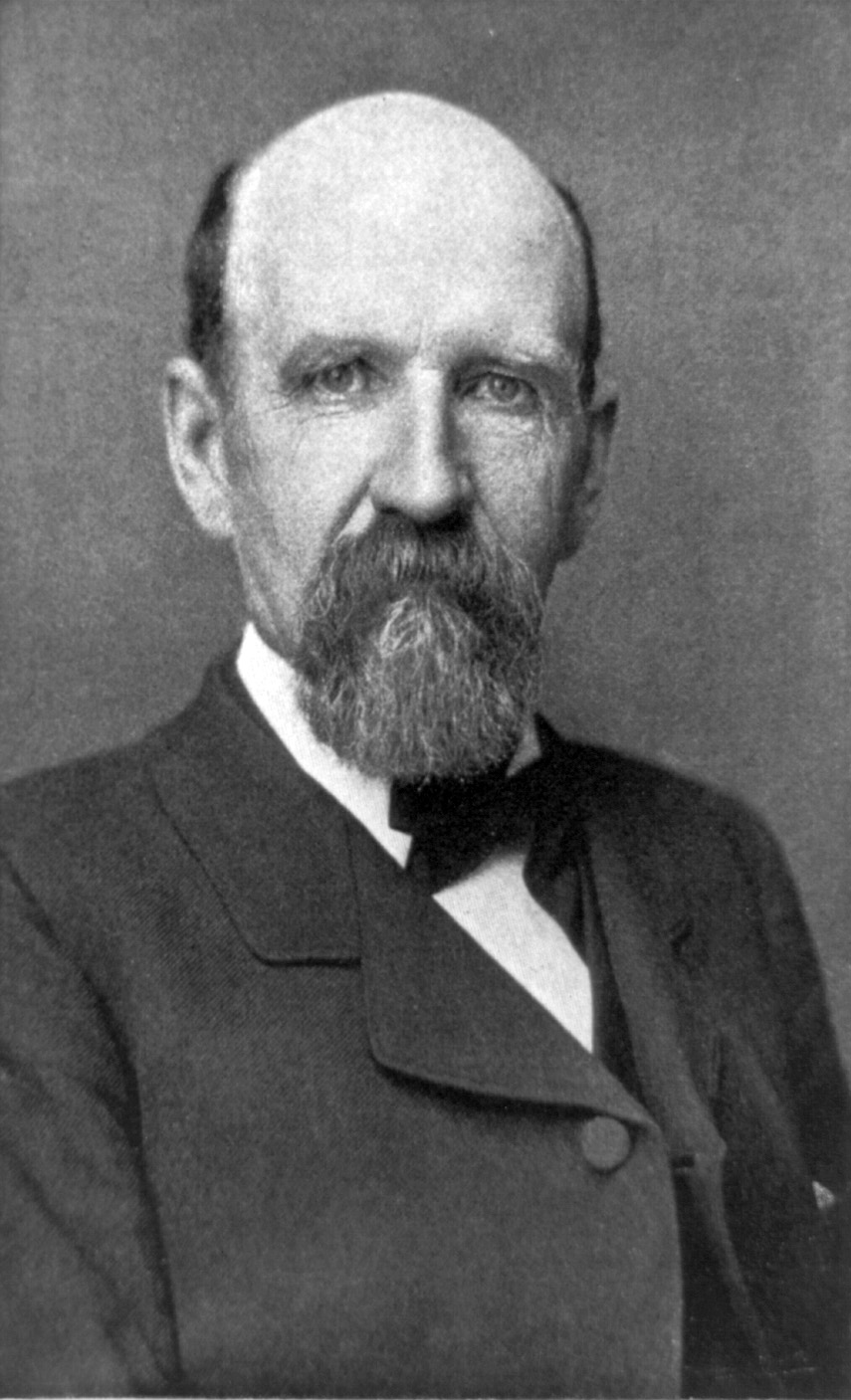

By the autumn of 1909 Joshua Slocum was one of the most famous sailors in the world. Eleven years earlier he had brought his small sloop Spray into Newport, Rhode Island, as the first person known to have sailed alone around the globe, and his book about the voyage had made him a celebrity on both sides of the Atlantic. When he set out from Massachusetts again that November, it seemed like one more winter cruise for a man who had spent most of his life at sea, and yet that voyage would end in silence.
Slocum was born on February 20, 1844, at Mount Hanly in Nova Scotia, according to his entry in the Dictionary of Canadian Biography, written by Brian D. Murphy. He went to sea in 1860, shortly after his mother died, and spent much of the next 23 years in the Pacific, where he rose to command merchant ships of his own. By the 1880s, though, the age of sail was ending, and after the loss of his bark Aquidneck on a sand bar in Brazil in 1887, no new command came his way.
A Rebuilt Oyster Boat
In 1892 an acquaintance gave him an old sloop called Spray. As Slocum recalled in his own account, the man had offered him a ship with the warning, “she wants some repairs.” Writing in Practical Boat Owner, Ian Nicolson describes Spray as a 36ft 9in oyster fishing vessel that Slocum found high and dry in a field near New Bedford, and says he spent 13 months and $553 rebuilding her, more or less single-handed.
On April 24, 1895, at the age of 51, Slocum sailed from Boston with, Nicolson writes, $1.50 in his pocket. His route took him across the Atlantic to Gibraltar and back across to South America. From there he passed through the Strait of Magellan, crossed the Pacific to Australia, and came home by way of southern Africa. The Dictionary of Canadian Biography records that he reached Newport on June 27, 1898, after a voyage of 46,000 miles, and that he declared himself healthier, happier, and younger than when he left.
Spray became famous for her ability to hold a course with nobody at the tiller, and Slocum described how, after three days of squalls and shifting winds, he lay down to sleep “while, with helm lashed, the sloop sailed steadily on her course.” The same book records how close he came to disaster at other times. While carrying an anchor out through the surf in the dory he had cut down to fit on deck, the little boat capsized under him, and he wrote: “I suddenly remembered that I could not swim.”
The Celebrity Years
Sailing Alone Around the World appeared in monthly installments in the Century Magazine in 1899 and 1900, and then as a book in New York in 1900. The Dictionary of Canadian Biography says that lectures and royalties gave him an income, and that he bought a farm with his second wife, Henrietta. However, he was no landsman, and he soon drifted back to Spray and began spending his winters in the West Indies.
In his book, Slocum had urged others to follow his example. “To young men contemplating a voyage I would say go,” he wrote. “The tales of rough usage are for the most part exaggerations, as also are the stories of sea danger.” Those words carry a different weight in light of what came next.
The Last Departure
The National Sailing Hall of Fame, in its entry on Slocum by Roger Vaughan, records that he set sail from Vineyard Haven in Massachusetts on November 14, 1909, headed for the West Indies, the Amazon, the Orinoco, and the Rio Negro. The writer Jonathan Raban, reviewing books on Slocum in The New York Review of Books in 1995, says he was “supposedly bound for the Bahamas and South America.” Since Slocum was born in February 1844, he was 65 years old that day, although the Hall of Fame entry gives his age as 64.
The boat he took was no longer the vessel of 1895. According to Raban, “The Spray was in bad shape, her rigging loose and frayed, her timbers frail,” and the yacht designer L. Francis Herreshoff, who saw her that year, deplored her condition. Raban also reports that a southeasterly gale blew up on the evening Slocum left, strong enough to send the Vineyard Haven fishing fleet running for home.
After that evening the record goes silent, and the Dictionary of Canadian Biography says simply that he sailed south from Massachusetts and was never heard from again. It dates his death to “on or shortly after 14 Nov. 1909 in the Atlantic Ocean,” and notes that whatever papers he had went down with Spray. The sources disagree about how the disappearance was settled in law. The Hall of Fame says that in 1910 his wife declared he had gone down at sea, Raban writes that he was declared officially dead in 1924, and Practical Boat Owner says he was declared legally dead as of November 14, 1909.
Storm or Structural Failure?
The simplest explanation for the disappearance is the sea itself, since a tired wooden boat with frayed rigging, sailed by one man in his sixties into the North Atlantic in November, faced real danger, and Raban’s gale was blowing on the first night. Stan Grayson, writing in WoodenBoat, notes that knowledgeable men who visited Spray toward the end, including the yachting writer H.S. “Skipper” Smith and the naval architect Charles Mower, suggested that structural failure may have been to blame.
Nicolson, in Practical Boat Owner, offers a more specific idea about what could have gone wrong. He believes Slocum probably shifted loose pieces of trimming ballast to windward to gain speed, a common practice at the time, and suspects that on the last voyage the boat “may have got caught ‘aback’, with the ballast on the wrong side when the wind made a major shift, perhaps when he was asleep.” He is careful to present it as speculation, and his theory has to be weighed against Slocum’s own description of the boat. “The ballast, concrete cement, was stanchioned down securely,” Slocum wrote in 1900. “There was no iron or lead or other weight on the keel.”
Run Down by a Steamer?
The other main theory involves a collision with a larger vessel, and Grayson reports that Slocum’s son Victor believed Spray was run down by a steamship, a danger that every lone sailor faced whenever he slept and left the boat to steer herself.
In 1959, the Boston maritime writer Edward Rowe Snow went further. Writing in the Quincy Patriot Ledger on April 8 that year, he claimed that Slocum “may have been run down by a steamer off of the Lesser Antilles within a relatively few hours after he had left the home of a farmer in the vicinity.” According to Grayson, Snow’s source was a Captain Charles H. Bond, who had the story from a farmer named Felix Meinickheim. Meinickheim is said to have visited Slocum when Spray called at Tortuga, off the northwest coast of Haiti. He later boarded a local steamer and noticed deep gouges in her bow. The captain reportedly admitted running down a local craft at night, but the second mate is said to have described a boat that was not from the area, with nobody at the wheel.
However, the story reached print half a century after the event, at second or third hand, and Grayson notes that by then nobody involved who might have been affected by it was still alive. Even its geography is uncertain, since Tortuga lies off Haiti, well away from the Lesser Antilles named in Snow’s article. Grayson calls the missing helmsman “a chilling clue,” and it does fit the way Slocum sailed. However, it remains an unconfirmed account, not evidence of where or how Spray went down.
A Man Who Preferred Sail
If a steamer did end the voyage, there would be a bitter irony in it. Slocum had spent his career in sailing ships and never made the move to steam. “Steam,” he once told one of his sons, according to Grayson, “was fine for others,” though not for him.
His disappearance came in the same year as one of the great mysteries of the steam age, the vanishing of the liner Waratah off South Africa in July 1909, as this site’s account of the SS Waratah explains. Nearly a century earlier, as this site’s account of Theodosia Burr Alston describes, the schooner Patriot sailed north from Georgetown, South Carolina, on December 31, 1812, and neither the ship nor anyone aboard was seen again. A storm was the most plausible explanation there too, while tales of pirates and confessions surfaced only decades later. The sea has kept other secrets since, among them the fate of the passengers of the MV Joyita, which disappeared in the Pacific in 1955.
What can be said with confidence is short. Joshua Slocum left Vineyard Haven alone on November 14, 1909, in an aging boat, at the start of a northern winter, and was never seen again. Every theory about his end rests on inference or on stories told long afterward. That holds for a gale on the first night and for a steamer in the Caribbean alike. The man who had shown the world that one sailor could go anywhere left no trace of where he finally went.
Get the Historic Mysteries newsletter, free
Unsolved cases, strange sightings and hidden history, straight to your inbox.
Sources
- Murphy, Brian D. Slocum, Joshua. Dictionary of Canadian Biography, vol. 13, University of Toronto and Université Laval, 1994. biographi.ca.
- Slocum, Joshua. Sailing Alone Around the World (New York: The Century Co., 1900). Project Gutenberg.
- Vaughan, Roger. Joshua Slocum. National Sailing Hall of Fame. The Sailing Museum.
- Nicolson, Ian. Joshua Slocum: is the Spray legend fact or fiction? Practical Boat Owner.
- Grayson, Stan. Slocum’s Luck: A life of near misses and good fortune. WoodenBoat.
- Raban, Jonathan. Walden-on-Sea. The New York Review of Books, April 20, 1995.
