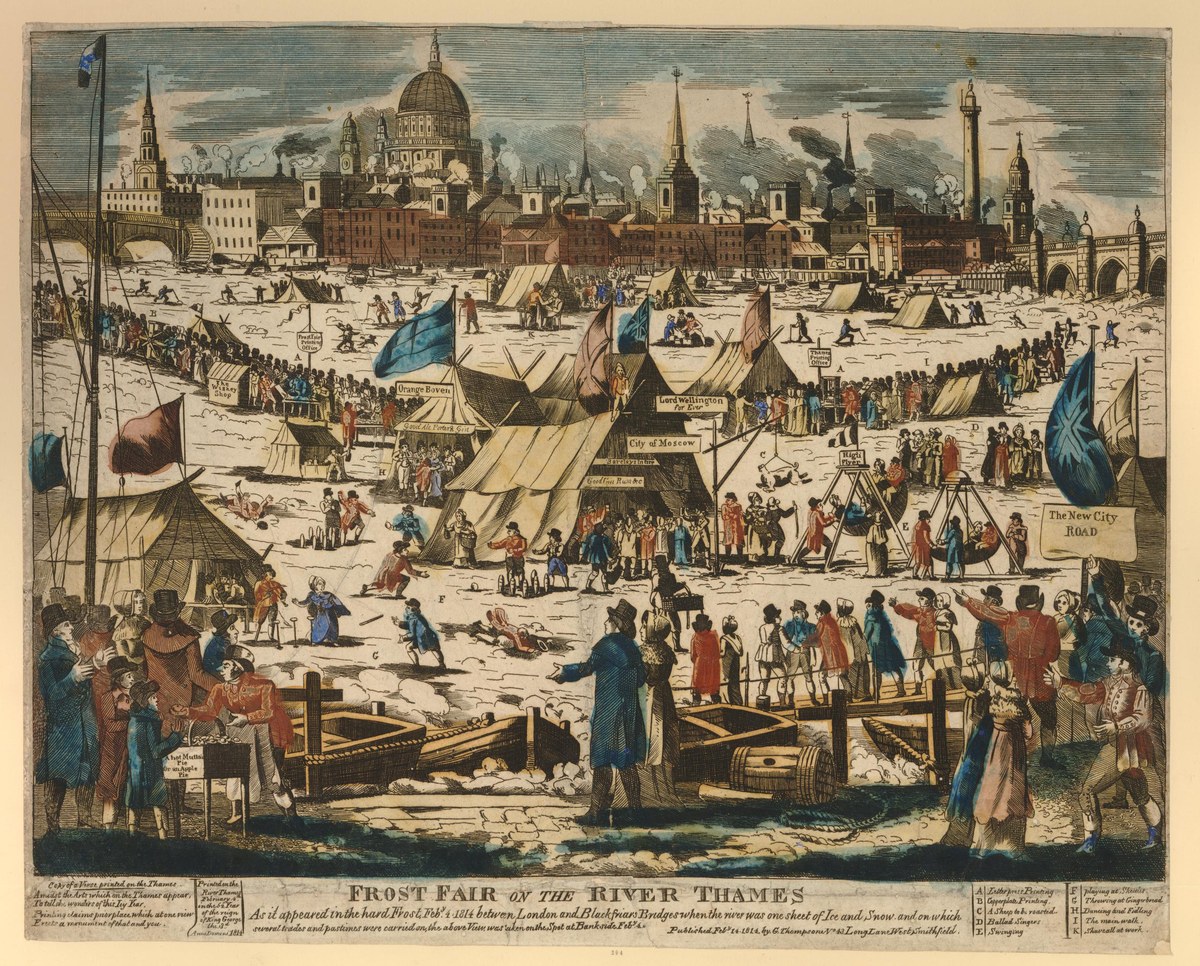

For a few days in February 1814, the stretch of the Thames between Blackfriars Bridge and London Bridge stopped being a river and became a street. People walked across it, drank on it, played skittles on it and bought souvenirs printed on it. Then the tide came back, and the whole thing broke up and went downstream in an hour.
The 1814 frost fair is usually described as the last of the famous fairs on the frozen Thames, and the two periodicals used here, the Gentleman’s Magazine and the Annual Register, describe it in plain and sometimes rather dry terms. That is part of their value, because they record what people actually did on the ice rather than what later writers imagined.
How the River Froze
The winter of 1813 to 1814 was hard well beyond London. The Annual Register printed a government circular asking county officials to clear “the obstructions which have taken place from the late heavy falls of snow” from the roads, partly so that work could be found for people who had been “deprived of their usual earnings by the inclemency of the season.”
The freeze on the Thames itself came in two stages, according to the Gentleman’s Magazine for February 1814. A thaw began on Wednesday, January 26, and it sent so much ice downstream that the river became choked between Blackfriars and London Bridge. A sharp frost then set in on the Saturday night and fixed the jammed masses in place, so that the tide could no longer move them.
The bridge had a part in this too. Readers of Historic Mysteries may remember that the old London Bridge had a long history of trouble with the river, and that “Originally designed with 19 arches, the Thames was not able to flow properly.” In 1814 the magazine noted that “The tide, from the obstruction at London Bridge, did not ebb for some days more than half the usual marks.”
On Monday, January 31, a few “adventurous persons of light weight” crossed the river on foot. A crowd of boys followed them, and many of them, the magazine said, did not escape without “an unwelcome immersion” where the ice was rotten near Blackfriars Bridge.
A Street Called the City Road
By the start of February the ice was busy. The Annual Register, in its entry for February 1, described “the novel scene of persons moving on the ice in all directions, and in greatly increased numbers.” It also observed that “the publicans and spirit dealers were most in the receipt of custom.” That will surprise nobody who has ever been to a fair.
The Gentleman’s Magazine gave the fuller picture, reporting that midway between the bridges, nearly opposite Queenhithe, “above 30 booths were erected, for the sale of porter, spirits, gingerbread, &c.” There were games of skittles, there was dancing in the drinking tents, and there were people sitting around large fires drinking rum and grog.
The fair even had its own geography, and the magazine reported that “Among the paths for the convenience of perambulation, the principal was dignified with the appellation of the City Road.” The woodcut at the top of this article shows a placard reading “The New City Road” on a gangway that led down from the Southwark bank.
The south bank was a fitting place to start. Bankside lay in Southwark, a district with a long and colorful history of its own, and readers can find more of it in the story of the Liberty of the Mint, where Henry VIII set up a mint “in Southwark, on the other side of the Thames in 1543.”
Printing on the Ice
One detail in the 1814 accounts has become the fair’s trademark. “Several printers, having brought their presses, pulled off various impressions, which they sold for a trifle.” The idea was simple enough. A sheet printed on the frozen Thames was proof that its owner had been there, and it cost very little.
The woodcut shows at least two presses at work on the ice, and the British Museum description quoted on its Commons page records placards for a “Frost Fair Printing Office” and a “Thames Printing Office.” The print also carries a verse that it says was printed on the Thames, which makes it a souvenir of a souvenir.
The trade on the river did not stop at printing. According to the magazine, tradesmen sold “books, toys, and trinkets of every description.” The watermen and coal heavers, who would normally have been carrying people across the river by boat, made what they could by building rough steps down to the ice and beating paths across it.
There was also food, although not all of it was a success. “On Thursday, Feb. 3, a sheep was roasted, or rather burnt, over a charcoal fire, in a large iron pan.” Admission to the booth where the sheep was cooked was sixpence a head, which the magazine reported without any comment on whether it was worth it.
The Ice Gives Way
The fun on the ice carried a real risk, and the records do not hide it. The Gentleman’s Magazine reported that on February 3 a plumber named Davis, crossing near Blackfriars Bridge with some lead in his hand, fell between two masses of ice “and rose no more.” The Annual Register noted that two coopers were “with difficulty saved” after the ice gave way beneath them.
A thaw came on February 5, and upriver, Kingston Bridge, which the magazine said had stood for more than 300 years, was damaged by the pressure of the ice and sank nearly three feet between its high and low piers. On the stretch in central London, the end came in a single morning.
The Annual Register for February 7 described how, despite “evident signs of its speedily breaking up,” thousands of people had walked on the ice on the Saturday. Early the next morning a few “fool-hardy persons” still crossed from Bankside to Queenhithe. About an hour later “the whole mass gave way,” and it swept through the arches of Blackfriars Bridge taking about forty barges with it.
A group who had stayed “carousing in the tents till midnight” found the ice parting beneath them and scrambled into two barges, which the tide then carried off. One barge cleared Blackfriars Bridge, and the other struck a pier and stuck there. Spectators who saw their plight, “having procured ropes, contrived to haul them up in safety.”
Why It Never Happened Again
The great frost fairs belong to a colder period of European history. The Little Ice Age, as the article on this site puts it, was a time when “the Thames froze a few times,” along with harbours and rivers elsewhere. The winters that followed 1814 were not cold enough, for long enough, to repeat the event.
There is another explanation often given for the end of the fairs, and it involves the bridge itself. The old London Bridge was replaced by a new bridge that, according to the London Bridge article on this site, officially opened in 1831, and the river was later embanked. Both changes are commonly said to have let the Thames flow faster and freeze less easily. The records used here do not discuss that question, so it is left as the usual explanation and not tested.
What Remains Uncertain
The two magazines agree on the broad story but differ on detail. The Annual Register said the ice was “totally unfit for amusement,” while the Gentleman’s Magazine described skittles and dancing in the same week. Both were probably right, since the rough, snow-covered ice was useless for skating while the tents and booths did a brisk trade.
The woodcut is a good piece of evidence, although it was published as a commercial print ten days after the scene it claims to show. Its details agree closely with the written accounts, from the City Road to the presses and the sheep. For a fair that lasted only a few days, that is a reasonably solid record.
Sources
- The Gentleman’s Magazine, vol. 84 part 1 (February 1814), Domestic Occurrences, p. 192. Scan via Internet Archive.
- The Annual Register, or a View of the History, Politics, and Literature, for the Year 1814, Chronicle, pp. 11 to 13. Scan via Internet Archive.
- Frost Fair on the River Thames. Hand-colored woodcut published by G. Thompson, February 14, 1814. Wikimedia Commons.
