
On a late November day in 1810, a crowd began to gather in Berners Street in the West End of London that would not stop growing until evening. Coal carts, furniture and a great many tradespeople arrived at the door of number 54, the home of Mrs Tottenham, and for much of the afternoon the street was blocked. They had been sent for by letters written in her name, and she had written none of them.
The episode became known as the Berners Street Hoax. It is usually credited to Theodore Hook, the young writer and wit, though no record used here shows that he was ever charged with it. The surviving records are worth reading closely, because they disagree on the year, on the scale of the affair and on how much anyone knew at the time.
What the 1810 Record Says
The earliest full account used here is the chronicle of events in The New Annual Register for 1810, which printed it under the heading “A HOAX.” It placed the event on the 27th of the month, on a page headed November, in a section that moves on to December directly after it. Its writer called the affair “This very malignant species of wit” and said the house had been “beset by about a dozen tradespeople at one time, with their various commodities.”
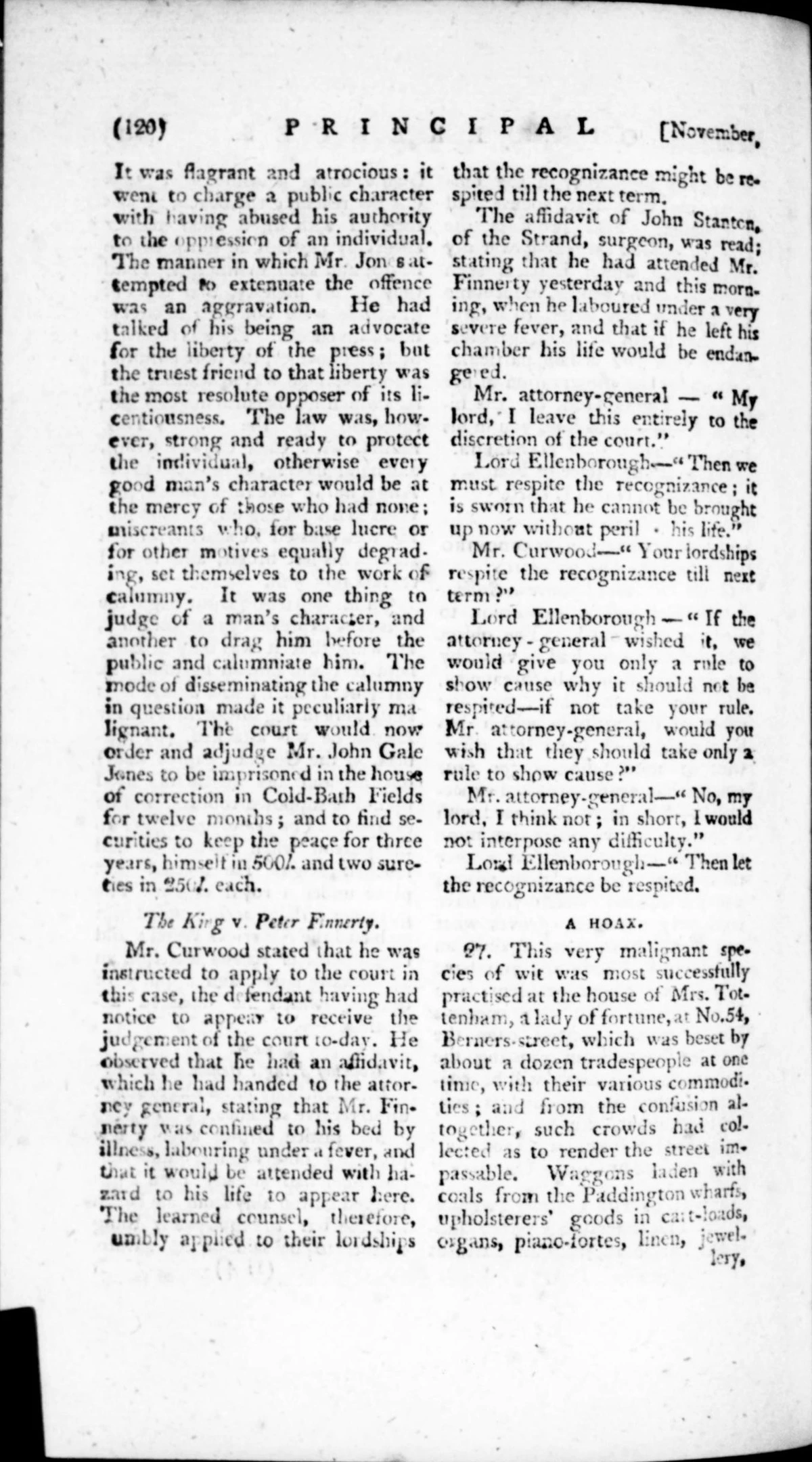
The scene it describes is chaotic but specific. “Waggons laden with coals from the Paddington wharfs, upholsterers’ goods in cart-loads, organs, piano-fortes, linen, jewellery, and every other description of furniture” arrived at the door. The Lord Mayor came in his carriage, stayed only a short while, and then drove to the police office in Marlborough Street. There he told the magistrate he had received a note that claimed to come from Mrs Tottenham, who said she had been summoned to appear before him but was confined to her room by illness, and who asked him to call on her instead.
Officers from Marlborough Street were sent to restore order, and the account says the first thing they saw “was six stout men bearing an organ,” surrounded by wine porters, barbers with wigs, dressmakers with band-boxes and opticians. By four o’clock the street was still in confusion, and officers were posted at its corners to turn back anyone who arrived with goods. The writer added that servants looking for work began to assemble at five, and that the letters to the tradespeople had carried “recommendations from persons of quality.”
The account also printed three of the notes, each dated from “54, Berner’s-street, Monday” and asking for a visit “at two to-morrow.” One asked for a post chaise and four to take her toward Bath, and the others asked gentlemen to call on business. November 27, 1810 fell on a Tuesday, which fits notes written on a Monday for the following day. The chronicle even noted that this hoax “exceeded by far that in Bedford-street a few months since,” which suggests that the trick was not entirely new.
A Town That Knew the Joke
Londoners had seen crowds gathered by deception before, and some of those earlier jokes were still remembered in 1810. In 1698, according to a newsletter of the day, people turned up at the Tower of London on April 1 to watch the annual Washing of the Lions, an event that did not exist and never had. In 1749 an advertisement filled a theatre in the Haymarket with people waiting to see a performer climb into a wine bottle, and the Bottle Conjuror never appeared. Rumour blamed that one on a duke with a taste for practical jokes.
The difference at Berners Street was that the crowd was drawn from every trade at once and sent to a private house rather than a public place. The letters had to be written, addressed and timed for a single day, and the people most affected were the tradespeople who made a wasted journey and the woman at number 54.
A Name in a Speech Bubble
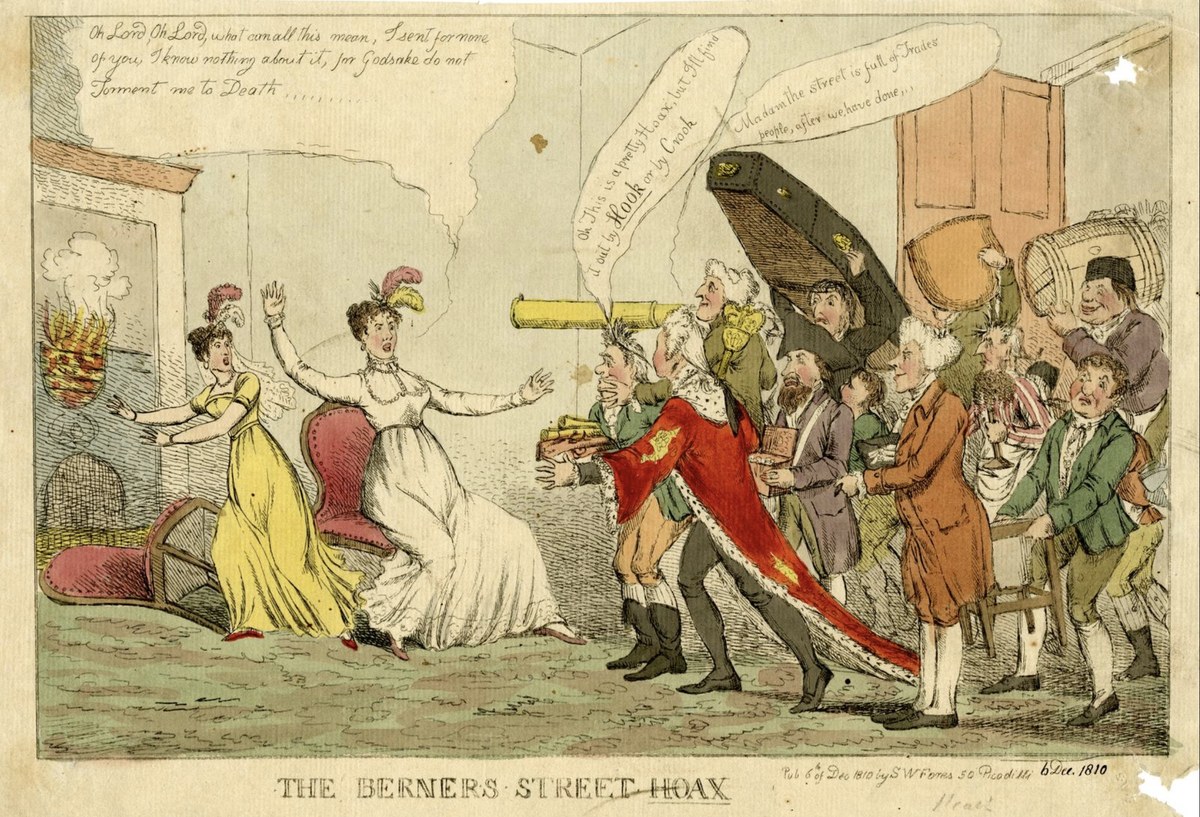
The first hint of a culprit in the surviving material appears in a print rather than a report. On December 6, 1810, the Piccadilly printseller S. W. Fores published a caricature titled “THE BERNERS STREET HOAX,” now attributed to William Heath. It shows two frightened women in a drawing room as a crowd pushes in with a coffin, barrels and furniture. In a speech bubble, a man in official robes says that he will find it out “by Hook or by Crook,” with the word Hook underlined in the original.
The pun suggests that Hook’s name was already being linked to the affair within ten days of it. The print says nothing more, though, and a caricature is evidence of gossip rather than proof, so it settles nothing about who actually wrote the letters. No record used here shows that anyone was charged.
The Biographer’s Account
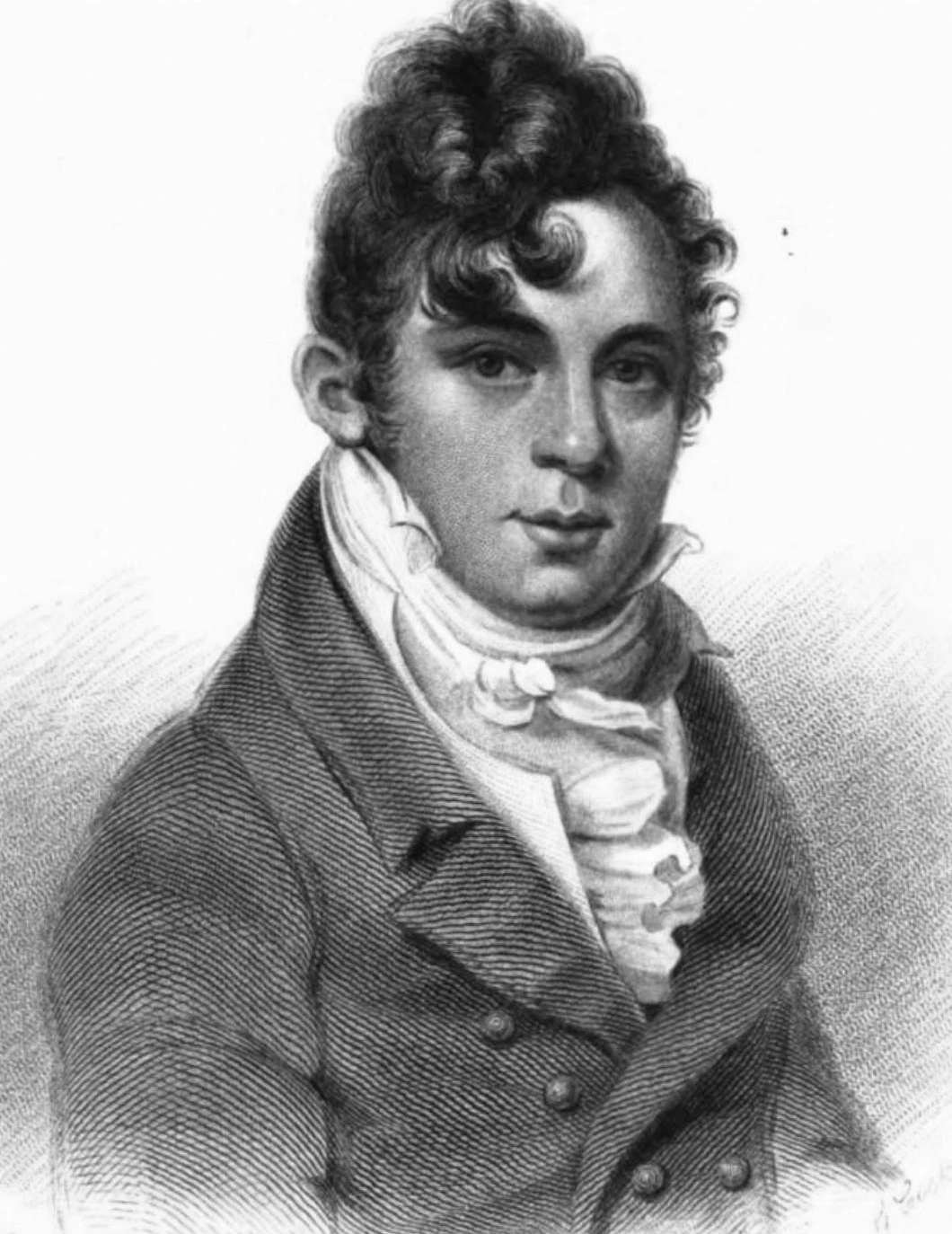

The fuller story comes from The Life and Remains of Theodore Edward Hook, published in 1849, eight years after Hook’s death, by R. H. Dalton Barham, who called the hoax “the most inexcusable and most mischievous” of Hook’s youthful pranks. He identified Hook’s two confederates only by initials, one of them an actress he described as “still alive,” and said that “six weeks were spent in preparation, during which time about four thousand letters were despatched.”
That kind of patient planning is what separates an ambitious practical joke from a passing prank, and it has a long history. More than a century and a half later, the Alaskan prankster behind the Mount Edgecumbe April Fools joke of 1974 said his plan had taken three to four years to bring off.
Barham’s version adds people who do not appear in the 1810 chronicle. He said Hook lured the Governor of the Bank of England with promised revelations about a fraud, invited the Chairman of the East India Company by a similar device, and drew the Duke of Gloucester with a message from a dying woman. In his telling, Hook and his two associates watched from “an apartment opposite,” and afterward the victims tried to bring the charge home to “the principal offender, who was pretty generally suspected.” The attempt failed, and Hook, after a short stay in the country, returned “unmolested.”
Barham then reprinted a newspaper account of the day, which matches the opening of the chronicle report almost word for word but begins with the word “yesterday.” He did not name the paper.
1809 or 1810?
Barham dated the hoax to 1809, and the Dictionary of National Biography followed him in 1891 with “perpetrated in 1809.” The British Museum’s catalog commentary, which follows M. Dorothy George’s 1947 catalog of satires, also dates the hoax to 1809 and names Hook as the perpetrator. The contemporary evidence points the other way. The chronicle entry sits in the volume for 1810, under November, on the 27th. The Fores print is dated December 6, 1810, only nine days later. The notes dated Monday also fit a Tuesday on November 27, 1810, while in 1809 that date fell on a Monday.
On those three points, the date of November 27, 1810 is the better supported one. Barham was writing almost forty years after the event, and his own reprinted newspaper report carries no year at all.
What Remains Uncertain
The scale of the hoax is the hardest part to pin down. The 1810 chronicle spoke of about a dozen tradespeople at a time and crowds large enough to block the street, while the figure of four thousand letters comes from Barham alone, and the Dictionary of National Biography repeated it with “it is said.” The Duke of Gloucester, the Governor of the Bank of England and the chairman of the East India Company also appear only in the later accounts used here, not in the 1810 chronicle.
Hook’s part rests on the 1810 pun, on what Barham said was general suspicion, and on Barham’s account written long after Hook’s death. The joke itself is well documented in the record of 1810. Who wrote the letters, and how many there really were, still depends largely on a biographer writing almost four decades after the event.
Sources
- The New Annual Register, or General Repository of History, Politics, and Literature, for the Year 1810 (London). Principal Occurrences, November 27, entry headed A Hoax, pp. 120 to 121. Scan via Internet Archive.
- Barham, R. H. Dalton. The Life and Remains of Theodore Edward Hook, vol. 1, pp. 72 to 76 (London: Richard Bentley, 1849). Scan via Internet Archive.
- Dictionary of National Biography, 1885 to 1900. “Hook, Theodore Edward.” Wikisource.
- The Berners Street Hoax. Hand-coloured etching published by S. W. Fores, December 6, 1810, attributed to William Heath. Wikimedia Commons.
- British Museum, collection object 1868,0808.7963, “The Berners Street Hoax,” hand-coloured etching, December 6, 1810, print made by William Heath, published by S. W. Fores. Collection record.
