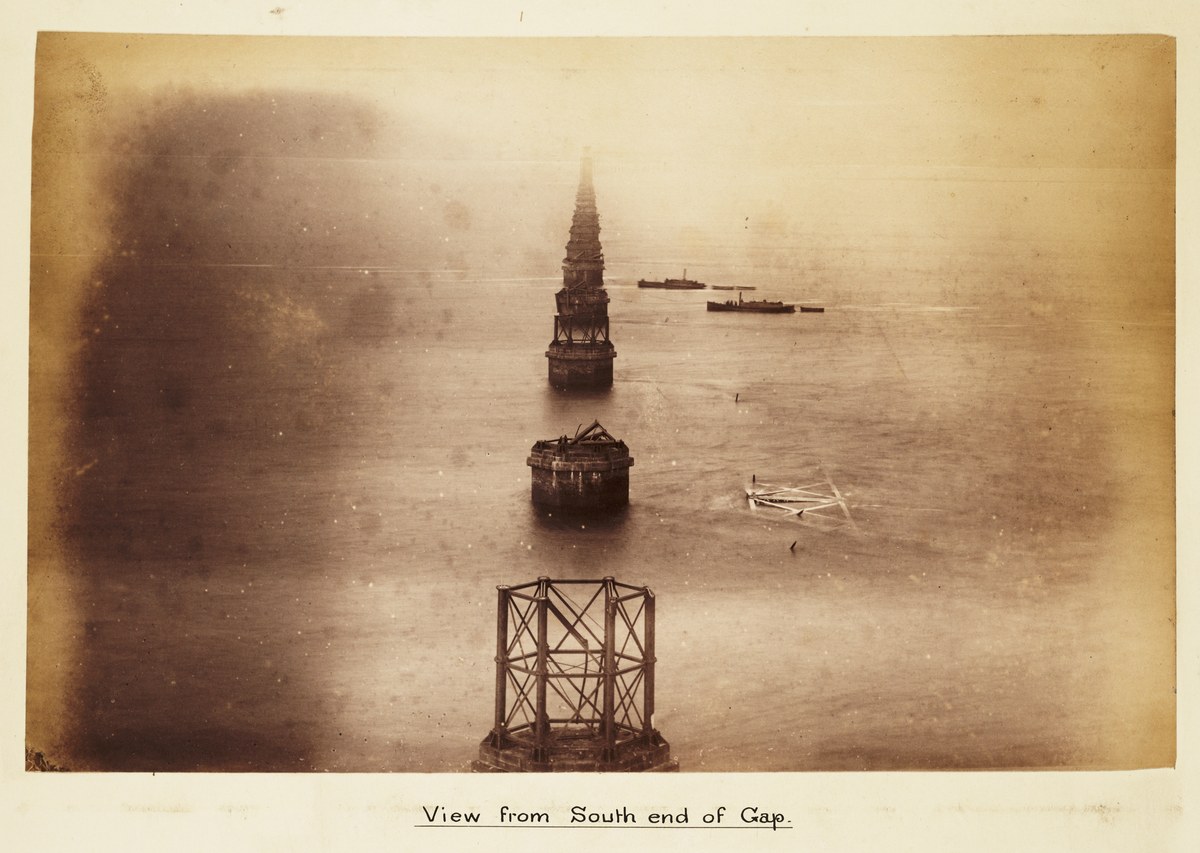

The first Tay Bridge carried the North British Railway across the Firth of Tay to Dundee. It stood for about a year and a half before its central girders came down in a gale, and the official inquiry that followed left a detailed record of how a Victorian engineering project failed.
The Board of Trade appointed three men to hold it. They were Henry Cadogan Rothery, the Wreck Commissioner, Colonel William Yolland, the Chief Inspector of Railways, and the engineer William Henry Barlow. They heard evidence in Dundee and at Westminster but could not agree on a single report, so Yolland and Barlow signed one and Rothery wrote another, and both were published together in 1880.
A Bridge Across the Firth
According to the joint report, the bridge was “3,465 yards in length” and stood on 85 piers. It was designed by Sir Thomas Bouch, who had also supervised its construction and was afterwards responsible for its maintenance. Over the navigable channel the trains ran inside tall iron lattice girders carried on piers of cast-iron columns.
The joint report says that “It was this portion, called the high girders, which fell.”
General Hutchinson inspected the finished bridge for the Board of Trade on February 25, 26 and 27, 1878, running six locomotives coupled together across it at 40 miles an hour. The bridge behaved well under the test, and on “the first day of June 1878 it was open for passenger traffic.”
The Last Train
On the evening of December 28, the train from Edinburgh stopped at St. Fort, where tickets were collected for the passengers bound for Dundee. The joint report lists the passengers and the railwaymen aboard, “making 74 or 75 persons altogether.” The train left St. Fort at 7.8 p.m. and slowed at the cabin at the south end of the bridge so that the driver could collect the baton he needed to cross.
The signalman, Thomas Barclay, then signaled the train to the north cabin, and his book recorded the time as “exactly 13 minutes after 7 o’clock.” The report said that “It was then blowing a strong gale from about W.S.W., and therefore almost directly across the bridge,” and although the moon was full, the night was dark because the clouds hid its face.
A railway surfaceman named John Watt was keeping Barclay company in the cabin and watched the train through the window. According to Watt, he saw sparks flying from the wheels, and after about three minutes “there was a sudden bright flash of light, and in an instant there was total darkness.” The two men could not make their way along the bridge against the wind, and Rothery recorded that “every person in it had perished.”
The Storm Over Dundee
The training ship Mars, lying near Newport, recorded it as “the force of 10 to 11 of the Beaufort scale,” and the joint report added that it was “especially characterised by strong gusts at intervals.” R. H. Scott of the Meteorological Office told the court that the anemometers at Glasgow and Aberdeen showed wind speeds close to 100 miles an hour for some minutes around the time the bridge fell.
The meteorologist Ralph Abercromby studied the storm for the journal Nature in March 1880. He traced the center of the cyclone across the north of Scotland at 62 miles an hour, which was, he wrote, “the highest on record in this country.” At Dundee the barometer fell fast until about seven o’clock, “at 7.15 the Tay Bridge was blown down,” and the trough of the cyclone passed over the town about half an hour later.
Abercromby thought the bridge “was blown down by an ordinary gust” during that interval, and he concluded that the storm “was in many ways of the most ordinary character” even though “it was exceptionally squally and gusty,” which he put down to the unusual speed of its movement.
Loose Ties and Cracked Columns
However, the court looked hardest at the bridge itself, and found signs of weakness early in its short life. The iron columns of each pier were braced together by tie bars fixed to lugs cast on the columns, and the joint report found that “The holes in the lugs on the columns were all cast and left conical, instead of being drilled, thus causing the pins to have unequal bearings.”
The bridge was looked after by Henry Noble, whose experience lay in brickwork and earthworks. Rothery’s report says that as early as September 1878 Noble “heard what he described as a chattering of the tie bars” and, climbing the piers, found some of them loose. Without telling anyone, he tightened them with small pieces of iron, and he told the court that he had put in “about 150 packing pieces” before the bridge fell. He also found cracked columns and had them bound with wrought-iron bands.
Speed and Wind Pressure
Hutchinson had approved the bridge with a warning, suggesting “25 miles an hour as a limit, which should not be exceeded.” The railway company did not enforce it. William Robertson, an engineer and former Provost of Dundee, told the court that he had often timed northbound trains through the high girders at 60 seconds, and Rothery worked that out as a speed of 35.78 miles an hour, rising to 42.94 on two occasions when Robertson timed the run at 50 seconds.
The deeper question was how much wind the bridge had been built to resist. In 1873 the Astronomer Royal, asked about Bouch’s planned bridge over the Firth of Forth, had written that the wind pressure over a whole span would probably be no more than 10 pounds per square foot, although he warned that “upon very limited surfaces, and for very limited times, the pressure of the wind does amount sometimes to 40 lbs. per square foot, or in Scotland probably to more.” Bouch told the court that after that report he had a “different idea of the force of the wind.”
Barlow asked Bouch why he had not followed the plan of the Belah Viaduct in Westmorland, an earlier Bouch structure whose columns were tied by horizontal cross girders. Rothery called the reply “rather remarkable evidence.” Pressed by the Commissioner, Bouch said the old ties were more expensive and “this was a saving of money.”
Two Reports, Two Verdicts
Yolland and Barlow set out fifteen numbered findings. The twelfth reads: “That the fall of the bridge was occasioned by the insufficiency of the cross bracings and its fastenings to sustain the force of the gale on the night of December 28th, 1879, and that the bridge had been previously strained by other gales.” They recommended that the Board of Trade establish rules for wind pressure on railway structures.
Rothery went further. His report, which explains that “Although this Report is only signed by myself, I have retained the plural number throughout,” concluded that “this bridge was badly designed, badly constructed, and badly maintained,” and that “Sir Thomas Bouch is, in our opinion, mainly to blame.” He also found that the railway company was “not wholly free from blame” for letting trains cross faster than Hutchinson’s limit. However, he would not join his colleagues’ call for wind rules. In his view, if the profession had no settled rule, “it is for the engineering profession, and not for the Board of Trade, to make them.”
Storms, Structures and Inquiries
Scotland had seen engineers called in to explain a disaster before. After the Tradeston Flour Mills explosion in Glasgow in 1872, described in this site’s account of the Tradeston Flour Mills explosion, an insurance company turned to “a professor of Civil Engineering and mechanics at Glasgow University” to find the cause.
The tension at the heart of the Tay inquiry, between a structure and the worst weather it might meet, did not end in 1880. More than a century later the oil platform Ocean Ranger was working in a part of the north Atlantic that, as this site’s account of the Ocean Ranger disaster explains, “was prone to high waves and severe storms.” Closer to home, twenty-one years after the Tay Bridge fell, the records of the Flannan Isles lighthouse keepers showed that “Eilean Mor was hit with a strong storm on December 14,” shortly before the three keepers vanished.
The Tay Bridge is often remembered for a single terrible night. The inquiry reports tell a slower story of loose ties, conical holes, fast trains and a design that allowed too little for the wind, and they leave no doubt that the gale found a weakness already there.
Sources
- Tay Bridge Disaster. Report of the Court of Inquiry, and Report of Mr. Rothery, upon the Circumstances attending the Fall of a Portion of the Tay Bridge on the 28th December 1879 (London: HMSO, 1880). Parliamentary paper digitised by the University of Southampton Library, scan via Internet Archive.
- Ralph Abercromby, “The Tay Bridge Storm,” Nature 21 (March 11, 1880), pp. 443 to 444. Scan via Internet Archive.
- “View from South end of Gap,” National Library of Scotland Phot.la.17. Wikimedia Commons.
