
In the summer of 1816, farmers in New England watched frost kill their crops in June, rain fell for weeks across much of Western Europe, and people looking at the sun through colored glass could see dark spots on its face. Newspapers and astronomers offered explanations, and some of them caused panic. The cause that scientists now accept had happened more than a year earlier and thousands of miles away, and the earliest printed link that modern researchers cite came almost a century later.
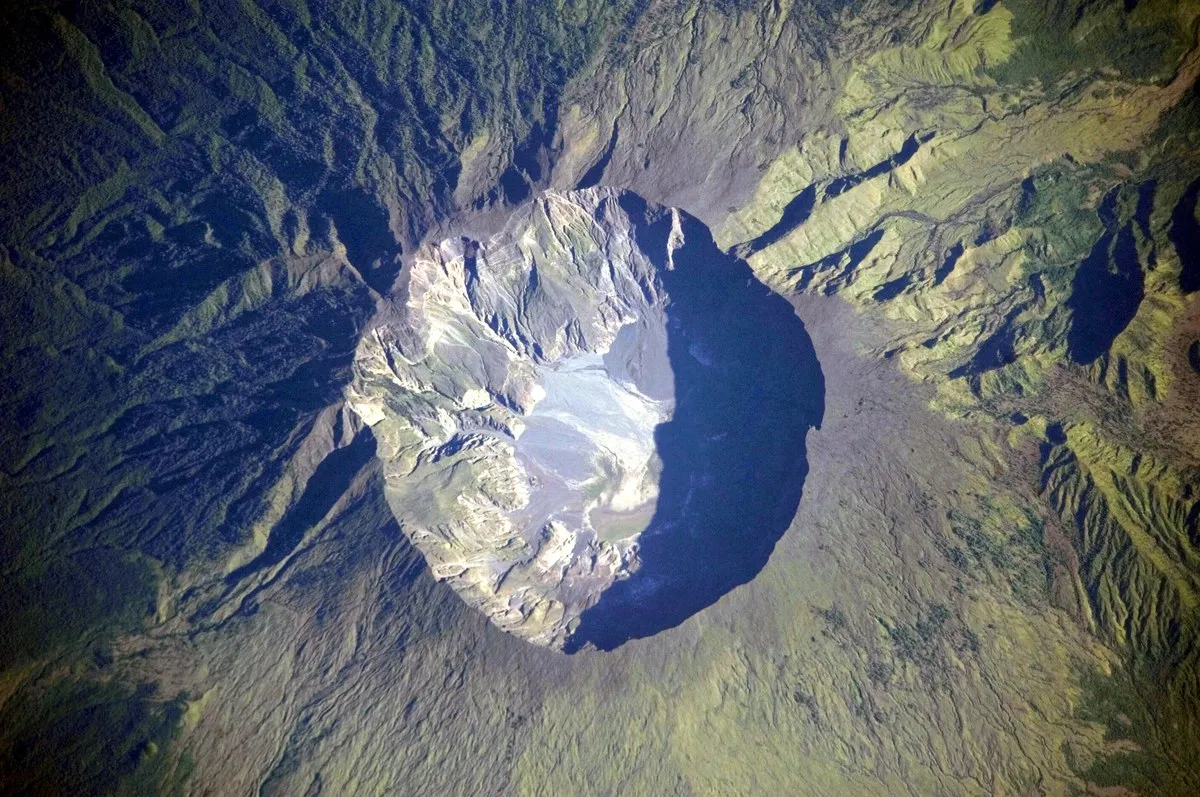
According to a 2016 review of the science led by the climate researcher Christoph Raible, the dormant volcano Tambora on the Indonesian island of Sumbawa “erupted violently” in April 1815. The blast killed thousands of people immediately, and tens of thousands more died of starvation and disease on Sumbawa and nearby islands in the months that followed. Raible and his colleagues describe it as the largest eruption since a 1257 eruption on the neighboring island of Lombok.
An Eruption the World Barely Noticed
A Smithsonian Magazine account of the eruption reports that soldiers on Java, hundreds of miles away, mistook the early rumbling for cannon fire and went looking for a battle. The eruption cut more than 4,000 feet from the mountain’s height, and the magazine puts the death toll on Sumbawa and Lombok at an estimated 90,000, most of them from starvation.
Yet the eruption made little impression on the wider world at the time. The same article points out that Tambora was ten times more powerful than Krakatau in 1883, but news of it “traveled no faster than a sailing ship.” Krakatau, by contrast, erupted after the telegraph had arrived. The gas plume, meanwhile, had reached the stratosphere. According to the 2016 review, it produced sulfate aerosols that shielded incoming sunlight for the next three years and cooled the tropics and much of the Northern Hemisphere by roughly 0.4 to 0.8 degrees Celsius.
A Summer That Never Came
In the northeastern United States, the Smithsonian account says, the weather in mid-May 1816 turned “backward,” as locals put it, with summer frost reaching as far south as Virginia. A Virginian named Pharaoh Chesney later recalled that in June “another snowfall came and folk went sleighing.” Thomas Jefferson, retired at Monticello, had such a poor corn crop that he applied for a $1,000 loan.
Private diaries from the time record the cold almost day by day. The Massachusetts Historical Society holds the diary of Hannah Dawes Newcomb of Keene, New Hampshire, who wrote on May 18, 1816, “Very hard frost last night, very cold this morning.” By early July she was writing that “all nature appears encircled in gloom” and that the corn was so backward there might not be food enough for people or animals. English Heritage adds that snowstorms swept New England in June and that woodland birds driven into New York City fell dead in the streets.
The cold reshaped the country in small ways. The Smithsonian article cites the historian L. D. Stillwell’s estimate that about twice the usual number of people left Vermont in 1816 and 1817, between 10,000 and 15,000 in all. Many of them headed west of the Ohio River, and the magazine notes that Indiana became a state in 1816 and Illinois in 1818, partly as a result of such migration.
Across the Atlantic, Europe suffered even more than New England did. The 2016 review places the most extreme summer cold over Switzerland and eastern France, and the heaviest excess rain over southeast England and northeast France. Smithsonian Magazine reports that it rained without a break in Ireland for eight weeks, the potato crop failed, and typhus followed late in 1816. It quotes the historian John Post’s description of the period as “the last great subsistence crisis in the western world.”
Byron, Shelley and the Dark Summer
The bad weather also left a mark on literature. Byron spent that summer beside Lake Geneva, having left England in 1816 amid scandal, as this site’s account of his private life describes. English Heritage writes that rain and thunder kept him and his guests, Mary Shelley among them, indoors at the Villa Diodati, where they wrote ghost stories by candlelight.
Out of that wet summer came Byron’s poem “Darkness,” which opens with “I had a dream, which was not all a dream.” Its second line reads “The bright sun was extinguish’d,” and the poem goes on to imagine humanity after the death of the sun. According to Smithsonian Magazine, John Polidori wrote The Vampyre in the same circle, and Mary Shelley, who later remembered the season as “cold and rainy,” began Frankenstein.
What People Blamed at the Time
The people living through it had no reason to look to Indonesia. English Heritage says that a strange haze dimmed the sun that year and that sunspots were large enough to be seen through a piece of colored glass. An astronomer in Bologna blamed the spots and predicted that the sun would go out on July 18, 1816. As the date approached, the same account says, riots broke out across Europe, troops were called out in Austria, and the French government printed pamphlets explaining that the spots were harmless.
The sunspot theory was not simply a popular panic, since it had a respectable scientific pedigree. English Heritage notes that in 1801 the astronomer William Herschel had compared grain prices with his own 40-year record of sunspots and concluded that the two were probably linked. The Massachusetts Historical Society writes that many people in 1816 blamed the weather on sunspots, and that the volcanic haze may have made the spots easier to see with the naked eye.
The same cold had a precedent long before Herschel. As this site’s account of the year of darkness in 536 describes, chroniclers then also reported a dimmed sun and failed harvests, which researchers now suspect a volcanic eruption caused.
The Link Made in 1913
According to the 2019 study discussed below, the link was made as early as 1913. Writing that August in the Bulletin of the Mount Weather Observatory, a Weather Bureau publication, W. J. Humphreys set out a theory that volcanic dust in the upper atmosphere could cool the climate and might even help explain ice ages. He named 1816, the “year without a summer,” as a special case. It had followed the eruption of Tambora, which he spelled Tomboro, and had been cold the world over. He also gave a death toll of 56,000 for the eruption, a figure far below some later estimates.
Humphreys was careful about what the records could show. He pointed out that the list of past eruptions was incomplete and that the clearest test was a year colder than sunspot numbers alone would predict. The 2016 review notes that Tambora and its climate effects have been studied repeatedly over the past century, from ice age theory onward, and that the first comprehensive overview was not published until 1992. The Massachusetts Historical Society goes further and says it took until the 1970s to piece the clues together.
As this site’s account of what caused the Little Ice Age describes, volcanic activity is now one of the accepted ways of cooling the planet, and Tambora in 1815 is a standard example.
What the Models Say
Modern work supports the volcanic explanation without making it the whole story. The 2016 review argues that an unidentified eruption in 1808 or 1809 had already cooled the decade, and that the period also fell within a spell of weak solar activity known as the Dalton Minimum. European records make the 1810s the coldest decade since measurements of that kind began in the 1780s, with 1814 and 1816 standing out.
A 2019 study led by Andrew Schurer of the University of Edinburgh tested the link directly. It begins by noting that 1816 was probably the coldest year worldwide for at least the last 250 years, which made it a natural test case for attribution methods normally used on modern extreme weather. Its authors write that Tambora had often been assumed to be the cause but that “this link has not, until now, been proven.” Using climate models, they found that the eruption made the cold European summer up to 100 times more likely, while the wet weather became 1.5 to 3 times as likely. The pressure pattern over Europe that summer could explain the rain without any volcano but only about a quarter of the cold.
Smithsonian Magazine adds a caution of its own. Researchers are careful not to blame every misery of those years on Tambora, it says, because a cooling trend was already under way by 1815, and there is little evidence that the eruption affected the Southern Hemisphere. The 2016 review notes that Southern Hemisphere records disagree with many climate models on this point.
The people of 1816 looked at the sun and saw spots. The eruption that had dimmed it had happened in a place few of them had heard of, and the earliest written link between the two that researchers now cite came almost a century later.
Get the Historic Mysteries newsletter, free
Unsolved cases, strange sightings and hidden history, straight to your inbox.
Sources
- Byron, George Gordon, Lord. Darkness. 1816. Poetry Foundation.
- Bush, Alex. 1816: the Year Without a Summer. Massachusetts Historical Society, The Beehive, April 7, 2020. masshist.org.
- English Heritage. 1816: The Year the Sun Nearly Died. English Heritage blog.
- Humphreys, W. J. Volcanic Dust and Other Factors in the Production of Climatic Changes, and Their Possible Relation to Ice Ages. Bulletin of the Mount Weather Observatory 6 (1913). Internet Archive.
- Raible, Christoph C., et al. Tambora 1815 as a Test Case for High Impact Volcanic Eruptions: Earth System Effects. WIREs Climate Change, 2016. PubMed Central.
- Schurer, Andrew P., et al. Disentangling the Causes of the 1816 European Year Without a Summer. Environmental Research Letters 14 (2019). Max Planck repository.
- Smithsonian Magazine. Blast from the Past. smithsonianmag.com.
