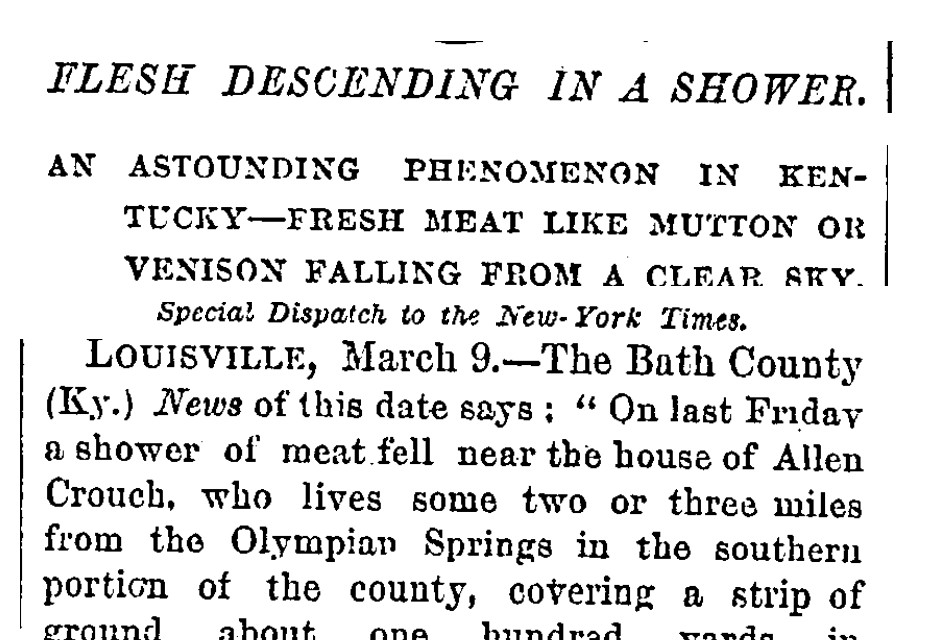
On a clear day in early March 1876, a farm wife in eastern Kentucky was making soap in her yard when pieces of what looked like raw meat began to fall around her. Within a week the story had reached the New York Times. Within a few months, scientists in several states were arguing over jars of preserved samples. Was it a vegetable growth, a freak of the weather or something far less pleasant? The Kentucky meat shower has never been fully explained, but the evidence gathered at the time points in a surprisingly earthy direction.
What happened at the Crouch farm?
The first report came from the Bath County News and was carried in the New York Times of March 10, 1876, under the heading “FLESH DESCENDING IN A SHOWER.” The paper’s special dispatch from Louisville quoted the local report in full. “On last Friday a shower of meat fell near the house of Allen Crouch, who lives some two or three miles from the Olympian Springs in the southern portion of the county, covering a strip of ground about one hundred yards in length and fifty wide.”
The dispatch was dated March 9, which places the event on Friday, March 3, 1876. That is also the date Scientific American gave in a 2014 retelling. The Crouch farm lay in the southern part of Bath County, near the resort known today as Olympia Springs.
Mrs. Crouch was the only direct witness named in any of the reports, and her account is the core of the case. According to the report, “Mrs. Crouch was out in the yard at the time, engaged in making soap, when meat which looked like beef began to fall around her.” It went on, “The sky was perfectly clear at the time, and she said it fell like large snow flakes, the pieces as a general thing not being much larger.” One piece that landed near her “was three or four inches square.”
The paper’s informant was a neighbor, Harrison Gill, described as a man “whose veracity is unquestionable.” Gill went to the farm the following day and said he “saw particles of meat sticking to the fences and scattered over the ground.” The report adds that the meat “appeared to be perfectly fresh” when it first fell.
A correspondent of the Louisville Commercial, writing from Mount Sterling, confirmed the story and said the pieces came in various sizes and shapes, some about two inches square. Then came the detail that has kept the story alive ever since. “Two gentlemen, who tasted the meat, express the opinion that it was either mutton or venison.”
Was it really meat at all?
The first scientific explanation arrived a few months later and said no. According to the 2014 account by the science writer Bec Crew in Scientific American, a man named Leopold Brandeis received specimens preserved in glycerine and announced that the substance was nostoc. Nostoc is a cyanobacterium that forms colonies inside a jelly-like envelope and swells up after rain. Because it is easy to miss when dry, people long believed it fell from the sky.
Scientific American greeted the idea warmly in 1876. “At last we have a proper explanation of this much talked of phenomenon,” it reported, adding, “The Kentucky ‘wonder’ is no more or less than nostoc.” Crew pointed out the obvious problem, which is that nostoc swells in wet weather while the Kentucky report said the sky was perfectly clear.
What did the microscopes show?
The nostoc theory did not survive long once the samples reached people with good microscopes. In July 1876 the Scientific American Supplement printed a letter from a microscopist of the Newark Scientific Association in New Jersey, identified by Crew as Dr. A. Mead Edwards. The writer explained that he had once expected the samples to be nostoc himself. He then tracked down the specimens, including the supply Brandeis had studied, and examined them.
He also reported that Dr. Allan McLane Hamilton had written to the New York Medical Record about a piece of the shower. Hamilton and Dr. J. W. S. Arnold had examined it under the microscope and found it to be lung tissue, from either a human infant or a horse, because the structure of the organ is very similar in the two. In the letter’s account, every sample the writer examined turned out to be of animal origin.
Crew summarized the final tally from the various laboratories. Seven samples were examined by several scientists, and two were identified as lung tissue, three as muscle and two as cartilage. Whatever fell on the Crouch farm, it had once been part of an animal.
So where did the flesh come from?
An animal origin raised a harder question, and a far less comfortable one. How did pieces of lung and muscle end up falling out of a cloudless sky? Ideas ranged widely. Atlas Obscura, in a 2020 profile of the Kentucky artist and professor Kurt Gohde, mentions one grim story in which a whirlwind was supposed to have carried off the remains of a fight and dropped them on the farm.
The explanation that won most support came from a Kentucky doctor. Writing in the Louisville Medical News in 1876, Dr. L. D. Kastenbine said he had obtained a sample, burned it and found that it smelled of rancid mutton. As quoted by Crew, he wrote, “The only plausible theory explanatory of this anomalous shower appears to me to be that suggested by the old Ohio farmer.” That theory was vomit from vultures flying high above the farm, scattered by the wind.
Kastenbine argued that only such an explanation fit the mixture of tissues found. “The variety of tissue discovered” could, he wrote, be “explained only by this theory.” The idea is less strange than it sounds. Crew noted that two species of vulture live in Kentucky, the black vulture and the turkey vulture, and both are known to throw up the contents of their stomachs, either in defense or to become light enough to fly.
Atlas Obscura adds that turkey vultures gorging on carrion can have trouble taking off, and that a startled bird will lighten its load by bringing up its last meal. On this view, a group of vultures circling over the Crouch farm may have been disturbed and emptied their stomachs together, sending a scatter of half digested meat over the yard.
The theory has a weakness that no one in 1876 could resolve, because no one reported seeing birds overhead at the time. Mrs. Crouch spoke only of a clear sky and falling flakes, and the newspaper reports say nothing of vultures.
Did anyone ever test the meat again?
The story might have ended in the 19th century if not for Gohde, a professor of art at Transylvania University in Lexington. According to Atlas Obscura, he was clearing out storage closets at the university in 2004 when he found an old glass jar sealed with a cork. Inside was a chunk of pale, fatty material in a yellowish liquid, and the faded label still showed the words Olympia Springs.
Gohde arranged for a colleague in the biology department to have the sample genetically tested. The results were disappointing, because the material was too old and too contaminated to give any conclusive answer. In 2007 he took a more playful approach and had a flavor laboratory reconstruct the taste of the sample in a jelly bean, which he handed out at the Court Days festival in nearby Mount Sterling.
Not everyone in 1876 took the event seriously. Atlas Obscura reports that the humorist William Livingston Alden wrote in the New York Times on March 11, 1876. “The obvious conclusion is that the Kentucky shower of meat was really a meteoric shower,” Alden wrote. He went on to imagine forecasts in which “light showers of beefsteak may be looked for in the New England and Middle States during the morning, followed by a heavy rain of mutton in the afternoon.”
What do we know for certain?
The record supports a few firm points, drawn from the 1876 reports themselves. A shower of flesh-like pieces was reported on the Crouch farm in Bath County in early March 1876, and a neighbor saw the remains the next day. Samples reached scientists in New York and New Jersey, and their microscopes found lung, muscle and cartilage. That ruled out nostoc.
Beyond that, the case rests on reasonable guesswork. The vulture theory explains the mix of tissues and the smell, and it fits the behavior of birds common in Kentucky. Yet no witness saw a flock overhead, and the one surviving jar has not given up its secrets to modern testing. More than 150 years later, the vultures remain the leading suspects in a case that was never formally closed.
Established: Pieces of flesh-like material were reported falling on the Allen Crouch farm in Bath County, Kentucky, in early March 1876, and microscopic examination in 1876 identified samples as lung, muscle and cartilage.
Disputed: That the material was nostoc. Proposed by Leopold Brandeis in 1876 and contradicted by the microscope findings.
Unverified: That the flesh came from vultures disgorging their food overhead. This is the leading explanation, proposed in 1876 by Dr. L. D. Kastenbine, but no one reported seeing birds at the time.
Unverified: That the jar found at Transylvania University in 2004 holds material from the 1876 shower. Its label reads Olympia Springs, but genetic tests were inconclusive.
Sources
- Flesh Descending in a Shower, The New York Times, March 10, 1876, page scan from TimesMachine read via the Internet Archive, transcribed by hand.
- The Kentucky Meat-Shower, letter to the editor from the Newark Scientific Association, Scientific American Supplement No. 30, July 22, 1876.
- Bec Crew, The Great Kentucky Meat Shower mystery unwound by projectile vulture vomit, Scientific American blog network, December 1, 2014. scientificamerican.com
- Marina Wang, The Artist Trying to Explain Kentucky’s ‘Meat Shower’ of 1876, Atlas Obscura, February 7, 2020. atlasobscura.com
