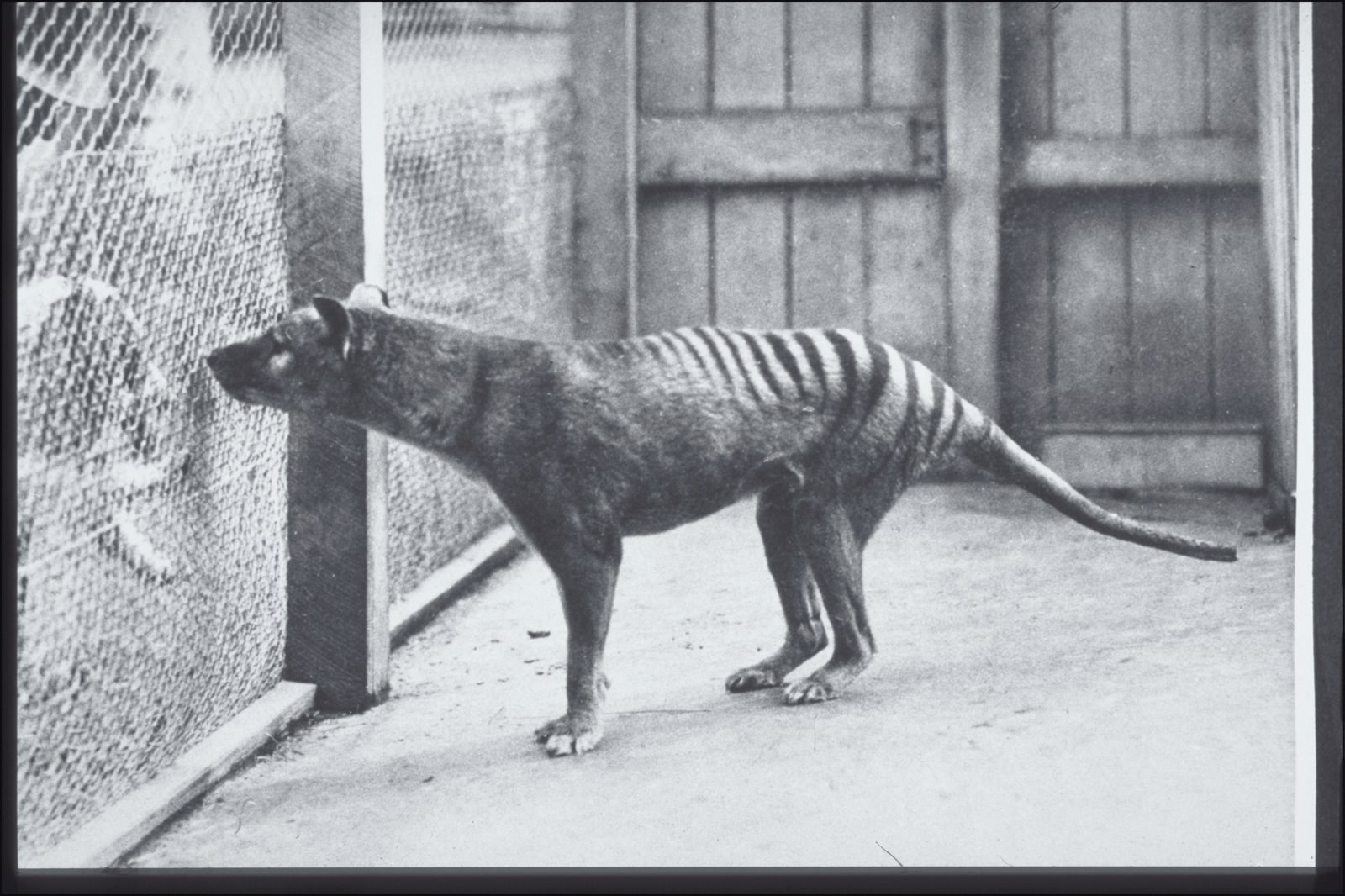

On September 7, 1936, the last known thylacine died in captivity at the Hobart Zoo in Tasmania. Few animals have such a precise date attached to their disappearance. Yet the reports did not stop. For almost ninety years farmers, bushwalkers, drivers and park rangers have described a striped, dog-like animal crossing a road or slipping into the scrub. In 2023 a team of scientists went back through more than a thousand of those reports and reached a surprising conclusion. The Tasmanian tiger, they argued, may have survived in the wild for decades after the world wrote it off.
So what are people seeing, and how much weight can a sighting carry when there is no body, no clear photograph and no way to question the witness again?
What was the thylacine?
The Australian Museum describes the thylacine as “a large carnivorous marsupial now believed to be extinct.” It was the only member of its family, Thylacinidae, to survive into modern times. People called it the Tasmanian tiger or the Tasmanian wolf, and both names make sense once you see one of the surviving photographs. The museum notes that it had “15 to 20 distinct dark stripes across the back from shoulders to tail.” Its head looked like that of a dog or wolf, but its tail was stiff and its legs were short. Females carried their young in a pouch that opened to the rear.
Andrew Pask, a professor of epigenetics at the University of Melbourne, told Live Science that the animal was “our only marsupial apex predator.” That role made it important to the ecosystem, and it also made it a target. The museum states that its decline in Tasmania “appears mainly due to direct human persecution as an alleged pest.” On the mainland the thylacine had already vanished at least 2,000 years ago, probably because of competition with the dingo and perhaps hunting by people.
How did it disappear from Tasmania?
The answer lies largely in a bounty, and a preprint of the study by Barry Brook of the University of Tasmania and his colleagues records government and private bounties paid out from 1888 to 1909. It lists snaring and trapping by fur traders, capture for zoos, habitat change and possibly disease as further pressures that drove the animal to extreme rarity. A farmer named Wilfred Batty shot a thylacine on his property in 1930, and that animal is now thought to have been the last Tasmanian tiger killed in the wild, according to the ABC. The species was given legal protection only after the last captive animal died in 1936.
Even that famous final animal has become a subject of argument. In November 2023 the ABC reported that the researcher Gareth Linnard and his colleagues had challenged the long-repeated story that the Hobart animal died after being shut out of its sleeping quarters on a cold night. They said no records support that version of events. The episode shows how quickly stories gather around the thylacine, even where records exist.
Why do people keep reporting sightings?
Reports have continued throughout the decades since 1936. In 2019 the Tasmanian government’s Department of Primary Industries, Parks, Water and Environment, known as DPIPWE, released documents under a right to information request. They listed eight reports of thylacine sightings received between September 2016 and September 2019.
One of the most detailed came from a pair of tourists from Western Australia driving near Corinna in the island’s northwest. According to the department’s record, quoted by the ABC, the animal walked in front of their hire car. “It was in clear view for 12 to 15 seconds. It had stripes down its back. It was the size of a large kelpie. The animal was calm and did not act scared at all.” The couple said they were “100 per cent certain” of what they had seen.
Another account came from a motorist on the Murchison Highway in April 2017, who described a cat-like animal crossing the road in front of his car. “I had high beam on so it was reasonably lit up. It was not a dog or a cat or a fox.” A cyclist on the Lyell Highway described “a large cat-like creature” seen on a misty, overcast day. A bushwalker reported a footprint, and a farmer in the Midlands believed he had seen the animal on his property.
When asked, the department gave a short reply to the ABC. “There have been no confirmed sightings of the thylacine in Tasmania for more than 50 years,” a spokesperson said. The department said it considers the species presumed extinct.
Col Bailey, a veteran thylacine hunter and author, offered a view from inside the search. He said he believed the animals were still out there, yet he also admitted that “many people don’t know what they’re looking at.” He put the enduring interest down partly to regret. “People want them to be there and that drives the belief that they could still be out there,” he told the ABC.
What did the 2023 study find?
The study that revived the debate was published in the journal Science of the Total Environment in 2023, with Brook as lead author. The team, which included scientists from the United States, the United Kingdom and France, assembled what the preprint calls “an exhaustive database of 1,237 observational records” dating from 1910 onward. These included physical evidence such as bodies and pelts, along with sightings by experts and members of the public.
Instead of throwing out every record without physical proof, the researchers rated each one for plausibility and modeled how the species might have retreated across the island. If you take only hard evidence, Brook told the ABC, “it comes to the unsurprising conclusion that they were probably gone by the early 1940s.” Allowing for uncertainty in the wider records, the team concluded that “extinction likely occurred within four decades of the last capture, so around the 1940s to 1970s.”
Further analysis pushed that window later still, Brook explained. “But we found, through further analysis, that extinction might have been as recent as the late 1980s to early 2000s, with a very small chance that it still persists in the remote south-western wilderness areas,” Brook said.
One case from the files stood out to Brook. In 1982 Hans Naarding, a park ranger, parked his car one rainy night at a remote crossroads at Togari in the far northwest. He reported watching a fully grown male thylacine for about a minute, but he had no camera. His report led to a year-long search by the parks service, which found nothing. Brook called it one of the cases that “seem, on the face of it, to be extremely plausible.”
Does the study mean thylacines are still alive?
Brook himself does not think the animals survive today. Asked about the remote southwest, he told the ABC, “I don’t think it is possible.” He pointed out that the thylacine was a large predator that roamed widely, and that cameras placed in the bush over the last decade should have recorded one. “So there’s a tiny possibility, but my probability estimate would be that it’s 99 per cent likely they’re extinct now,” he said.
Other experts have doubts about the raw material itself. The wildlife biologist Nick Mooney, who once investigated some of the more credible reports for Tasmania’s parks and wildlife services, said the modeling was “perfectly alright” but added that “the original data is very fragile.” His concern was the witnesses. “The trouble is you can’t cross-examine the people who actually made those reports, and there’s a problem with that anyway,” he said, pointing to what he called “modified memory.”
Pask was more direct in his view of the reports. “There is no evidence to confirm any of the sightings,” he told Live Science. He also suggested a reason the reports keep coming. The thylacine evolved to look so much like a wolf that, at a distance, it is “very hard to tell the difference” between a thylacine and a dog. That, he said, is likely why there are still so many sightings “despite never finding a dead animal or unequivocal picture.”
Where does that leave the Tasmanian tiger?
The thylacine’s story now runs along two tracks. One is the documented history of bounties, a farmer’s shot in 1930 and a captive animal that died in Hobart in 1936. The other is a long trail of sightings that no one has been able to confirm, from Naarding’s rainy crossroads in 1982 to the tourists near Corinna in 2018.
The 2023 study did not prove that any single sighting was genuine. What it argued is that, taken together and weighed for plausibility, the reports suggest the species may have lingered for decades after its official extinction. Whether those decades were the 1940s or the 1980s depends on how much trust you place in people who saw something striped at dusk and had no camera to hand. For now, the department’s position stands. No sighting has been confirmed in more than half a century, and the animal remains presumed extinct.
Established: The last known captive thylacine died at Hobart Zoo on September 7, 1936, after decades of bounty killing, and the Tasmanian government considers the species presumed extinct.
Established: A 2023 study in Science of the Total Environment modeled 1,237 records and estimated extinction most likely between the 1940s and 1970s, possibly as late as the late 1980s to early 2000s.
Unverified: Any individual sighting after 1936, including the 1982 Naarding report and the 2016 to 2019 reports released by the state government.
Disputed: That the sightings data are reliable enough to support a late extinction date. Wildlife biologist Nick Mooney and geneticist Andrew Pask both question the quality of the underlying reports.
Sources
- Barry W. Brook and others, Resolving when (and where) the Thylacine went extinct, Science of the Total Environment, vol. 877, 2023, doi:10.1016/j.scitotenv.2023.162878. Read as the bioRxiv preprint (2021).
- Rebecca Hewett, Thylacines may have survived later than scientists thought, new research suggests, ABC News, March 27, 2023. abc.net.au
- Phoebe Hosier, Tasmanian tiger sightings detailed as document release reveals alleged encounters, ABC News, October 16, 2019. abc.net.au
- Department of Natural Resources and Environment Tasmania, right to information release of thylacine sighting reports, 2016 to 2019 (RTI 025).
- Live Science, report on the 2023 thylacine extinction study, March 2023. livescience.com
- Loretta Lohberger and James Dunlevie, New thylacine research project casts doubt on last captive Tasmanian tiger assertions, ABC News, November 9, 2023. abc.net.au
- Thylacine, Australian Museum. australian.museum
