
The Dorabella cipher is a single sheet of curved marks that the English composer Edward Elgar sent to Dora Penny in July 1897. The specialist sources consulted for this article report no verified or accepted decipherment, and discussion of it works from a facsimile that Penny printed in her own memoir forty years later. Any honest account has to begin with that book, because almost everything else depends on it.
Penny published Edward Elgar: Memories of a Variation in 1937 under her married name, Mrs. Richard Powell, through Oxford University Press. The cipher appears in a short Appendix on page 98, the last numbered page of the first edition. Her account of where it came from is brief, and the details she chose to give are worth reading closely before turning to any of the many proposed solutions.
A Family Friend in Wolverhampton
Dora Penny was not a member of the Elgar family. Her memoir explains that her father became Rector of Wolverhampton in 1895 and married Mary Frances Baker, a close friend of Alice Elgar. Penny first met the composer on December 6, 1895, when he and his wife came to lunch at the invitation of her stepmother, and visits between the two households followed.
In July 1897 the Elgars stayed at the Wolverhampton rectory for five days, according to the memoir, which records music, sketches for a new choral work and a kite-flying trip to Boscobel. The cipher, Penny writes, followed upon that visit. It reached her inside a letter from Alice Elgar, whom Penny called “the Lady” in her memoir, addressed to Penny’s stepmother.
Penny’s description of its contents goes no further than “the third letter I had from him, if indeed it is one” in her account. She reported that the back of the sheet was addressed “Miss Penny” in plain writing, without saying whose hand wrote it.
The earlier letters help set the tone. Penny reproduces one from March 1897 that opens “Dear Miss Penny” and jokes about Elgar’s new hobby of die sinking, with what he called his parcel post seal pressed in red on the back of the envelope. Playful, friendly formality is the register the memoir documents for these early letters.
What the Page Actually Shows
The facsimile on page 98 shows three lines of small looped symbols, each built from one, two or three short arcs facing in different directions. Beneath the third line, set off to the right, is a short line of ordinary handwriting in which the figures 14 and 97 are clear, and the line is usually read as the date July 14, 1897.
That date is the one part of the sheet that can be read without any key, and Penny’s text gives no explanation of the symbols at all. She wrote that she had “never had the slightest idea what message it conveys” and said Elgar never explained it. She reported that attempts to solve it had failed and invited readers to send her a solution.
The memoir does not say where the original sheet was kept or what became of it, so its present location cannot be confirmed from this source, and modern discussion therefore works from the printed facsimile. The facsimile allows a reader to inspect the marks, but the memoir supplies neither a key nor a plaintext against which any proposed reading can be checked.
How the Name Dorabella Came Later
The note is now called the Dorabella cipher, but Penny dates Elgar’s first use of the nickname for her to the following year. In September 1898, at a house party at Hasfield Court, Elgar asked her stepmother how his “sweet Dorabella” was and explained that it was a quotation from Mozart’s opera Cosi fan tutte.
A letter from Elgar dated September 24, 1898 followed, and Penny wrote simply, “Ever afterwards I was Dorabella.” The nickname then passed into Elgar’s Enigma Variations, in which one movement portrays her. Her memoir describes the June premiere at St. James’s Hall in London under Richter and a later performance at the Three Choirs Festival in Worcester.
The chronology is more than a curiosity for anyone weighing proposed solutions. Nick Pelling, who writes the Cipher Mysteries blog, points out that the ciphertext is dated 1897 while Penny places the first use of Dorabella in September 1898. On that basis he argues that any proposed solution containing the word Dorabella is wrong. The point rests on Penny’s own dating, which the memoir supports.
Patterns Without a Message
Elgar’s interest in codes is well attested in the sources consulted here. Penny opened her Appendix by noting that he was always interested in puzzles, ciphers and cryptograms, and the Cipher Foundation, a specialist group that studies historical ciphers, credits him with solving a cipher published in Pall Mall Magazine that had been presented as unbreakable.
The Cipher Foundation describes the shapes on the Dorabella sheet as a variant of the pigpen cipher. In its account the symbols form a 24 character set made of three versions each of eight rotated shapes, and the same alphabet appears in two other places in Elgar’s papers, including the margin of a concert program discussing Liszt.
The difficulty begins once that key is applied to the note itself. According to the Cipher Foundation, applying what appears to be the matching key to the Dorabella sheet produces apparently nonsensical text. Some researchers have therefore suggested that the note might encode a melody rather than words, given Elgar’s profession. The foundation itself calls that comparison superficial for now, since the Liszt marginalia has not been decrypted either.
The note had already gathered a reputation before modern solvers arrived. The critic Eric Sams, writing in The Musical Times in 1970, reported that the 1949 third edition of Penny’s memoir said no solution had come in. He quoted its phrase “been examined by a good many people skilled in such matters” in that account. He added that the writer David Kahn, in his 1966 survey of codebreaking, described it as unsolved and suggested it might hold a clue to the enigma of Elgar’s Enigma Variations.
Sams, who described cryptology as his own former profession, then offered a solution of his own in that essay. Neither the Cipher Foundation account nor Pelling’s January 2025 discussion presents an accepted reading. The Cipher Foundation lists the note among other historical puzzles it studies, such as the Voynich manuscript and the Beale papers, and it still describes the Dorabella sheet as unread.
What Remains to Be Checked
The surviving record behind all of this discussion is narrow. There is a printed facsimile, Penny’s few sentences about how the sheet arrived and the later memoir passages that date the nickname. The consulted record provides no explanation from Elgar, and the Cipher Foundation sums up the problem by saying that researchers still do not know what the note is or even how to try to read it.
Further evidence may yet exist in archives, and in his January 2025 post Pelling noted that the Royal College of Music holds a bequest of Dora Powell’s papers, including pocket diaries from 1896 to 1913, and wrote that he had been meaning to read her diaries for 1897. Until a new document or an independent key appears, the most accurate description is of a dated note from Elgar to a family friend whose meaning remains unverified in these accounts.
Sources
- Powell, Mrs. Richard (Dora M. Penny). 1937. Edward Elgar: Memories of a Variation. Oxford University Press. Appendix p. 98, pp. 1, 8, 9, 11, 12 and 20. Consulted via Internet Archive, Digital Library of India item 2015.155431.
- Cipher Foundation. The Dorabella Cipher.
- Pelling, Nick. January 5, 2025. Dorabella Cipher update. Cipher Mysteries.
- Sams, Eric. 1970. Elgar’s Cipher Letter to Dorabella. The Musical Times. Consulted through the online transcription on ericsams.org, not the journal original. Its quotation from the 1949 memoir is secondhand here.
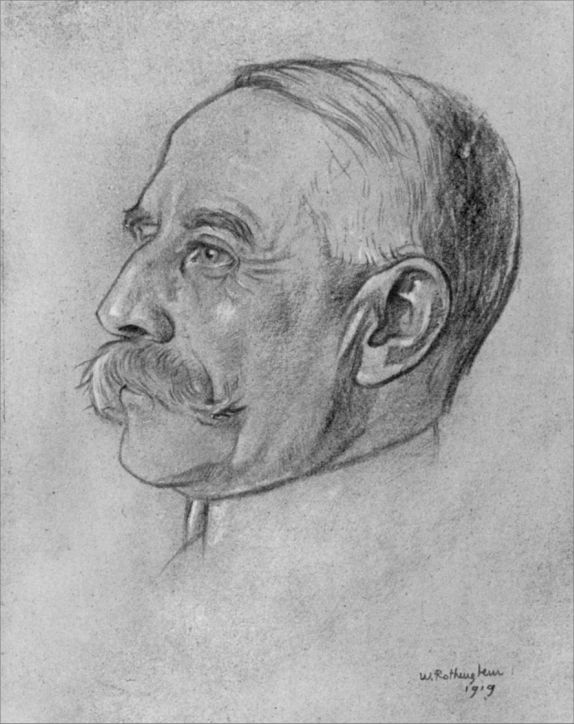
- Rothenstein, William. 1919 drawing of Sir Edward Elgar, printed with G. Bernard Shaw’s essay Sir Edward Elgar in Music & Letters, vol. 1, no. 1, January 1920. Image source.
