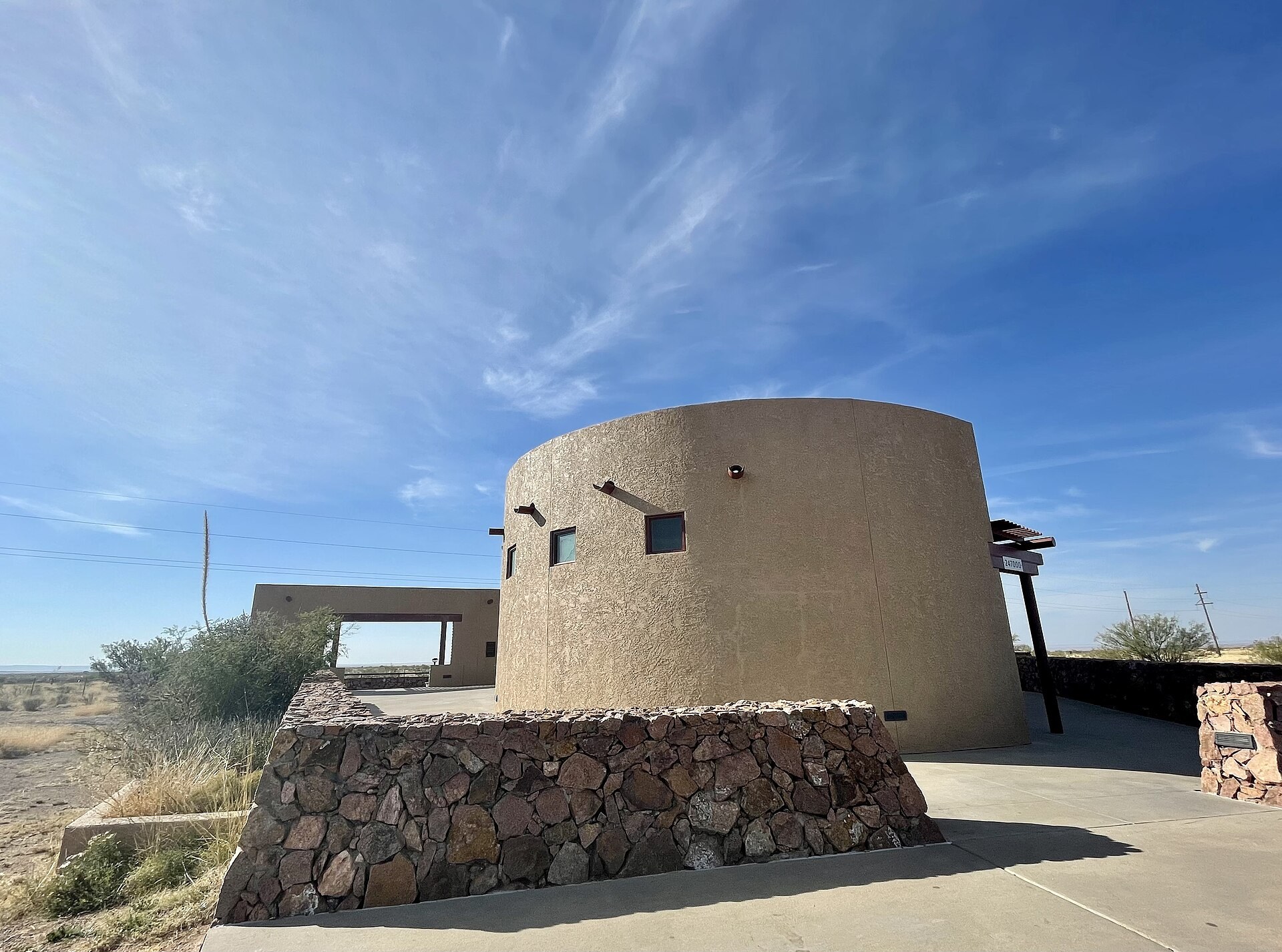

On clear nights in far West Texas, visitors gather at a roadside viewing area east of the small town of Marfa and look south across the desert toward the Chinati Mountains. Sooner or later many of them see small lights on the horizon that seem to glow, drift, split apart and vanish.
The Marfa lights have been a local legend for generations and a tourist draw for decades. Students and physicists have offered a plain answer for most of what visitors see. However, a few researchers still say that some sightings do not fit the explanation, and the history of the earliest reports is less certain than the legend suggests.
What do people see near Marfa?
The Handbook of Texas, published by the Texas State Historical Association, describes lights that are “often visible on clear nights between Marfa and Paisano Pass.” According to its entry by Julia Cauble Smith, “They move about, split apart, melt together, disappear, and reappear,” and at times they “appear colored as they twinkle in the distance.”
The engineer and researcher Karl Stephan, speaking to Vice in 2017, gave a more modest picture of the usual display. He said the lights are “much smaller than the size of a fist,” and added, “it looks almost like a star, maybe,” with a yellowish to white color, and that “they move very slowly.”
The town has built a business around the view. The Handbook says the Texas Department of Transportation built a roadside parking area nine miles east of Marfa on US Highway 90, and that “The Marfa Mystery Lights Viewing Center was built at that site in 2003.” A 2018 BBC report notes that the annual Marfa Lights Festival began in 1986 and is still held each September.
When were the Marfa lights first reported?
The story most often told begins with a cowhand. The Handbook says that “in 1883 a young cowhand, Robert Reed Ellison, saw a flickering light while he was driving cattle through Paisano Pass and wondered if it was the campfire of Apache Indians.” It adds that other settlers told him they often saw the lights and found no ashes when they went to look.
The same entry records that the early settlers Joe and Sally Humphreys reported their first sighting in 1885, that cowboys rode into the mountains in 1919 looking for the source and “found nothing,” and that pilots training nearby during World War II searched for the lights from the air “again with no success.”
However, the earliest part of this history has been challenged. The writer Brian Dunning of the Skeptoid podcast argued in 2007 that “there is no actual record that Robert Ellison ever saw such a thing.” He wrote that the claim comes from Ellison’s descendants, and that there is no written account “not even when he wrote his memoirs about his life in the region in 1937.”
Dunning dates the first published report of the lights to a magazine article in 1957, decades after cars and highways had reached the region. The student team that later studied the lights wrote that it had “yet to find historical accounts of Marfa mystery light observations,” and said it would keep searching.
The lights became a local industry largely through one resident. The BBC reports that Armando Vasquez first saw them in 1971 and spent the next 20 years driving visitors from the town’s two motels out to a bluff at dusk. “I was afraid Marfa would turn out to be a ghost town, but this was very good because it helped to keep our town alive,” he said.
Dunning also noted that attempts to find the lights on the ground have failed. Television crews placed observers at different points to triangulate a light, and he wrote that “The only thing conclusively demonstrated was that the lights are not where they appear to be.”
What did the 2004 student experiment find?
In May 2004 a dozen members of the Society of Physics Students at the University of Texas at Dallas spent several nights near Marfa running experiments. Their progress report, signed by students Alexander Stolyarov, Patrick Roddy and Jeff Klenzing with their faculty adviser Heelis, describes three tests that proved the most useful.
The team filmed the lights from the official viewing area, installed a traffic counter on US Highway 67 between Marfa and Presidio, and sent a chase car down that highway with a radio link back to the observers. Viewed at high speed, their video showed that the lights “move from left to right (south to north) along a very well defined path,” and that most “appear and disappear at very specific locations on the horizon.”
The traffic counter showed volume on the highway falling steadily through the night, which matched the falling number of lights. The decisive test was the chase car. Its flashing headlights “appeared in the exact same area on the horizon as the mystery lights were observed,” and the observers saw mystery lights move through the car’s position at the moment the chase team reported being passed by another vehicle.
The report concluded, “It is the finding of the research expedition that all the lights reliably observed during the experiment were car headlights.” Its summary attributes the lights seen on two nights to “automobile headlights traveling along US 67 between Marfa and Presidio, TX.” That summary gives the nights as May 11 and 13, 2005, although the report states earlier that the fieldwork ran from May 10 to 14, 2004.
Why would headlights look so strange?
Stephan told Vice that he and colleagues published a study of the lights in 2011 using sensitive spectrometers. “It turns out that they’re headlights,” he said. “Headlights on a highway, highway 67, which is some distance, about 15 or 20 miles south of the viewing area.”
He explained that the air over the flats bends and breaks up the light on its way to the viewers. “When the desert heats up, the air above the ground gets warm and rises in little kind of bubbles after dark,” he said. “It’s like looking through a wavy piece of glass.”
Dunning credits a superior mirage, in which layers of air at different temperatures make distant objects look higher than they are. The Handbook reaches a similar view and calls the likeliest explanation “an unusual phenomenon similar to a mirage.”
Are all the Marfa lights explained?
Not everyone accepts that headlights account for every sighting. Stephan himself told Vice that there have been reports of lights “that don’t match the description of these warped headlights,” including lights that move backward or vanish suddenly. “My colleague Jim Bunnell has actually witnessed these in person, and has taken photographs of them,” he said.
Bunnell, described by the BBC as a retired NASA aerospace engineer who grew up in the area, returned in 2000 and saw what he called “a shocking light display for which I could find no reasonable explanation.” He spent the next 12 years recording the lights with ten cameras on nearby ranches. “No pattern emerged,” he told the BBC.
However, Bunnell’s own theory, which the BBC summarizes as underground friction producing an electromagnetic light show, has no definitive proof, by the BBC’s account. Dunning, for his part, argues that close encounters with the lights are probably misjudged distances, since a distorted distant light can seem to hover “just out of reach.”
Folk explanations have never gone away either. The Handbook lists ideas “ranging from an electrostatic discharge, swamp gas, or moonlight shining on veins of mica, to ghosts of conquistadors looking for gold.” Some residents seem content to leave the question open. As the longtime resident Aurie West told the BBC, “I hope they never find out about what’s out there.”
Established: Lights are seen on clear nights from the viewing area east of Marfa, and the 2004 student study traced the lights it recorded to car headlights on US Highway 67.
Disputed: Whether every Marfa light is a distorted headlight. Stephan and Bunnell report lights that do not fit, while Dunning holds that the mystery is solved.
Unverified: That the lights were seen before cars reached the region, including the 1883 Ellison sighting, and Bunnell’s underground electromagnetic theory.
Fringe: That the lights are ghosts of conquistadors or other spirits.
Sources
- Julia Cauble Smith, Marfa Lights, Handbook of Texas Online, Texas State Historical Association. tshaonline.org
- Alexander Stolyarov, Patrick Roddy, Jeff Klenzing and R. A. Heelis, An Experimental Analysis of the Marfa Lights, Society of Physics Students, University of Texas at Dallas, progress report dated December 10, 2005.
- Brian Dunning, The Marfa Lights, Skeptoid episode 38, April 11, 2007. skeptoid.com
- Kaleigh Rogers, interview with Karl Stephan on the Marfa lights, Vice, May 9, 2017. vice.com
- Eliot Stein, BBC Travel report on the Marfa lights, January 2018. bbc.com
