
In the years before World War I, settlers, officials and railway engineers in what was then British East Africa began writing to the journal of a natural history society in the colony about a heavy, shaggy animal they could not name. They called it the Nandi bear, after the Nandi people of the western highlands, although Africa has no native bears that any zoologist recognizes today.
The reports appeared in The Journal of the East Africa and Uganda Natural History Society between 1912 and 1914, and they are still the core of the case. Read side by side, they raise a simple question that the journal’s own writers could not settle. Did these people see one undescribed animal, or several familiar ones seen badly at dusk and in mist?
What did Geoffrey Williams see on the Uasin Gishu?
The first detailed account came from Geoffrey Williams in the July 1912 issue of the journal. Several years earlier, he wrote, he had been crossing the Uasin Gishu plateau with a cousin “just after the Nandi expedition,” walking ahead of their safari toward Sirgoit Rock in thick mist.
When the mist cleared, Williams saw “a large animal sitting up on its haunches not more than 80 yards away.” He compared its pose to that of a bear at the zoo “asking for buns,” and judged it “nearly 5 feet high,” although he admitted it was hard to estimate height in a case like this.
He described thick fur on the forequarters and legs, hindquarters that were “comparatively speaking smooth or bare,” and a head that was “long and pointed and exactly like that of a bear.” He fired one shot and missed, and the animal shambled away among the rocks. Weeks later the young man who had been with them looked through a book of animal pictures and stopped at a brown bear, saying that was the animal.
Williams added that he had since learned the Nandi called the animal Chemosit, and that “their description tallies with mine.” He also recorded a story the Nandi told him, that they had once killed one after it broke through the roof of a hut, by burning the hut down with the animal inside. He ended firmly, writing that “the beast was not the least like either a baboon or an ant-bear, of this I am quite certain.”
How did C. W. Hobley gather the evidence?
After Williams’ letter appeared, Hobley, a member of the society’s executive committee, collected further accounts from settlers and officials, which he published in the journal in July 1913 as On Some Unidentified Beasts. Hobley wrote that the evidence “all goes to show that some curious beast does exist,” and that “it still eludes the collector, but the circle is narrowing.”
One of his witnesses was Major Toulson, a settler on the plateau, who ran out one evening after a servant reported a leopard near the kitchen. Toulson saw an animal “about 18 in. to 20 in. at the shoulder,” which “appeared to be black, with a gait similar to that of a bear,” but he admitted that “it was nearly dark at the time.” He added that some Dutch farmers had seen a similar beast only at dusk, and that “it turned on their dogs and chased them off.”
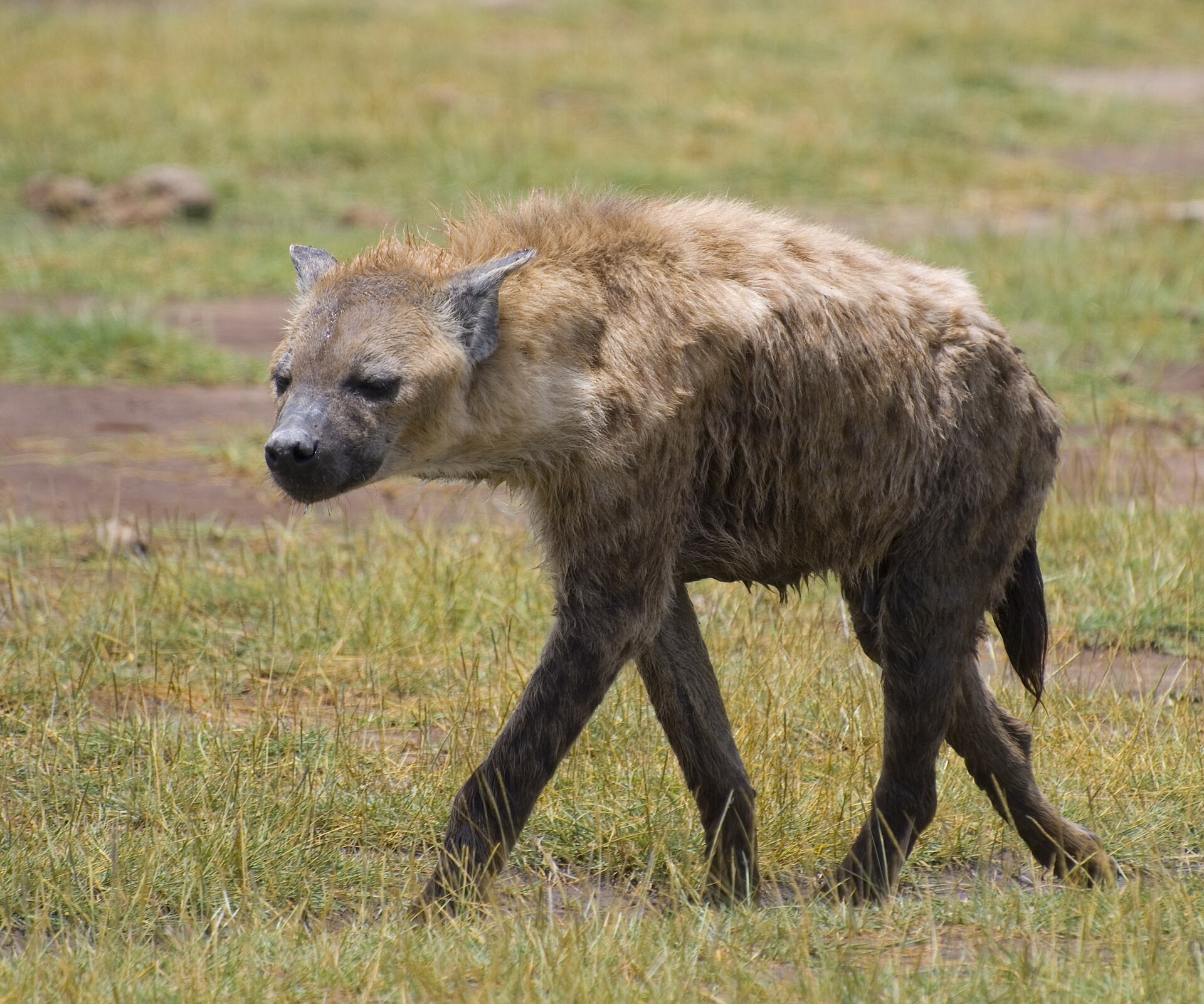
The most senior official among the witnesses was Corbett, the District Commissioner at Eldoret, who walked almost into the animal while fishing on the Sirgoi River. It was “only a yard or so away,” he said, but he had left his glasses behind and saw it mostly as it crossed the stream into the bush. Corbett described “Thick, reddish-brown hair, with a slight streak of white down the hind quarters,” and an animal “rather bigger than a hyena, with largish ears.”
Hobley also reported a footprint said to have been seen in dried mud by the Magadi Railway, sketched for him by a man named Schindler. He mentioned a story that a Boer had shot one but “left it and later on could not find it.” Some skeptics, he wrote, thought the beast was “only the hairy ant bear, Orycteropus,” which is the aardvark. However, Hobley answered that most witnesses knew the ant bear well, and that it was rarely seen in daylight. He was confident enough to predict that “it cannot be long before one of these creatures is bagged.”
Why did the railway engineer think it was not a hyena?
Alongside Hobley’s article the journal printed a note from Hickes, the engineer building the Magadi Railway, dated at Magadi Junction on April 11, 1913. The scanned text gives the date of his sighting as March 8, 1918. A note dated April 1913 cannot describe a sighting five years later, so this article reads the year as a likely misprint or scanning error for 1913. The journal itself does not say so.
Riding a motor trolley along the line at about nine in the morning, Hickes saw “what I took to be a hyena” about fifty yards ahead. As he drew closer, he wrote, “I saw it was not a hyena.” The animal “looked about as high as a lion,” was tawny “with very shaggy long hair,” and was “short and thick-set in the body, with high withers.” He closed with a strong statement for a man who had spent years building railways across Africa. “I have never before seen anything like this beast.”
Hickes’ account matters because it shows how close the comparison with a hyena was, even for a witness who rejected it. Corbett also used the hyena as his measure of size. The two descriptions differ in color and build, however, which is part of why the case was hard to pin down even at the time.
What did the Nandi themselves say about the Chemosit?
The Nandi name that settlers attached to the beast had its own meaning. In 1909 the writer Hollis published The Nandi: Their Language and Folk-lore, which described the Chemosit as a figure of belief rather than a wild animal.
Hollis wrote that “There is also a devil called Chemosit, who is supposed to live on the earth and to prowl round searching to devour people, especially children.” The Chemosit, he continued, “is said to be half man, half bird, to have only one leg but nine buttocks, and his mouth, which is red, is supposed to shine at night like a lamp.” Sir Charles Eliot, in his introduction to the book, called it “a fantastically shaped ogre rather than a spirit.”
Later reports complicated this picture, because in a letter printed in the journal in January 1927, Orchardson, who had lived for many years among the Kipsigis, a people closely related to the Nandi, wrote that “Amongst the Kipsigis one finds no belief that the Chemosit is a devil or spirit or god or man.” Instead, he said, people “insist very strongly that it is only an animal.” The descriptions some old men gave were, in his words, “very wild ones.” He also noted that mothers used the name to make children behave, with the warning “If you don’t eat your food the Chemosit will come and eat you.”
Was the Nandi bear one animal or many?
The sharpest skeptic inside the journal was Percival, another contributor to the journal, who wrote a short note titled The Chemosit in August 1914. He referred to “the chemosit or chimiset or Nandi bear” and said he was “still a bit doubtful about its existence as a new animal.”
Percival explained that a similar beast had once been described to him in the Sotik country, standing on its hind legs and very savage, until “Careful inquiries and a picture of the ratel settled the matter.” The ratel is the honey badger. From such cases he drew a clear conclusion of his own. “My own view of the chimiset is that it consists of a number of animals,” he wrote, listing the chimpanzee, ratel, leopard, lion, baboon, bush pig and hunting dog.
However, he also gave the other side its due. “The strongest point in favour of there being such an animal is that it has a native name,” he wrote, adding that it “appears to be well known amongst the Nandi.” Percival asked anyone who saw it to note the tracks. He also insisted that the reports from the Nandi country and from Magadi referred to “totally different animals” and “should not be considered together.”
That split between the two men still frames the question today, since Williams and Hobley read the reports as one creature closing in on the collector, while Percival saw a name that had gathered stories about several known animals. No skin or skeleton was described in any of the sources cited here. The creature Hobley expected to be bagged soon never reached a museum through them.
Why does the Nandi bear endure?
The Nandi bear has lasted partly because its early witnesses were people the colonial world trusted, including a district commissioner, a railway engineer and a settler major. Their words were printed in a scientific society’s journal, and they described brief sightings in poor light with real care about what they could and could not see.
However, their accounts also show how a story can grow at the meeting point of two cultures. A Nandi name for a feared figure was attached by outsiders to a run of strange sightings, and each new report seemed to confirm the last. Whether anything more than familiar animals lay behind them remains the open question.
Established: Settlers and officials reported a large, shaggy animal in the Nandi and Uasin Gishu country and near the Magadi Railway, and their accounts were printed in the East Africa and Uganda Natural History Society’s journal from 1912 to 1914. The Nandi had a tradition of a feared being called the Chemosit, recorded by Hollis in 1909.
Disputed: Whether the reports describe a single animal, since Hobley treated them as evidence of a single curious beast, while Percival argued they came from several known animals and that the Nandi and Magadi reports should be kept apart.
Unverified: That the Nandi bear is a species unknown to science. No specimen, skin or skeleton is described in the sources cited here.
Sources
- Geoffrey Williams, An Unknown Animal on the Uasingishu, The Journal of the East Africa and Uganda Natural History Society, No. 4, July 1912. archive.org
- C. W. Hobley, On Some Unidentified Beasts, and G. W. Hickes, Notes on the Unknown Beast Seen on the Magadi Railway, The Journal of the East Africa and Uganda Natural History Society, July 1913. archive.org
- A. Blayney Percival, The Chemosit, The Journal of the East Africa and Uganda Natural History Society, August 1914. archive.org
- A. C. Hollis, The Nandi: Their Language and Folk-lore (Oxford: Clarendon Press, 1909). archive.org
- I. Q. Orchardson, letter to the editor, The Journal of the East Africa and Uganda Natural History Society, No. 28, January 1927. archive.org
