
Cholera was one of the most feared diseases in Victorian cities. It could kill a healthy adult in a single day, nobody could say for certain how it traveled from one person to the next, and one common idea blamed foul air, which Snow’s book argues against in a section headed “Cholera not communicated by means of effluvia.”
John Snow, a London doctor, thought that idea was wrong. He believed the disease passed through something people swallowed, and the outbreak in Soho in 1854 gave him the clearest test he would ever get. His own description of it appears in the second edition of his book On the Mode of Communication of Cholera, which was published in London in 1855, and the account below follows that book closely.
A Disease Without an Explanation
London had already suffered badly from cholera before 1854. The article on this site about the London Necropolis Railway describes the crisis that came when “the 1848-49 cholera epidemic struck the city,” and notes that “14,601 people died.” The city’s burial grounds could not cope with the dead, and a new kind of cemetery service grew out of that disaster.
The same uncertainty about the disease reached across the Atlantic. In 1850 the American president Zachary Taylor died after a short illness, and his doctors could not agree on the cause. As the article on this site about Zachary Taylor and the cherries points out, “Cholera was very prevalent in America in the 1800s,” and some doctors believe it played a part in his death.
Snow had been writing about the disease for years by then. The preface to his second edition, dated 11 December 1854, explains that the first edition “was published in August 1849, was only a slender pamphlet.” The new edition contained “much new matter, the greater part of which is derived from my own recent inquiries,” and the Broad Street outbreak was the most dramatic of those inquiries.
Five Hundred Deaths in Ten Days
Snow did not soften his opening. “The most terrible outbreak of cholera which ever occurred in this kingdom, is probably that which took place in Broad Street, Golden Square, and the adjoining streets,” he wrote. Within two hundred and fifty yards of the corner of Cambridge Street and Broad Street, he counted “upwards of five hundred fatal attacks of cholera in ten days.”
The outbreak began in the night between 31 August and 1 September. Snow thought the number of deaths would have been higher still “had it not been for the flight of the population,” because people simply ran, and in less than six days, he wrote, the worst streets “were deserted by more than three-quarters of their inhabitants.”
Suspecting the Pump
As soon as he learned where the deaths were, Snow suspected the water of “the much-frequented street-pump in Broad Street, near the end of Cambridge Street.” That was a bold guess, because the water did not look bad, and when he examined it on the evening of 3 September, he found so little organic impurity that he “hesitated to come to a conclusion.”
Over the next two days the water changed. He saw impurity that was visible “in the form of small white, flocculent particles,” and he concluded that the water might have been even dirtier when the outbreak began. He then went to the General Register Office and copied out the deaths from cholera for the week ending 2 September, where eighty-nine deaths had been registered in the three local sub-districts, and he looked in detail at the eighty-three that had taken place in the last three days of that week.
What he found was a pattern on the ground, with nearly all the deaths within a short distance of the pump. Of those in the pump’s own neighborhood, Snow was told in sixty-one cases that the person who died had drunk its water, “either constantly or occasionally.” In six cases he could get no information, and in six more he was told the dead person had not drunk the water at all.
The water also reached people in ways their families did not always know about. “The water was used for mixing with spirits in all the public houses around,” Snow wrote, and “It was used likewise at dining-rooms and coffee-shops.” It was even sold in little shops “with a teaspoonful of effervescing powder in it, under the name of sherbet.”
The People Who Escaped
Some of Snow’s strongest evidence came from people who did not fall ill. The workhouse in Poland Street was almost surrounded by houses where people died, yet out of 535 inmates “only five died of cholera.” The workhouse had its own pump-well, its inmates never sent to Broad Street for water, and had the death rate matched the streets around it, he calculated that “upwards of one hundred persons would have died.”
The brewery in Broad Street was another case, and its owner, Mr. Huggins, told Snow that “there were above seventy workmen employed in the brewery,” and that none of them had suffered from cholera in a severe form. The men were given an allowance of beer, and Mr. Huggins believed “they do not drink water at all.” The brewery also had “a deep well,” so the pump in the street played no part in its supply.
The Widow at Hampstead
The case that Snow thought most telling of all came from well outside Soho. A death was registered at West End in Hampstead on 2 September, that of “the widow of a percussion-cap maker, aged 59 years,” and her son told Snow that she had not been near Broad Street for many months.
She had, however, liked the taste of its water. “A cart went from Broad Street to West End every day,” Snow wrote, and it was the custom to take out “a large bottle of the water from the pump in Broad Street, as she preferred it.” She drank from a bottle filled on 31 August and fell ill the next evening. A niece who was visiting her also drank the water, went home to Islington and died there too, and Snow added that there was no cholera at the time “either at West End or in the neighbourhood where the niece died.”
The Handle Comes Off
On the evening of Thursday, 7 September, Snow put his findings to the local Board of Guardians. His account of what happened next takes a single sentence, “In consequence of what I said, the handle of the pump was removed on the following day.”
It is tempting to say that removing the handle ended the outbreak, and it is the version of the story that most people know. Snow himself was more careful, since his table of attacks shows 143 on 1 September and only twelve on 8 September, the day the handle came off. He admitted plainly that “the attacks had so far diminished before the use of the water was stopped, that it is impossible to decide whether the well still contained the cholera poison in an active state, or whether, from some cause, the water had become free from it.”
The Map and Its Limits
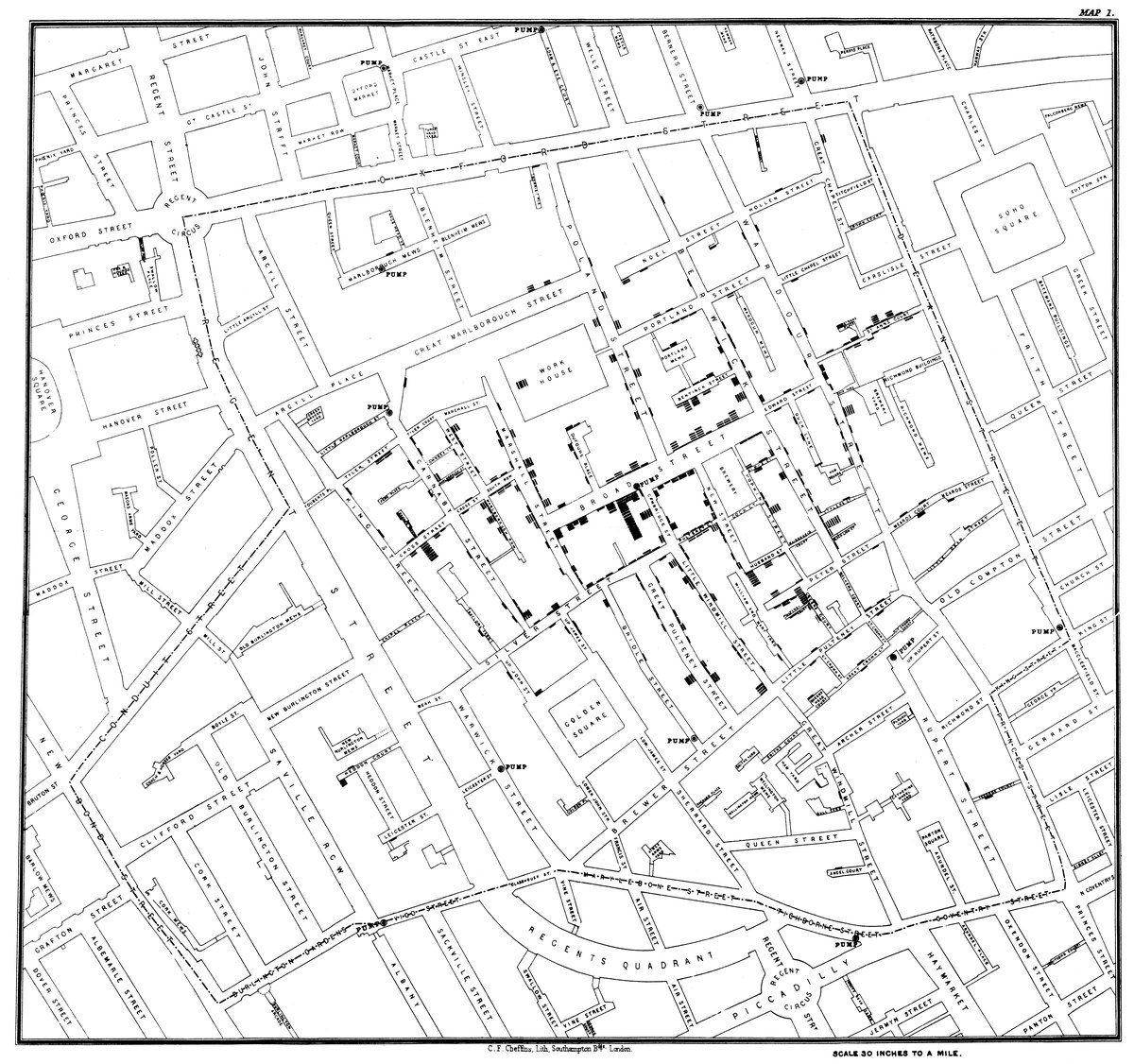
The map at the top of this article is Snow’s own picture of the outbreak, printed in the 1855 edition. Each black bar stands for one death, stacked at the house where the fatal attack happened, and the bars pile up thickly around the Broad Street pump and thin out toward the other pumps marked on the sheet.
Snow was honest about its gaps, because some people died in hospitals or in the country after leaving the area, and their home addresses were never recorded. “Indeed, the full extent of the calamity will probably never be known,” he wrote. His table for the six weeks from 19 August to 30 September gives a total of 616 deaths.
What Came After
Snow died in 1858, four years after the outbreak. London’s next shock came that same year as a smell, and this time Parliament acted. As the video on this site about London’s Great Stink of 1858 explains, sewage was flowing into “the Thames, the city’s primary drinking water source,” and only then were lawmakers moved to fund “a modern sewer system.”
Snow’s work in Soho shows how much a careful count of the dead could reveal, even when the cause was invisible. It also shows a doctor willing to set down the evidence that cut against his own neat story, and that caution is a large part of why his account is still worth reading.
Sources
- John Snow, On the Mode of Communication of Cholera, second edition (London: John Churchill, 1855), preface, list of maps, pp. 38 to 52, Table I and Map 1. Wellcome Library copy, scan via Internet Archive.
- Map 1, Snow-cholera-map-1.jpg, digitally enhanced version. Wikimedia Commons.
