On the morning of Thursday, September 1, 1859, Richard Carrington was doing what he did on most clear days at his observatory in England, drawing the sunspots and timing their positions. Within a few minutes he saw something that, by his own account, he believed to be exceedingly rare, and the event that followed now carries his name.
The Carrington Event is often described as the most powerful solar storm on record. That claim belongs to modern science and is not tested here. The papers written at the time can be checked, however, and they tell a careful and rather human story about a flash of light, a magnetic storm and the telegraph operators who found their wires carrying a current that no battery had supplied.
A Flash Inside the Great Spot
Carrington described the morning in a short paper for the Monthly Notices of the Royal Astronomical Society. He projected the image of the Sun onto a plate of glass, giving a picture about 11 inches across, and he was timing the spots against a chronometer when, within the great northern group, “two patches of intensely bright and white light broke out.”
His first thought was that light was leaking through a hole in the screen around his telescope. Moving the image showed him otherwise, and he wrote that he “was an unprepared witness of a very different affair.” Being “somewhat flurried by the surprise,” he ran to fetch someone to share the sight. He was back within 60 seconds, and by his own admission he “was mortified to find that it was already much changed and enfeebled.”
Carrington timed the first outburst at 11h 18m Greenwich mean time and the disappearance at 11h 23m. In those five minutes, by his reckoning, the two patches had traveled about 35,000 miles across the face of the group. He kept a strict watch for nearly an hour afterwards and saw no recurrence of the light.
Carrington was not the only witness, because Richard Hodgson, observing from his own house, sent a separate note to the same journal. Hodgson saw “a very brilliant star of light, much brighter than the sun’s surface,” which lasted about five minutes. Carrington wrote that he had carefully avoided exchanging any information with Hodgson, so that the two accounts would carry more weight for being independent.
A Storm in the Wires
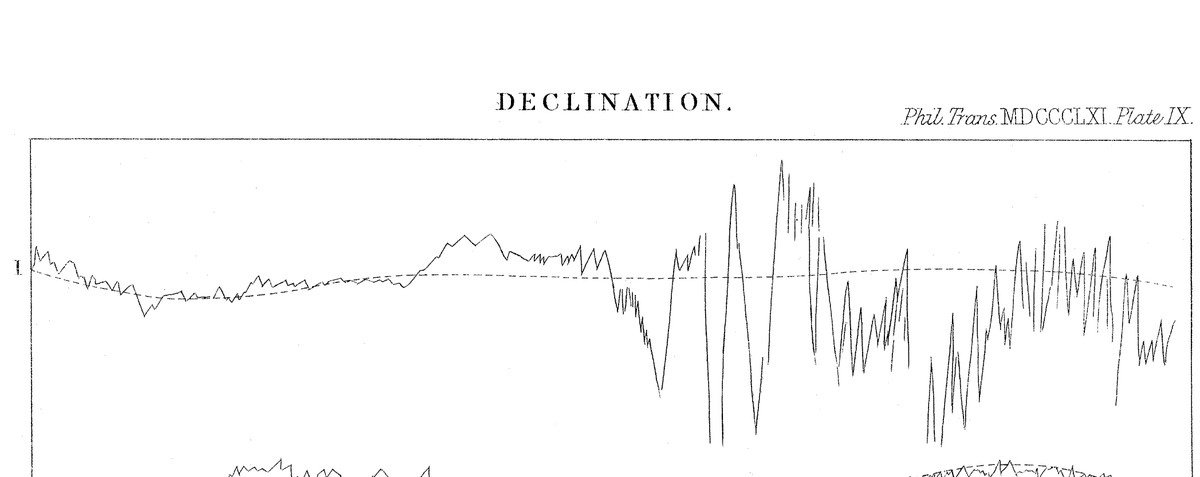
Hodgson ended his note with a sentence that would matter later, reporting that “The magnetic instruments at Kew were simultaneously disturbed to a great extent.” Kew Observatory, near London, kept self-recording magnetographs that traced the behavior of the Earth’s magnetism onto photographic paper around the clock.
Balfour Stewart of Kew described those records in the Philosophical Transactions of the Royal Society. He reported that at the end of August and the start of September 1859, “auroral displays of almost unprecedented magnificence were observed very widely throughout our globe.” He counted two great displays, one beginning on the evening of August 28 and the other early on September 2.
Stewart’s examples ranged widely, and he wrote that the Director of the Havannah Observatory in Cuba had remarked that “only four previous displays had been recorded in the traditions of the island.” General Sabine, Stewart said, had assured him that the storm “has never been surpassed by any similar phenomenon which has occurred in his long and varied experience.”
The sky was only part of the story, because in George Prescott’s 1860 history of the electric telegraph, the author reported that across the northern United States and Canada, “the lines were rendered useless for all business purposes through its action.” Even circuits of only twelve miles were so badly affected that operating them became difficult, and at times impossible.
At least one operator felt the storm directly, since Frederick Royce, working in Washington, wrote that his forehead grazed a ground wire while he leaned toward his sounder, and that he “received a very severe electric shock, which stunned me for an instant.” An old man sitting nearby told him he had seen a spark jump from his forehead to the instrument.
Working on the Aurora Alone
The most striking report came from the line between Boston and Portland on the morning of September 2, between half past eight and eleven o’clock. During a quiet spell between waves of interference, the Boston operator asked his colleague in Portland: “Please cut off your battery, and let us see if we cannot work with the auroral current alone.”
The Portland operator agreed to cut off his own battery and asked Boston to do the same, and Boston answered that it had already done so. “We are working, with the aid of the aurora alone. How do you receive my writing?” Portland’s answer was “Very well indeed,” with the added remark that the signal was “much better than when the batteries were on.”
The Boston operator, named in the account as Mr Milliken, then sent private dispatches. According to the report printed by Prescott, “The line was worked in this manner more than two hours, when, the aurora having subsided, the batteries were resumed.” In Philadelphia the same morning, an operator named Steacy sent a business message to Pittsburg using only the auroral current.
Stewart, writing at Kew, recorded the same pattern in his summary of reports from around the world. He wrote that telegraph currents had become so powerful in some places that the line was used “instead of the ordinary current, the batteries being cut off and the wires simply connected with the earth.”
Taken in the Act?
The link between Carrington’s flash and the storm that followed is where the records become most interesting, because the first observers were cautious. When Carrington showed his drawing to the Royal Astronomical Society in November 1859, he also produced the Kew records. They showed a short, moderate disturbance at about 11h 20m on September 1, and a great magnetic storm starting about four hours after midnight.
However, the Society’s report of that meeting stressed his reserve. It said he “would not have it supposed that he even leans towards hastily connecting them.” It closed with the proverb “One swallow does not make a summer.”
Stewart went a little further two years later. He pointed out that the Kew instruments had recorded a sudden disturbance at about 11h 15m on September 1, affecting all the magnetic elements at once. Since Sabine had shown a relation between magnetic disturbances and sunspots, Stewart wrote, “it is not impossible to suppose that in this case our luminary was taken in the act.”
However, “not impossible” is a modest phrase, and it was chosen with care. Stewart had one well-timed coincidence and a growing body of statistics. The physics that connects a solar flare to a magnetic storm on Earth was not available to him.
Echoes in Other Strange Skies
Readers of Historic Mysteries will know that strange skies did not always come with an explanation attached. When darkness fell over New England in 1780, during the Day of Darkness, fear was made worse by “the absence of communication technologies, such as telegraphs or radios.” By 1859 the telegraph existed, and it was the telegraph that felt the storm first.
Bright skies also followed the Tunguska Event of 1908, when an eyewitness said “the whole northern part of the sky appeared covered with fire.” That glow had a very different cause, and its comparison with 1859 shows how easily a lit sky can be misread.
The same caution applies in the modern world. In the case of the Vela Incident of 1979, the account on this site points out that “ionospheric waves can be caused by a lot of things, including solar activity, geomagnetic storms,” as well as other events. The upper atmosphere still responds to the Sun, and its signals still need careful reading.
What Remains Uncertain
Several details are less certain than the popular versions suggest. Hodgson’s address is given as Highgate in the 1859 journal and as Holloway in Stewart’s paper, both in north London. The times reported by Carrington, Hodgson and the Kew instruments differ by a few minutes, which is close agreement for the period but not exact.
However, the larger caution belongs to the observers themselves. Carrington refused to claim that his flash caused the storm, while Stewart called a connection “not impossible” and went no further. Much of the telegraph evidence comes from operators’ accounts collected by Prescott, which were not systematic measurements.
What the records do establish is solid enough. Two independent observers saw a brief, brilliant outburst on the Sun on September 1, 1859. Magnetic instruments at Kew jumped at the same moment, a great storm followed within a day, and for a few hours in September some American telegraph lines ran on the aurora itself.
Sources
- Carrington, R. C. “Description of a Singular Appearance seen in the Sun on September 1, 1859.” Monthly Notices of the Royal Astronomical Society 20 (1859), pp. 13 to 15. NASA ADS scan.
- Hodgson, R. “On a curious Appearance seen in the Sun.” Monthly Notices of the Royal Astronomical Society 20 (1859), pp. 15 to 16. NASA ADS scan.
- Stewart, Balfour. “On the Great Magnetic Disturbance which extended from August 28 to September 7, 1859, as recorded by Photography at the Kew Observatory.” Philosophical Transactions of the Royal Society 151 (1861), pp. 423 to 430, with Plate IX. Wikimedia Commons.
- Prescott, George B. History, Theory, and Practice of the Electric Telegraph (Boston: Ticknor and Fields, 1860), pp. 319 to 328. Scan via Internet Archive.
