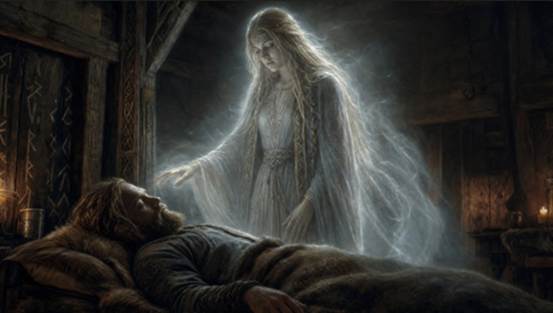
Imagine a ghostly wolf padding silently through the darkness ahead of a Norse warrior, or a cloaked woman appearing in a dream to warn of approaching doom. These are not random visions but the fylgja, a supernatural guardian spirit unique to Norse belief that shadowed every person from birth to death. Long before the modern concept of a “spirit animal” became fashionable, the Vikings believed that the soul had an outer, visible counterpart walking alongside it through the world.
The Old Norse word fylgja (plural fylgjur) is often translated as “follower” or “one who accompanies.” These were supernatural beings bound to an individual or, in some cases, an entire family line, and their fate was intimately tied to the person they accompanied. Unlike a simple omen or a passing apparition, the fylgja was a persistent, living presence – an extension of the self that could be glimpsed in dreams, seen by those with second sight, or perceived by others in moments of great crisis (LLC, 2025). To understand the fylgja is to understand something profound about how the Norse people conceived of identity, fate, and the boundary between the visible and invisible worlds.
Two Kinds of Fylgja: Animal and Human
Scholars of Norse mythology broadly recognize two distinct forms of the fylgja. The first and perhaps more widely known is the animal fylgja, which takes the shape of a creature that reflects the character and destiny of the person it accompanies. A king or great chieftain might be followed by a bear or an ox (symbols of strength and authority) while a cunning, untrustworthy man might be trailed by a fox. A warrior of exceptional ferocity could carry a wolf or eagle as his fylgja, and a gentle, wise person might be accompanied by a swan or a deer.
- Important Norse Symbols and Their Meaning
- Valkyries and Norse Sexism: Warriors, Servants, or Damsels in Distress?

These animal spirits were not chosen by the individual; they were considered an innate expression of the person’s inner nature, assigned at birth and inseparable from them until death. Crucially, the animal fylgja was typically invisible to ordinary people and could only be seen in dreams or by those gifted with prophetic sight. When such a seer perceived the animal fylgja of an approaching stranger, it was understood as a direct revelation of that person’s true character – a kind of spiritual X-ray that cut through social masks and pretense (Vikingr, 2024).
The second form is the human fylgja, most often appearing as a woman. Known as the fylgjukona (“fylgja woman”) or ættarfylgja (“clan fylgja”), this spirit was associated not just with a single individual but with an entire family lineage. She was seen as an ancestral guardian, possibly the spirit of a deceased matriarch, who watched over successive generations and could transfer her protection from one family member to another upon a person’s death. These female spirits bear a strong resemblance to the Valkyries of Norse belief, and some scholars suggest the two concepts may share a common origin in the idea of a divine female protector (Lodge, 2023).
Fylgjur in the Sagas: Dreams, Omens, and Death
The Old Norse sagas are rich with accounts of fylgjur, and these stories reveal how deeply embedded the concept was in everyday Norse spiritual life. One of the most striking examples comes from Gísla saga Súrssonar, in which the outlaw Gísli is visited repeatedly in his dreams by two women – one kind and protective, the other ominous and threatening. These dream women are widely interpreted as his fylgjukona and the fylgja of his enemies, respectively, and their shifting appearances track the arc of his fate as he moves closer to his violent end (LLC, 2025).
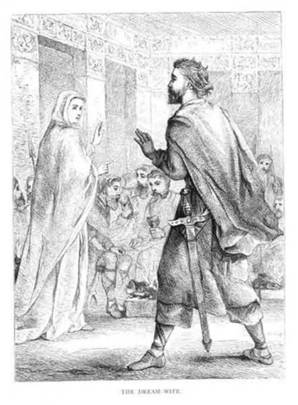
In Gunnlaugs saga Ormstungu, a man dreams of a swan and two eagles fighting over her, and the dream is interpreted as the fylgjur of a woman and her two rival suitors – a prophecy of the tragic love triangle that will unfold. Similarly, in Þorsteins saga Víkingssonar, a man sees a procession of bears and wolves in a dream and understands them to be the fylgjur of an enemy clan marching against him. In nearly every case, the appearance of a fylgja in a dream is treated not as a random fantasy but as a genuine communication from the spirit world, carrying information about events yet to come (Wikipedia, 2025).
The connection between the fylgja and death is particularly striking. In several sagas, a person’s fylgja is seen departing or fading just before that person dies, as though the spirit is releasing its charge. In other accounts, a dying person’s fylgja is transferred to a younger relative, ensuring the continuity of the family’s spiritual protection. This transferable quality sets the ættarfylgja apart from a purely personal spirit and ties it firmly to the Norse concept of family honor and ancestral legacy (Vikingr, 2024).
The Fylgja and the Norse Soul
To fully appreciate the fylgja, it helps to understand that the Norse conception of the self was far more complex and fragmented than the modern Western idea of a single, unified soul. Old Norse texts describe several distinct spiritual components of a person, including the hugr (mind or personality), the hamr (shape or outer form), and the hamingja (luck or fortune, sometimes personified as a female spirit). The fylgja occupied a unique position among these components as the most externalized aspect of the self — the part that could be seen by others and that moved through the world semi-independently (LLC, 2025).
This complexity reflects a worldview in which the boundary between the individual and the wider spiritual cosmos was permeable and dynamic. A person was not simply a body with a soul inside; they were a nexus of spiritual forces, some inherited from ancestors, some shaped by personal deeds, and some connected to the great web of fate woven by the Norns at the base of Yggdrasil. The fylgja was one thread in this web, a visible sign of the invisible forces that shaped a life from beginning to end.
Today, the concept of the fylgja continues to fascinate scholars of Norse religion and enthusiasts of Viking Age culture alike. While popular culture has sometimes reduced it to a simple “spirit animal,” the true depth of the concept – its ties to fate, family, ancestry, and the multi-layered Norse soul – reveals a sophisticated spiritual tradition that deserves to be understood on its own terms. For the Vikings, the fylgja was not a metaphor or a symbol. It was as real as the sword at their side and the stars overhead.
Top image: A female spirit guide or fylgja accompanies a Norse warrior. Source: AI generated.
By Gary Manners
References