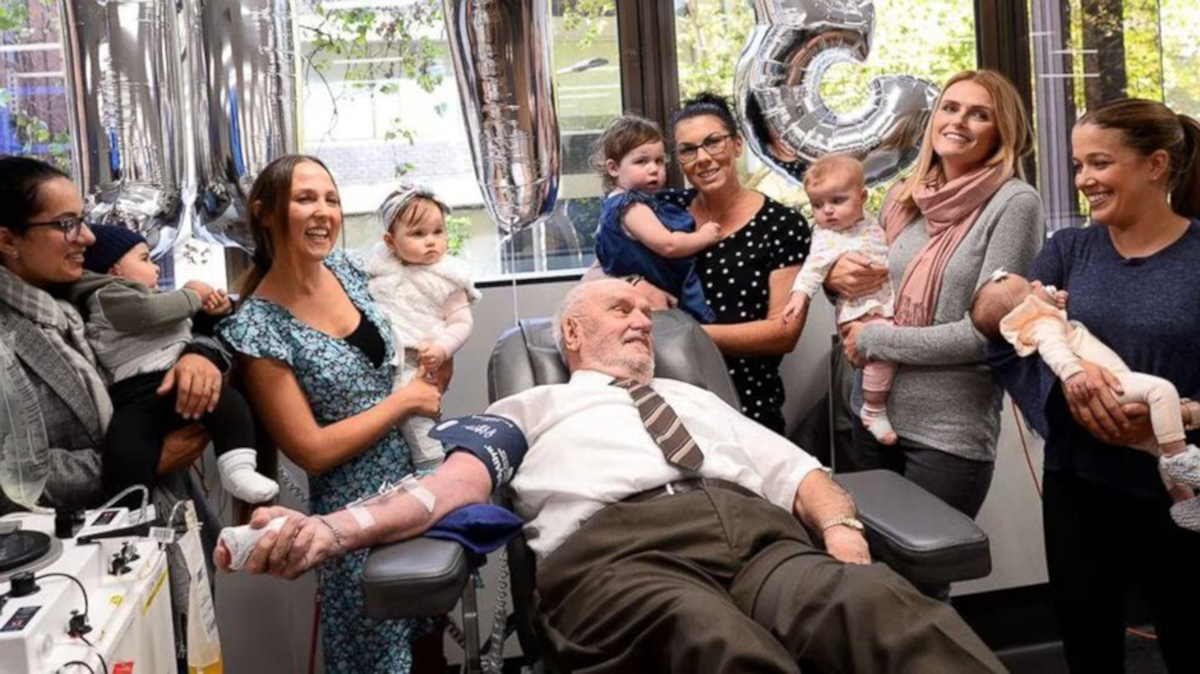
James Christopher Harrison, famously known as the “Man with the Golden Arm,” was an Australian blood donor whose extraordinary generosity and rare biology combined to save the lives of an estimated 2.4 million babies. For over six decades, Harrison rolled up his sleeve more than 1,100 times, driven by a childhood promise and a uniquely powerful antibody in his blood. His remarkable story is not just a testament to human selflessness but also a fascinating chapter in medical history, illustrating how one person’s unique biology can change the world.
In 1951, at the age of 14, Harrison underwent major chest surgery that required a significant amount of donated blood to save his life. Grateful for the strangers who had unknowingly kept him alive, he made a pledge to become a blood donor as soon as he turned 18. True to his word, Harrison began donating blood in 1954, despite harboring a lifelong fear of needles. Little did he know that his blood held a secret that would soon revolutionize prenatal care across Australia and beyond.
A Rare Biological Gift
After his first few donations, medical professionals discovered something astonishing about Harrison’s blood. It contained unusually strong and persistent antibodies against the D Rh group antigen, a discovery that would change the course of prenatal medicine. This rare antibody, known as Anti-D, is crucial in preventing Haemolytic Disease of the Fetus and Newborn (HDFN), a potentially fatal condition that arises when an Rh-negative mother is pregnant with an Rh-positive baby. Without intervention, the mother’s immune system can develop antibodies that cross the placenta and attack the fetus’s red blood cells, leading to severe anemia, brain damage, or stillbirth.
- Corpse Medicine: The Surprising History of Human Fat Treatments
- Medical Malpractice and the Mysterious Death of George Washington
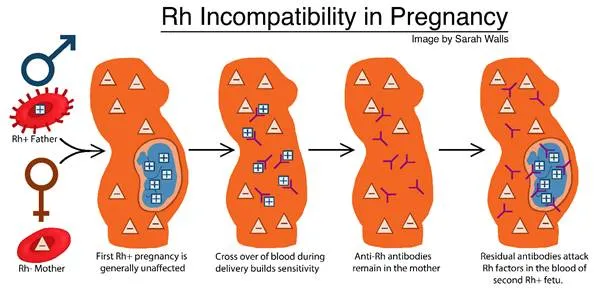
According to Australian Red Cross Lifeblood, more than 3 million doses of Anti-D containing Harrison’s blood have been issued to Australian mothers with a negative blood type since 1967.
The discovery of Harrison’s unique antibodies coincided perfectly with the medical community’s growing efforts to find a solution to Rh disease. In 1969, Harrison became one of the founding donors of the New South Wales Rh Program, one of the first such programs in the world. His plasma was used to create Anti-D immunoglobulin injections, which are administered to Rh-negative mothers during and after pregnancy to prevent the formation of harmful antibodies against their babies. The Embryo Project Encyclopedia notes that since Anti-D immunoglobulin was first released in 1968, it has reduced the risk of Rh incompatibility from 10–20 percent to less than 1 percent.
- The Evolutionary Mystery of Blood Types: A Hidden Advantage?
- John Hunter: Syphilis, Hubris, and the Great Misbegotten Experiment
Decades of Dedication
For the next 57 years, Harrison dedicated himself to the cause, donating plasma on average once every three weeks. Unlike whole blood, plasma can be donated as often as once every two weeks, allowing him to reach staggering milestones. By May 2011, he had made his 1,000th donation, a feat that earned him a place in the Guinness World Records. His commitment was unwavering, and his contributions were so significant that every batch of Anti-D produced in New South Wales contained a trace of his antibodies.
The impact of his donations is almost incomprehensible. The AARP reported that approximately 17 percent of all pregnant women in Australia required the Anti-D injections made possible by Harrison’s blood and the donations of around 150 others who share the same rare antibody. His plasma was instrumental in saving over 2.4 million babies. The personal dimension of his legacy is equally striking: his own daughter, Tracey, received the injection during her pregnancies, and the antibodies from his blood were later used on his granddaughter-in-law, Rebecca, during her pregnancies. As his grandson Jarrod remarked, “It’s pretty cool that part of him went into mum and got me a brother, then protected my kids.”
In 1999, Harrison’s incredible service was recognized when he was awarded the Medal of the Order of Australia (OAM). He was also nominated for the New South Wales Local Hero division of the Australian of the Year awards in 2011. Despite his fame, Harrison remained characteristically humble. “Saving one baby is good,” he told the New York Times.
“Saving 2 million is hard to get your head around, but if they claim that’s what it is, I’m glad to have done it.”
The Legacy of the Golden Arm
On May 11, 2018, at the age of 81, Harrison made his 1,173rd and final donation, as Australian policy prohibits blood donations from individuals past that age. Surrounded by balloons shaped into the number 1,173 and well-wishers at the Town Hall Center in Sydney, he described the moment as “the end of an era.” He expressed his hope that someone would eventually break his record, saying:
“I hope it’s a record that somebody breaks, because it will mean they are dedicated to the cause.”
The Australian Red Cross described his contribution as one that could never be fully repaid, noting that it was unlikely they would ever see another donor willing to make such a commitment.
Harrison also took a principled stand on the future of blood donation. In 2007, he was openly critical of plans to open Australia’s plasma donation program to foreign corporations, believing that commercialization would undermine the spirit of volunteerism that made the program so successful. His advocacy highlighted the delicate balance between medical necessity and the ethical foundations of blood donation systems worldwide.
Scientists have since embarked on a project to create a synthetic version of his remarkable antibodies, a research initiative colloquially called “James in a Jar,” which aims to manufacture the Anti-D antibody in bioreactors using hybridoma technology. Should this research succeed, it would ensure a sustainable supply of Anti-D independent of human donors, cementing Harrison’s legacy in a laboratory as well as in the hearts of millions of families.
James Harrison passed away peacefully in his sleep on February 17, 2025, at the age of 88, at the Peninsula Villages nursing home in Umina Beach, New South Wales. His life stands as a profound reminder that ordinary people, through extraordinary dedication, can leave the world immeasurably better than they found it.
Top image: James Harrison donating blood plasma. Source: Michelle de Beer/CC BY-SA 4.0
By Gary Manners
References