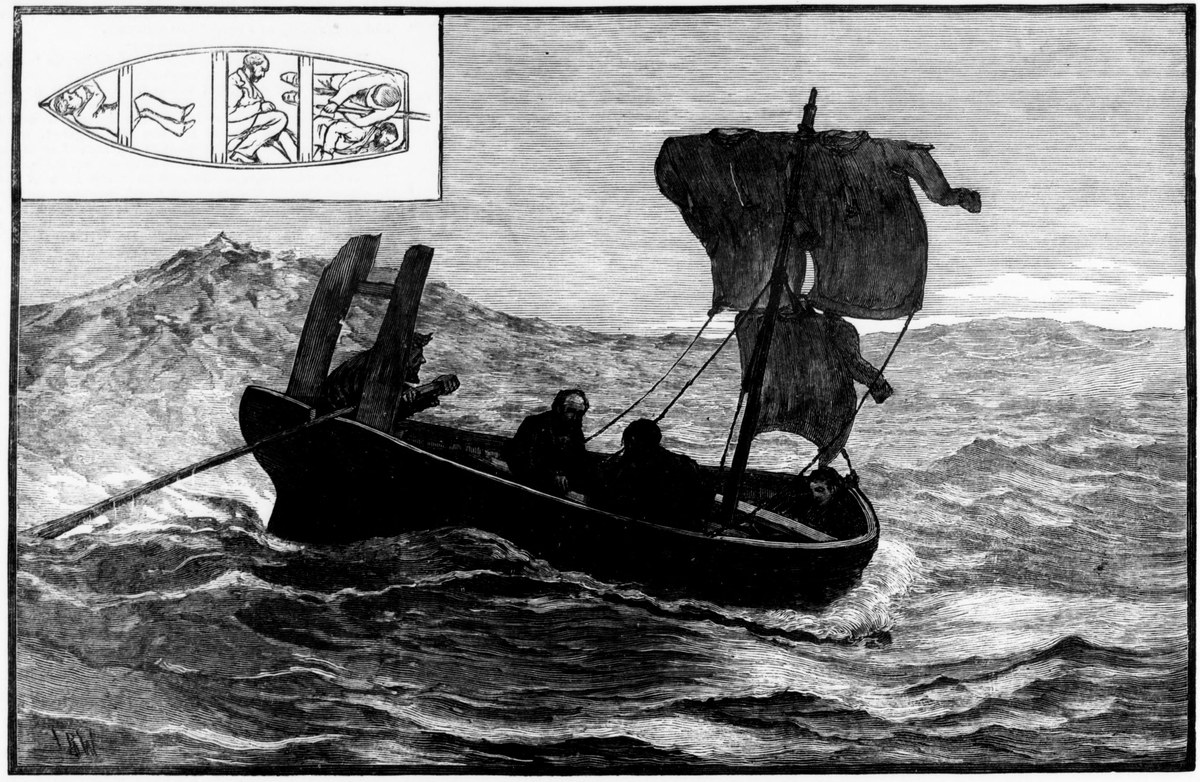
In the autumn of 1884 two English seamen stood trial for murder at Exeter for something that had happened more than a thousand miles from any land. The case of the Queen against Dudley and Stephens turned on a single question, which was whether men facing death from hunger could lawfully take the life of another person to survive. The court gave its answer in December of that year. The records of the case are worth reading for what they say, and for the small details they leave unsettled.
Readers of Edgar Allan Poe sometimes notice an odd echo in the story. In his only novel, The Narrative of Arthur Gordon Pym of Nantucket, published in 1838, castaways on a drifting wreck draw lots and a sailor named Richard Parker is chosen. Forty-six years later the youngest member of the Mignonette’s crew, the boy who died in the open boat, was also called Richard Parker. The coincidence is only that, though it has made the case familiar to many people who have never opened a law report.
The Voyage of the Mignonette
The Annual Register for 1884, which recorded the main events of each year, says the crew left Southampton on May 19 in the yacht Mignonette, “33 tons, for Sydney.” There were four people aboard. Thomas Dudley was the captain and Stephens the mate, with an able seaman named Brooks and Parker, whom the court later described as an English boy between seventeen and eighteen years of age. On July 5, according to the same account, a heavy sea knocked in one of the sides of the yacht and she sank soon afterward, leaving the four men a small open boat about thirteen feet long.
The jury at Exeter later set out the facts in what is called a special verdict, a careful statement of what had been proved. It is printed in full in the official Law Reports. It found that the four were “cast away in a storm on the high seas 1600 miles from the Cape of Good Hope” and had no fresh water and almost no food. Their only supplies were two tins of turnips, and on the fourth day they caught a small turtle. The verdict states, “That on the twelfth day the remains of the turtle were entirely consumed, and for the next eight days they had nothing to eat.” For water they had only the rain they could catch in their oilskin capes.
Twenty Days Adrift
As the days passed the men began to discuss what might be done if no ship came. The special verdict records that on the eighteenth day the two older prisoners suggested that one of them should be sacrificed to save the rest, “but Brooks dissented, and the boy, to whom they were understood to refer, was not consulted.” On the following day Dudley proposed drawing lots. Brooks refused, the proposal was never put to Parker, and the verdict notes that “in point of fact there was no drawing of lots.”
On July 25, the twentieth day in the boat, Dudley killed Parker with the agreement of Stephens, while Brooks dissented. The jury found that the boy was by then lying helpless in the bottom of the boat, weakened by hunger and by drinking sea water, and that he never agreed to his death. The survivors lived on his remains for four days, until a passing ship picked them up. The Annual Register names that ship as the Montezuma, and adds, “During the twenty-four days they were in the punt they had drifted 1,050 miles without seeing a sail.”
The jury recorded the hardest facts in the case alongside the evidence that told in the prisoners’ favour. It found that the men would probably have died within those four days without that food, that the boy was likely to have died before them, and that there was no sail in sight at the time. However, it also found that “there was no greater necessity for killing the boy than any of the other three men.”
Falmouth and Exeter
The survivors were taken to Falmouth, and on September 8 the captain, the mate and Brooks were charged before the police court there with the murder of Richard Parker. Only Dudley and Stephens were named in the indictment that went to trial. That trial came at the Exeter Assizes in November before Baron Huddleston, and the defence argued, in the words of the Annual Register, that the men were “justified by the inevitable necessity of the case.”
Instead of returning a verdict of guilty or not guilty, the jury found the facts and stated that it did not know whether they amounted to murder. It asked for the advice of the court, and its finding ends with the words that “the jurors are ignorant, and pray the advice of the Court thereupon.” The Annual Register adds that the jury “strongly recommended them to the commiseration of the Crown,” and that the judge released them on bail.
The Judgment of December 1884
The case was argued before a court of five judges in early December, and on December 9 the Lord Chief Justice, Lord Coleridge, delivered the judgment of the whole court. He began by acknowledging that the prisoners had been “subject to terrible temptation” and had endured great suffering. He then examined the old legal writers one by one, including Bracton, Hale, Foster and Bacon, and concluded that none of them supported the idea that hunger could justify killing an innocent person.
The heart of the reasoning was that the law could not leave each person to decide when necessity applied. Coleridge asked, “Who is to be the judge of this sort of necessity?” He pointed out that the principle would let the person who profited from it decide his own justification. He also noted that in this case the weakest and youngest had been chosen. He also wrote, “To preserve one’s life is generally speaking a duty, but it may be the plainest and the highest duty to sacrifice it.”
The court found unanimously that the prisoners’ act “was wilful murder,” and they were sentenced to death. Coleridge had already pointed toward another route, writing that where the law appeared too severe on individuals, judges should leave it “to the Sovereign to exercise that prerogative of mercy.” A note in the Law Reports records that the sentence “was afterwards commuted by the Crown to six months’ imprisonment.”
Other Castaways, Other Records
The Mignonette was not the first case in which shipwrecked or stranded people had survived on the dead. In 1821 the crews of the whaleship Essex, adrift in open boats in the Pacific, kept the bodies of men who had died for food, as the account of the Essex whale attack describes. Accounts of the men of the Franklin expedition in the Canadian Arctic include testimony from a local woman that the crew had resorted to cannibalism in their desperation.
The difference in 1884 lay in how the boy died, and that was where the court drew its line. As the history of the Donner Party in the Sierra Nevada notes, its survivors lived by eating those who had already died, and there were no murders. The Mignonette case was a prosecution because Parker had been killed, and the court was asked to decide whether necessity could excuse that act.
What the Records Leave Unsettled
The official records of the case agree on its outcome, though they do not agree on every detail. The Law Reports give the mate’s name as Edward Stephens in the special verdict and as Edwin Stephens in Lord Coleridge’s judgment, while the Annual Register calls him Edward in its November entry and Henry in December. The same report dates the Exeter trial to November 7 in one place and to “the 6th of November” in another. Those differences are left as they appear in the sources.
None of those slips affects the law the court laid down. However, they are a reminder that a famous ruling on necessity rests on printed records that do not always agree, even on the first name of one of the two men convicted.
Sources
- The Queen v. Dudley and Stephens (1884). The Law Reports, Queen’s Bench Division, vol. 14, pp. 273 to 288 (London, 1885). Scan via Internet Archive.
- Regina v Dudley and Stephens, judgment of Lord Coleridge, C.J., December 9, 1884. Wikisource transcription.
- The Annual Register: A Review of Public Events at Home and Abroad, for the Year 1884 (London, 1885). Chronicle, September 8, November 6, December 4 and December 9. Scan via Internet Archive.
- Poe, Edgar Allan. The Narrative of Arthur Gordon Pym of Nantucket (New York, 1838). Project Gutenberg.
- The Illustrated London News, September 20, 1884, front page report on the loss of the yacht Mignonette, with engravings from sketches by the mate. Scan via Internet Archive.
