Before the Book of Genesis was written, the ancient Mesopotamians had their own epic tale of how the universe began. Discovered among the ruins of the great Library of Ashurbanipal in Nineveh in 1849, the Enuma Elish is a Babylonian creation myth that dates back to the late 2nd millennium BCE. This incredible epic, inscribed on seven clay tablets in Akkadian cuneiform, tells a dramatic story of cosmic battles, the birth of gods, and the ultimate creation of humanity. The title itself translates to “When on High,” the opening words of the poem.
The Enuma Elish provides a fascinating window into the worldview of the ancient Babylonians. It is not merely a story of creation, but a theogony—an account of the origin of the gods—and a political document that established the supremacy of Marduk, the patron deity of Babylon. As Babylon rose from a city-state to a powerful empire, its chief god was elevated above the older Sumerian deities.
- The Epic of Gilgamesh: Mankind’s First Story?
- Kish: Was This Early Sumerian City Its Own Distinct Civilization?
The Primordial Chaos and the Birth of Gods
The epic begins with a universe that is nothing more than a watery chaos. There is no sky and no land. Instead, there are two primordial entities: Apsu, the god of fresh water, and Tiamat, the goddess of the salty sea. Their waters mingle together, and from this union, the first generations of gods are born.
However, the younger gods are loud and boisterous, disturbing the peace of Apsu and Tiamat. Annoyed by the constant noise, Apsu decides to destroy his offspring. Tiamat is horrified by the idea of killing her children, but Apsu proceeds with his plan. The younger god Ea (also known as Enki) learns of the plot, puts Apsu into a deep sleep with a spell, and kills him.
- (List) Mother of Monsters: The Eleven Children of Tiamat
- The Mušḫuššu: Ancient Proto-Dragon from Mesopotamia
The Rise of Marduk and the Cosmic Battle
Furious over the murder of her mate, Tiamat decides to seek revenge. She gives birth to an army of dragons and monsters, including the Mušḫuššu and the Ugallu, to wage war against the younger gods. The younger gods are terrified and unable to stand against Tiamat’s wrath.
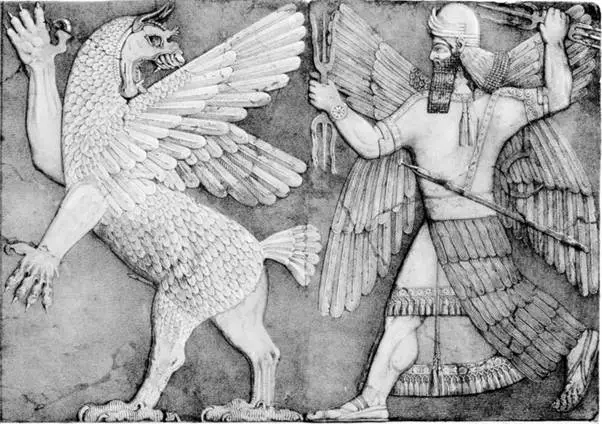
It is at this critical moment that Marduk, the son of Ea, steps forward. He agrees to fight Tiamat on the condition that he is recognized as the supreme ruler of all the gods. The gods agree, and a spectacular cosmic battle ensues. Marduk arms himself with a bow, arrows, a mace, and the winds. He traps Tiamat in a net, shoots an arrow down her throat, and splits her body in two.
The Creation of the World and Humanity
With Tiamat defeated, Marduk uses her massive, divided corpse to create the physical universe. He uses one half of her body to form the heavens and the other half to form the earth. Her eyes become the sources of the Tigris and Euphrates rivers. Marduk then organizes the cosmos, setting the stars, the sun, and the moon in their places to mark the days, months, and years.
Finally, to relieve the gods of their endless labor, Marduk decides to create humanity. He consults with Ea, and they use the blood of Kingu, a god who had sided with Tiamat and was executed for his rebellion, to create the first man, Lullu. The purpose of human beings in the Enuma Elish is explicitly stated: to serve the gods and maintain the order of the world.
The Enuma Elish was recited annually during the Akitu, the Babylonian New Year festival, to celebrate the renewal of the world and reaffirm Marduk’s divine authority. Today, this ancient text continues to captivate scholars and readers alike, offering profound insights into the origins of mythology and human civilization.
Top image: Relief drawing from Palace of Sennacherib, Nimroud, Nineveh – cleaned-up, touched-up version. Source: TYalaA / CC BY-SA 4.0
By Gary Manners
References